Wednesday, February 12, 2014

TC Blog Project: Family


This time of year, we start to hear a lot of talk about love.  And love in February is almost never referenced as the love between friends, the love of family, or even *gasp* a love for things.  No, our entire culture frames Valentine's Day - a celebration of love - as celebrating only romantic love.  Those who don't have romantic partners are said to be "alone on Valentine's", whether they will actually be physically alone or not.

I'd rather talk today about one of my favorite aspects of Heathenry: familial love.  For a long time, I considered myself the 'odd duck out' in many Heathen circles, being generally the most leftist of the US-politics liberals.  It's taken awhile, but I've come to realize that perhaps I found Heathenry because some part of me understood that, deep down, I actually hold a few traditional values.  One of the most important of these values, to me, is the importance of family.

Growing up, my immediate family was sort of the odd one in the extended family.  We were poor in a family full of middle-class, my mother was too Evangelical and my father too atheist, us kids were socially-awkward brainiacs and always wanted to play with the wrong genders.  And yet, despite the unspoken uncomfortableness surrounding those topics, the entire family was always warm and welcoming.  We were weird, but it didn't ultimately matter, because we were family.  There weren't any family feuds or in-fighting; we all got together on Thanksgiving, Christmas, and Easter and made generally pleasant dinner conversation with each other.

Growing up, I didn't exactly appreciate how rare and precious a family like this is.  When I went to college, I basically cut all ties with everyone - I didn't speak to even my parents for about a year.  It wasn't until I found myself pregnant, faced with beginning my own family, that I began to appreciate just how amazing a good family can be.  The biggest recent influence on my concept of family has been my mother-in-law; she comes from a very traditional culture where it is a woman's duty to care for her house and her family.  She welcomed me with open arms, took me in as her daughter, claimed me as part of her family.  She cares for her elderly mother together with her three local sisters, all of whom work full-time, because it is her duty to love and honor her mother the way her mother loved and raised her.  I have watched her pour out her heart into the food she makes for our family dinner every Sunday; all of her love and good wishes and affection goes directly into the meal.  She holds the most love for family of anyone I've ever known - and though I aspire to be like her in caring for my own family, I must admit that I seldom hit the mark.

I'd like to be clear that by valuing family, I am not referencing only a traditional nuclear family.  That's how mine worked out, but it's certainly not the be-all, end-all.  I spent a large part of my life with my mother and step-father on one hand, and a single father on the other, and we were just as much family as anyone else.  Same goes for gay, poly, or whatever relationships - if you think of yourself as a family, you are.  This is a special kind of love, and no matter how some conservatives would like to play it, it is there for everyone to experience.

I try to give my children the good things I had growing up, while skipping over the worse ones.  We eat dinner together every night, no TV or other interruptions, and talk about our days.  I make it a point to talk to my kids in the car when we're driving somewhere.  I plan family celebrations - not just for my own holidays; I throw a darn good party for Eid twice a year too!  Just as my mother and grandmother did growing up, I tell stories of the ancestors I remember, and those that are still with us but who we don't have the opportunity to visit.  These are all religious acts for me.  The simple act of loving my family - and expressing that love by caring for them, cooking for them, making sure their lives are organized and also enriching - is a big part of my religious devotion.  In Heathenry, your family's honor is incredibly important - it is simultaneously your legacy and your gift to your ancestors.  Caring for my children, loving them, and teaching them the ways of my ancestors is an offering to those who have gone before.  It is also an offering to those I will leave behind.

Monday, February 10, 2014

High Holy Day Essay: Imbolc

For Imbolc, I once again put together a ritual for Prairie Shadow Protogrove. We had a Celtic ritual honoring Brigid, held in the study space of a local metaphysical store, since the weather was unfortunately below zero. We had a processional through two candles, purifying the participants with fire. We honored Danu as the Earth Mother, gave offerings to the Fire, Well, and Tree, and welcomed Manannan mac Lir as the Gatekeeper. We welcomed the Three Kindreds to join us, and invited Brigid as the Being of the Occasion. The omen was read, and stated that our offerings were accepted, and the Kindreds gifted us with strong, creative passion in the coming days. We asked for the Blessing on the Waters of Life, and gave some to each participant. Afterwards, each person came up to take a bit of the Fire, so each person could take home a piece of the community flame. We thanked the Kindreds and each deity and spirit we had invited, and closed the Gates.

 After the Yule ritual, I felt much more confident about performing public ritual. This time, I wrote the script to include another more participation from another ritual leader, and also included a few parts for any attendees who volunteered to read. I feel like opening it up to more participation really helped the ritual to flow better and encourage the energy contribution of those attending. Also, I made sure to include many key phrases that I had put in the last ritual - especially phrases the participants were asked to repeat - and I feel like the growing familiarity of the Core Order of Ritual among those attending changed the feel of the ritual greatly, so that it felt truly profound, as I imagine most liturgists and ritual leaders hope ritual will feel. We had twelve people attend despite snow and bad temperatures, and the potluck afterwards was great to get to know those who were there for the first time, as well as to talk more with those who I'd seen before.

Crafting the Runes: Is

From Ralph Blum's Rune Deck


Ice is very cold and immeasurably slippery;
it glistens as clear as glass and most like to gems;
it is a floor wrought by the frost, fair to look upon.


The rune Is is translated to mean 'ice'.  It is one of my favorite stanzas in the Anglo-Saxon rune poem, with such striking imagery I always imagine an ice castle or how magical icicles looked when I was younger.  Ice is almost always so very beautiful; sometimes here on the prairie it comes as a freezing rain blown about by fierce winds, which leaves the bare tree branches coated - in the morning when the sun shines, everything sparkles like rainbow fire.  Something the Anglo-Saxon poem does not address, though, is the danger of ice.

The Icelandic rune poem describes Is as "bark of rivers, and roof of the wave, and destruction of the doomed".  It's easy to see which land had more experience of ice, and of severe cold.  In Iceland, ice covered the rivers like bark on a tree, even froze over the ocean.  It was inherently dangerous, because those who were killed by ice were considered "doomed" - there was no way they could have escaped the ice, their fate.

There is also the idea, not touched upon in either rune poem, that ice is one of the building blocks of all life.  In the Norse creation myth written down by Snorri Sturlson, he two contrasting elements, ice and fire, came together: the heat of Muspell met the great ice of Niflheim, and the fire thawed a few drops of the ice.  Fire and Ice come together to make Water, which grew into the frost giant Ymir.  Ymir is later slain by Odin and His brothers, and his body is used to make the world.

Though I try to stick with Anglo-Saxon ideas over those of other branches of the Germanic peoples, in this case I think climate dictates I look farther afield.  In the middle of the United States, we don't have the rather temperate climate that England experiences.  The weather ranges from -20 to -30 degree Fahrenheit wind chills like we had this morning, to over 100 degrees in the summer.  Our cold is intense, and often it lasts for four or more months of the year.  When ice comes in December, it tends to stick around until the first big thaw in March (unless we're lucky and global warming comes up with an unseasonably warm day).  I remember growing up, my neighbors never cleaned out their gutters, and an amazing icicle would form over the course of the winter months, as the sun warmed the ice in the gutters by day just enough for it to drip and freeze it into more icicle by night - some winters it reached all the way to the ground by the time spring rolled around!  It can be so beautiful; but also very dangerous.  It makes roads difficult to navigate, walking becomes hazardous; and one particularly memorable year, when everything froze early in October, the leaves of the trees were weighted down so much that many trees lost big branches.

In divination, I tend to think of Ice in all three ways - a dangerous force, a conduit for creation, and a beautiful art piece.  Sometimes the things that hurt us are beautiful and alluring, and sometimes out of our destruction, old pieces can be picked up and a new life made.  I attended a class on bindrunes by the local Heathen group, and one thing the teacher said has stuck with me: Ice, as that single upright stave, is the basis of all the runes.  It underlies everything.

Saturday, February 8, 2014

A Prayer for Manannán mac Lir

Photo by Robert Herring
Used under a Creative Commons License
As the winter drags on here on the cold and sunlight-starved prairie, I tend to lose a lot of my motivation and drive.  I'm naturally an introvert, so one of the first things to go is my desire to get out and engage in social things.  Some days I have a hard time bringing myself to open Facebook.  It's times like these that I find myself drawing inward, finding more time to sit and think rather than rushing to finish whatever task is next on my to-do list.  As I focus more on my personal spirituality, I am drawn more towards deities I honor that also have a strong sense of inner and spiritual work.

In contrast to the crochet I do for Frige, the house cleaning I try to maintain for Brigid, and the everyday writing I do for Ogma, in my UPG Manannán is a much less concrete deity.  I know for many He is like a favorite uncle, a God largely of laughter and good times - and He is that for me also, at times.  But much more often, He is the deity that calls to me when I am sinking in the dark depths of the proverbial ocean.  When I need to step back from the world for a bit, He is there to guide me to the deep sea - where no storms stir, where no light penetrates - only the solitude that is so refreshing to me.  In an effort to build a more consistent devotional practice, I've taken to writing prayers for each deity I honor; this I wrote for Manannán.  It is based on Ian Corrigan's call to Manannán in ADF's solitary Celtic ritual template, with the wavelets inspired by a baptism charm from the Carmina Gadelica.

Oh Manannán, powerful son of the sea,
holder of the magics of the crane bag:
a wavelet for sweet dreams,
a wavelet for laughter,
a wavelet for good song,
nine waves for Your graciousness.
Oh Lord of the Otherworld, bearer of the silvered apple branch,
I ask that you hear my call:
a wavelet for grief,
a wavelet for tears,
a wavelet for the dead,
nine waves for Your graciousness.
Mist-shrouded rider of the maned waves,
clothed in the sea-shifting cloak:
a wavelet for solitude,
a wavelet for wisdom,
a wavelet for oneness,
nine waves for Your graciousness.

Friday, February 7, 2014

C is for Courage

Born to be… by artmajor24, on Flickr. Creative Commons license.
ADF Druidry espouses a system of nine virtues: wisdom, piety, vision, courage, integrity, perseverance, hospitality, moderation and fertility.  Part of the work for the Dedicant's Path is to write an essay about each of these virtues. and since week is the letter 'C', I decided to write about Courage.  Now, all the writing for the DP can get a little long for the reviewers to read, so we're asked to keep our word counts reasonable; I could write a whole essay just on courage in my life!  But here it is in around 200 words.

Courage is defined by Google as "the ability to do something that frightens one" or "strength in the face of pain or grief".  In my life, I've found my own definition of courage to be most in line with the first.  I grew up in a very critical environment, and unfortunately I often find myself afraid to try something because I know I can't do it perfectly, or I don't know exactly how it will turn out.  Often I have to make myself do things that I know objectively would benefit me or others that I care about, but that I am afraid to do.  A group I am part of locally puts on a Winter Solstice service for the UU church every year, and this year they asked me to play guitar for a song.  I'm a decent, though not particularly good player, but performing in front of others honestly terrifies me.  It took a great deal of courage to even play in front of others at our practices, but after several times I began to feel more comfortable.  In the end I summoned the courage to sit before 100 or so UUs and perform, and the added atmosphere garnered many compliments and has helped to grow the local community.

Wednesday, February 5, 2014

Family Imbolc Celebrations

Imbolc has come and gone (except for Prairie Shadow Protogrove's ritual next weekend), and it was a nice, though busy, holiday for us.  My daughter's birthday is in early February, and so she had a big party this weekend with all her friends.  Despite the cake-baking, cleaning, and decorating (all of which honor Brigid in their own way), we managed to find some time to celebrate the holiday together as a family.

I am part of a flametending Cill on ecauldron.com, a wonderful forum I've been a part of for many years.  My shift was on the 30th, and the group as a whole tended flame on both the 31st and 1st; so I had Brigid's flame lit on my stove throughout the weekend.  I've always found flametending to be a wonderful tradition, easy to make a habit out of, and the presence of the flame is a constant helpful reminder to keep Brigid in mind.  Personally, I like to say a short prayer at sunset when I light the flame, and another the next day at sunset when putting it out; and in between I do cleaning and baking and home things while keeping the thought of honoring Brigid in mind.  There are so many other ways to do it though, and so many groups - I know ADF has a Cill for flametending, and I believe Gaol Naofa, a Celtic reconstructionist organization, does as well though they only accept women.

Together, my children and I put out some milk as an offering to Brigid, saying a short and Pagan-ised version of the Descent of Brigid (many examples can be found here at Brigit's Forge).  We also laid out a brat I received from a Imbolc exchange - a brat is a piece of cloth that is laid out overnight on Imbolc Eve, and is said to be blessed by Brigid when She passes by in the night.  Throughout the next year, it is used as a talisman for healing and comfort.  I've already had a chance to use it for my son, who is miserably fighting a cold today; laying him down in his crib, I gave him the brat to hold close to as he slept.

Next year, I'm hoping to be able to make some time for a full feast of corn beef and cabbage, and if I'm feeling adventurous, perhaps some homemade butter for our bread!  If I decide to attempt it, I'll be sure to document the process and let you all in on the craziness!

Monday, February 3, 2014

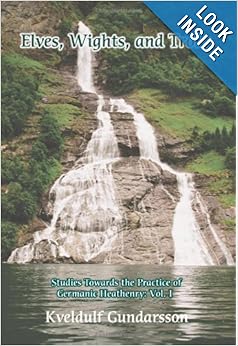
Book Review: Elves, Wights, and Trolls by Kveldulf Gundarsson

My personal spiritual practice has always been largely focused on local land spirits; and so when I began to explore Heathenry more deeply I was very interested in learning about nature spirits from a Germanic point of view.  Elves, Wights, and Trolls by Kveldulf Gundarsson is pretty cheap to pick up used, and is such a fantastic resource that, in retrospect, I would have paid 3 times the price.

As the title says, this book is a study of all kinds of spirits the ancient Germanic peoples would have classified as 'other' - or not Gods.  Gundarsson does a good job describing the fluidity that these categories had to the ancients that we, as modern peoples who like putting things in their little distinct boxes, don't often grasp right away.  Honestly, on picking up this book, I was hoping to receive some clarification on what exactly a Jötunn was, compared to a land wight, compared to the alfar, compared to a troll or any number of other words the Germanic peoples had for these beings.  There was not a lot of clarification, just an acknowledgement that the evidence seems to say that these categories were not at all distinct; and certainly none of them were definitively classified as 'good' or 'evil' to the Germanic peoples.  Gundarsson does give some ideas as to what the distinctions may have meant in the past, but this UPG is pretty clearly marked out.

There is a separate chapter for each type of being, mostly devoted to folk stories of the spirits, and appearances and actions in the lore that we do have.  Through these remnants, Gundarsson attempts to re-imagine what these beings may have been to the ancient Germanic peoples; and gives helpful suggestions on offerings, which spirits to propitiate with them, and which spirits to avoid.  My personal favorite was the portion on house spirits, which not only contains several folk tales, but many cautionary mentions that folk practice seems to suggest are prudent.  As someone who grew up in a home that still held some lingering beliefs about house spirits, it was very enlightening to see where some of these ideas and practices may have originated.

There are very interesting portions on the Jötnar, and Gundarsson is not hostile towards them in his writing.  He even suggests that Thor fought the Jötnar, especially females, in the lore because the main foe of the ancient Germanic peoples was the harsh environment they lived in - but now that humanity has shown itself capable of permanently damaging the environment, perhaps the scales ought to tip from malice towards concern for the Jötnar.

The one concern I had was Gundarsson's tendency to ascribe equal importance to all his sources - whether archaeology, ancient lore, or very recently recorded folk tales.  While interesting, there is certainly a vast amount of difference between the archaeology's conclusions about the culture of Germanic peoples around 0 BC and the culture of Northern Europe in the 19th century when many folk tales were recorded.  Gundarsson does make a great effort to reference his information, which diminishes the problem greatly, but I feel it still effects his conclusions in a way that I personally don't prefer.

All in all, it is a fantastic book, and belongs on the bookshelf of any land-honoring Heathen.  I also think it would be helpful to any Pagan looking to honor land spirits, even if they are not specifically interested in Germanic culture, because of its wealth of information - seriously, this book is just packed with info.  I've read quite a few books on the fae of Celtic lore, and none I've found have been so helpful or informative as Gundarsson's is on the land spirits of Germanic lore.