Friday, March 14, 2014

F is for Fréo

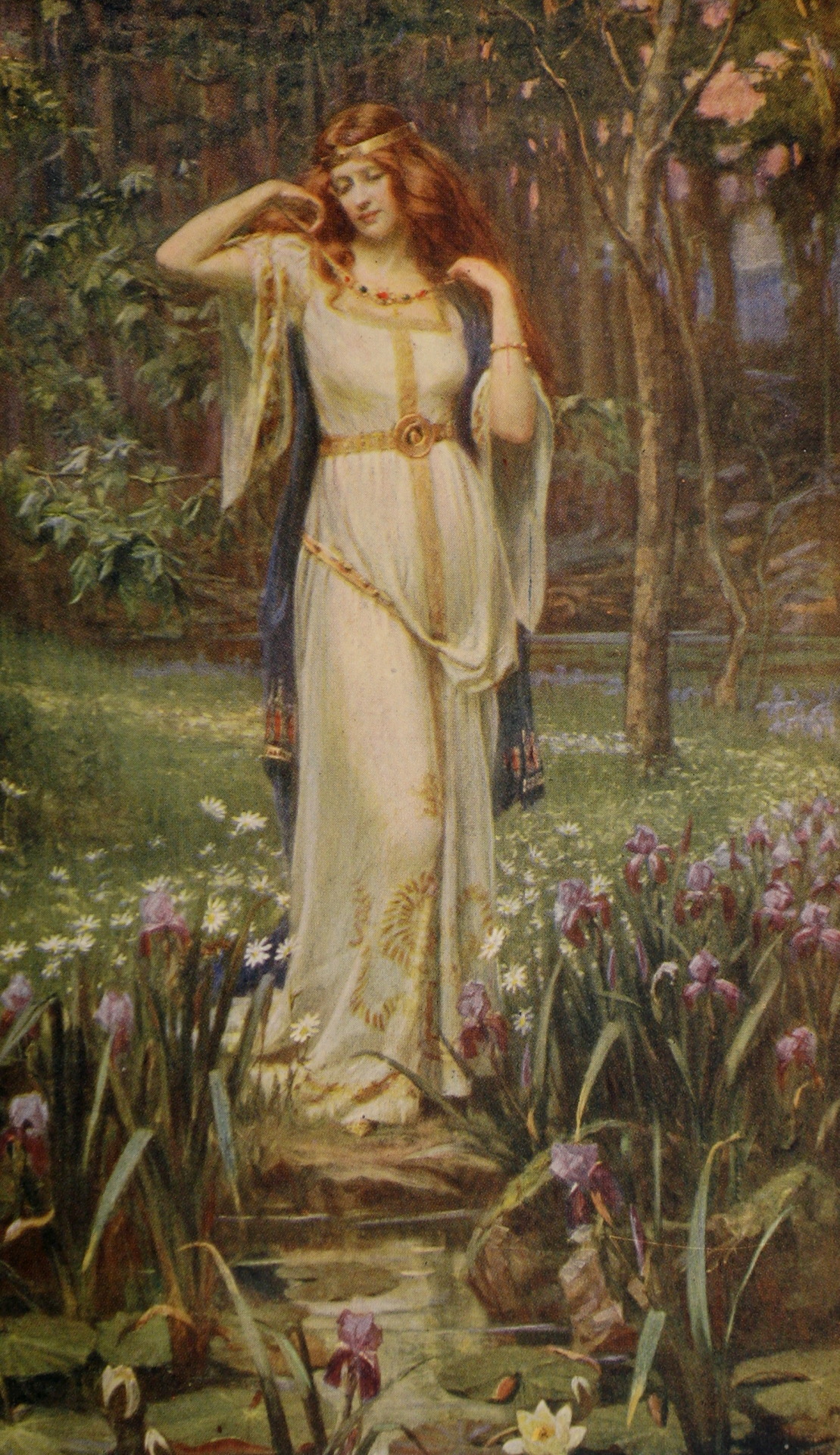
Freya and the Necklace
James Doyle Penrose (Public Domain)
Fréo of the cat-drawn chariot,
Fréo of the falcon cloak,
Fréo of the passions of all men:
with your vitality, with your passion, with your magic,
come and bless me and mine.
Fréo of the amber and gold,
Fréo of the soveriegn land,
Fréo of the boundless seidh:
with your vitality, with your passion, with your magic,
come and bless me and mine.
Fréo, strength of women,
Fréo, golden beauty,
Fréo, fierce in battle:
with your vitality, with your passion, with your magic,
come and bless me and mine.
- prayer to Fréo

Fréo is an Anglo-Saxon Goddess, experienced by many Anglo-Saxon Pagans, though not obviously attested - though one reason for this may be the similarity between Her name and Frige's, making it difficult to discern who place-names are referencing.  I experience the AS deities as separate, though similar to Their Germanic counterparts; Fréo is linguistically related to the Goddess Freya, of whom we have many reports.

She is a member of the tribe of the Vanir (the Wanes in Anglo-Saxon), a tribe of deities closely associated with nature and the earth.  Talking for a moment about Freya, there are many stories describing Her skill at magic (particularly seiðr), Her multiple sexual partners, Her warrior associations, and Her sovereignty.  Many see Her as originally being a sovereignty Goddess, granting Odin His power over the land through sexual relations - this is corroborated by the Sörla þáttr, in which not only is Freya described as a 'concubine' of Odin, but He becomes extremely jealous when He discovers She has given Her sexual favors to others.  Whatever Her function originally, it is clear in the many other stories of Her that She has become much more.  In Gylfaginning, it is said that "whenever She rides into battle She takes half of the slain," clearly marking Her as also a warrior Goddess.  She is also said to have taught seiðr magic to Odin - whether seiðr is Her own power or knowledge common among the Vanir, we do not know.  She is also portrayed as sorrowful; Her husband Óðr is frequently gone, and She is described as weeping tears of red gold for Him.  Her associations with fertility and the Earth are obvious.  It is speculated that many plants now named after Saint Mary in Northern Europe were originally named after Freya.

It is my impression that Fréo is a Goddess of the land, but not as much so as Her mother or Her brother, Ing Fréa.  She is associated with those parts of our lives that are still very much tied to our animal instincts: sexuality, hunger, etc.  And yet She also calls us to the mystery that lies behind these seemingly simple pleasures, the mystical experience of otherworldly trance and magic that stems from that which is green and growing.

Wednesday, March 12, 2014

Crafting the Runes: Eolh


The Eolh-sedge is mostly to be found in a marsh,
it grows in the water and makes a ghastly wound,
covering with blood every warrior who touches it.


Eolh is an Anglo-Saxon word describing a kind of sawgrass that grows in marshes all over Europe (though we have no way of knowing now exactly what species).  It has sharp, cutting edges; dangerous for anyone walking through with bare skin.  An older Germanic name, Algiz, is linguistically related to the Elk, and so the Elder Futhark rune is often associated with defense.  In his book Wyrdworking: the Path of a Saxon Sorcerer, Alaric Albertsson extends this meaning to the Anglo-Saxon elk-sedge, theorizing that the cutting nature of the elk-sedge is protection for the marsh - in contrast to Thorn, a sharp and dangerous plant that is regarded as an ill omen.

The wikipedia article on Agliz, which is actually very informative, talks about the transition from the rune's initial sound as an ending 'z' to its Anglo-Saxon use, a 'x' or 'ks' sound.  I feel the Anglo-Saxons saw the marsh as a dangerous, and yet mystical place.  To me, this rune represents the dangers and benefits of traveling out into wild places where people are not necessarily welcome.  Rather than being protective, I see this as a warning: come no farther, traveler, the dangers of the marsh lie beyond.

Monday, March 10, 2014

TC Blog Project: Calendars

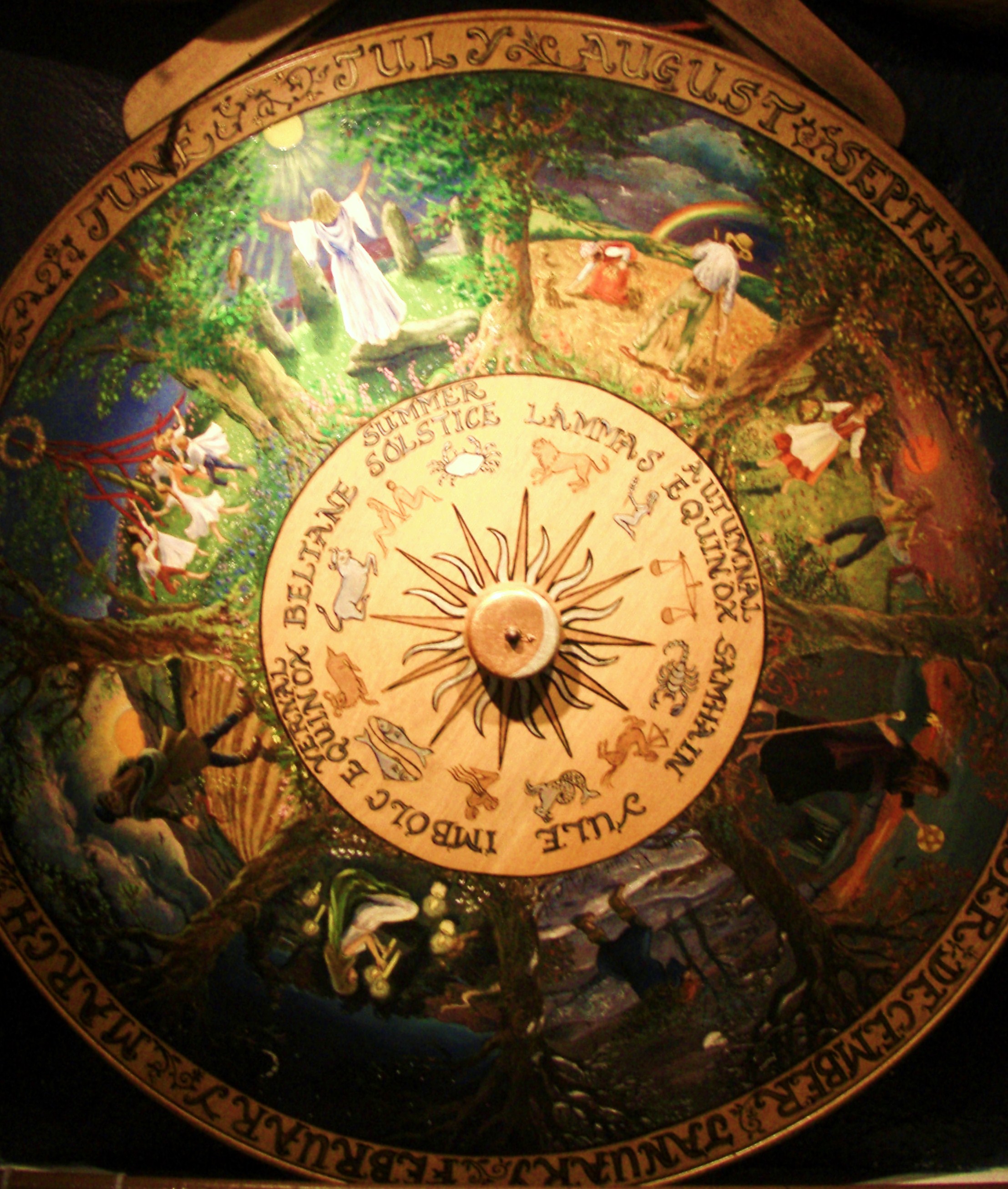
Wheel of the Year from the 
Museum of Witchcraft, Boscastle
Creative Commons license
Calendars - they can be such a touchy subject for Pagans!  For many outside the regular Wiccan paradigm, telling another Pagan that you don't exactly follow the Wheel of the Year (or even close) can lead to confusion and sometimes arguments.  I do follow the regular 8 holidays with my ADF grove and Wiccan coven, and the local Heathen group celebrates the solstices and equinoxes.  But in my family's practice, we have a bit of a different liturgical calendar.  I've posted before about my Anglo-Saxon holidays; this calendar includes my personal Gaelic holidays, some cultural holidays, and a couple to honor other deities.

Imbolc - February 1 (set out a brat to be blessed by Brighid, bless the house)

Ériu Day - March 17 (honor Irish ancestors, prepare traditional Irish food, honor to Ériu)

Cailleach Day - March 20 (bid goodbye to the Cailleach)

Earth Day - April 22 (ritual and offerings for Earth deities)

Arbor Day - April 25 (a big holiday in Nebraska, we visit Arbor Day Farms and discuss tree lore)

Beltane - May 1 (collect dew for holy water, ritually rekindle the household fire, decorate May tree with bright ribbons)

Midsummer - June 21 (tend a flame through the night, offering rushes to Manannán and milk-soaked bread to Áine)

Star Day - July 27 (a new moon, good day for star viewing, and honoring a star Goddess)

Lughnasadh - August 1 (honor Lugh, harvest the first fruits of the garden, make a large feast to share with the Gods, athletic fun and games)

Samhain - October 31 (honoring the Ancestors)

Totensonntag - November 23 (honoring recent Ancestors - this is a 19th century German holiday, and many of my near Ancestors came from Germany after that time)

Friday, March 7, 2014

E is for Eostre, the Holiday


This is not a post about the NeoPagan holiday of Ostara, but rather about the word from which early Wiccans borrowed the name of their holiday.  Ostara is a reconstructed Old High German word, reconstructed based on the Anglo-Saxon word Eostre.  The origin of Eostre itself is somewhat questionable.   The venerable Bede, writing De temporum ratione in the 700s, gives Ēosturmōnaþ as a name for a month in the Anglo-Saxon calendar that corresponds roughly with April (for more about the Anglo-Saxon calendar, Wednesbury Shire's website has some fantastic info).  He also notes that the month is named after the Goddess Eostre, whom the Pagans would honor with feasts during this month.  She is not attested in any other works, but her name can be linguistically linked with several other Indo-European dawn goddesses.

As an Anglo-Saxon Heathen, I think that celebrating the month of Ēosturmōnaþ is vitally important to my religion - in his writing, Bede references very few beings worshiped by his ancestors, which leads me to believe that the customs he does mention were very important that that time.  I choose to celebrate this holiday as a one or two-day affair rather than the entire month, though I do give honor to Eostre through all of the spring (which is considerably longer than a month here in the midwest).  Given that the Anglo-Saxons had a lunar-based calendar, I have chosen to celebrate Eostre's holiday on the day following the Full Moon - which usually ends up falling quite close to Easter, given that Easter is calculated as the first Sunday after the Full Moon after the spring equinox.  This year I'll be celebrating on April 15th, almost a full week before Easter.

In De temporum ratione, Bede specifically references feasts being given in honor of Eostre.  The feasting at least is very much practiced in our culture today - every Easter, my family and many like mine get together and enjoy a ham or turkey.  In our culture, which is becoming more secular, good times and good food with family are the markers of many holidays (which works out great for a Heathen!).  According to the Wednesbury Shire, many of the English-speaking world's Easter customs, such as egg decorating and the celebration of hares, go back almost to Anglo-Saxon times.  Alaric Albertsson in his book Travels through Middle Earth talks about the effects of light on the egg production of hens: by Eostremonath, the hen's eggs would have been an abundant food source, making them both an important symbol of the season and an object worthy of reverence.

So much like my Christian childhood, my children and I will be decorating eggs, cutting out bunnies from paper, and cooking up a delicious feast this mid-April - only instead of hauling them off to church that Tuesday morning, I'll be taking my children outside to explore all the changes happening around us: what flowers are sprouting, which trees have nests in them, what birds have brought their song back to our prairie now that the winter is over.  We'll rise with the dawn to give honor and thanks to Eostre for the return of the light and the warmth.  And that night, we'll all sit down and enjoy a feast together, leaving Eostre Her due on the altar.  For us, this is how Eostre's holy day is celebrated.

Wednesday, March 5, 2014

Crafting the Runes: Peordh

From Ralph Blum's Rune Deck


Peordh is a source of recreation
and amusement to the great,
where warriors sit blithely together
in a banqueting-hall.


Peordh is the most confusing rune in the Anglo-Saxon rune poem that I've encountered so far.  It appears to have no precise pronunciation, with many sources giving many different suggestions.  The wikipedia article on the rune cites a German book published in 2006, Das fuþark und seine einzelsprachlichen Weiterentwicklungen by A. Bammesberger and G. Waxenberger, which gives a etymological link between peordh and a Common Germanic word for pear-tree.  The article then goes on to link this to a woodwind instrument, or a game made out of the wood.  Alaric Albertsson in his book Wyrd Working: the Path of a Saxon Sorcerer, mentions and disputes a possible interpretation of a chess piece, stating that it can most likely be interpreted as related to some game of chance (and using the usual interpretation of the shape of the rune resembling a dice cup).  The rune is not mentioned in either of the other extant rune poems we have available.

Unable to find any more references or explanations for the translation, I suppose the traditional explanation of a game of chance is as good as any.  It certainly fits in with the poem - it is a game often played when people gather together, and is seen, even into our modern times, as a "source of amusement to the great".  Many will associate this rune with fate or chance; and given that I am learning these runes partly in order to practice a casting sort of divination with them, it doesn't seem entirely out of place.  But what the rune poem seems to suggest is more about camaraderie - warriors sitting together in a hall, feasting and drinking and playing games.  This reminds me more of family game nights or get togethers with friends than the mighty forces of fate and chance.  While I think either is a valid interpretation, in my own divination and magic, I think I will primarily interpret it as good times with friends and companions.

Monday, March 3, 2014

Daily Devotionals

With three children and a crazy schedule, it's difficult for me to find the motivation to do daily devotionals.  But they're incredibly helpful when growing a spiritual practice - since I've been offering to different deities or spirits most days, I feel more connected with the earth and my spirituality than ever before.  But these are all simple prayers to just one deity or spirit, and I really feel the need to have a more consistent practice day-to-day.  So, I've taken the time to put together a daily prayer that hits all of the points I find important, and can be done in less than 10 minutes - that's less time than it takes to go through Ian Corrigan's guided Two Powers meditation!  Modified a bit, it can be a thanking prayer for night-time rituals, or even done twice daily, at morning and night.

I come here, on the earth and under the sky, to call the day to being.
I stand before my mothers and fathers,
before the spirits of land and place,
before the Gods and Goddesses,
to call the day to being.

Max, Hattie, George, Opal, 
Herman and Anna,
Lena, my namesake,
and all my beloved dead,
watch over me and mine on this day.

Nebraskier(1), prairie-grass,
oak, maple, garden-fruits,
rabbit, robin, house spirits,
and all the spirits of this land,
be friendly to me and mine on this day.

Nerthus and Manannán,
Brigid and Frige,
and all the honored Gods and Goddesses,
give freely of your blessings to me and mine on this day.

With reverence, I give these gifts
To my ancestors, the beloved dead,
to the spirits of this land and place,
to the Gods and Goddesses I honor,
as I call the day to being.

Let the day begin!

1) I use the name the Otoe Native American tribe gave to the local river as Her name.  I struggled with this for a long time - whether it would be more disrespectful to continue to call Her by the name European conquerors had given Her, or to use the name She had been called for years and years though I have no affiliation with the Otoe tribe.  I chose to use Her Otoe name, though I know it's not a choice everyone would make in this circumstance.

Saturday, March 1, 2014

Fréo and Ing Fréa - More Fun with Salt Dough

For the past month or so, I've felt a pull towards the Wanic deities.  Well, that's not exactly right - I've been honoring Nerthus since before I knew Her name.  But recently, I feel as if I'm being asked to explore Her children as well.  Nerthus was the earth-mother Goddess of the Saxons before their migration to England, and it is assumed She was still very important to them, especially considering the Æcerbot's reference to the earth as a mother deity all the way in the 11th century.  Ing Fréa, whose name can be linguistically traced to Freyr and is thought to have many of the same qualities, was one of the three most important Gods in Anglo-Saxon times (the other two being Woden and Thunor).  Fréo, however, seems to have managed a complete vanishing act - though according to Alaric Albertsson in Travels Through Middle Earth, it's very possible that Her place-names are now impossible to distinguish from Frige's.

My interest catalyzed this past weekend when the local Heathen group offered a class exclusively focused on Freyja.  It was so interesting to discuss Her roles and stories.  As a hard polytheist, I do consider Her and Her Anglo-Saxon counterpart Fréo to be different deities; but in my opinion they are like close cousins.  Learning about Freyja has increased my desire to try to connect with both Fréo and Her brother, Ing.


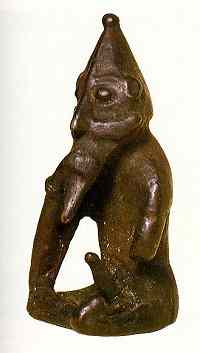
After a few offerings, I've decided to make representations of Them to sit on my nature altar next to Nerthus.   I made them out of salt-dough, which is almost like playdough to work with, and super cheap to make.  I shaped them based off of an image of Freyr from an archaeological dig in Sweden (though no visible penis - this is being displayed in my kitchen, after all!).  After drying them out in the oven, I painted them with greens and golds to imitate vegetation and wheat.  I painted Fréo an amber necklace, though I don't believe She was connected with an Anglo-Saxon version of Brísingamen - however, since we know so little of Her, there's no way to say Fréo didn't have an amber necklace of her own either.

I've been offering Ing and Fréo birdseed, which is what I keep to offer to Nerthus, but I may begin experimenting with other offerings related to the earth or plants.  I've been saving some rose petal powder to burn as incense that I'd like to see if Fréo enjoys.  If my readers have any offerings suggestions, please let me know in the comments!