Okay, so I cheated on the title, but I haven't made a PBP post yet this week, and this has been on my mind a lot lately.
There are almost as many opinions about parenting and Paganism in the Pagan community as their are Pagans! Now that's a mouthful - but it's true. With each person, comes a different religious background, a different upbringing, and a different attitude towards their childhood religious experiences.
I've met many Pagans who are refusing to raise their children in their own religion, many because of bad experiences having been raised in fundamentalist Christian households. I can understand the worry that these people have. Having been indoctrinated in a religion as a child, that's the last thing they want to do to their own children. It's something that I fear for my kiddos - I don't want to dictate their beliefs, or tell them how to represent themselves to others. They deserve the ability to decide for themselves.
However, I am of the opinion that a tabula rasa is not the best way to go about choosing a religion or spiritual path. I believe it would be doing my children a great disservice to have them grow up and enter the public sphere without any knowledge of the many different beliefs the people around them hold. We talk about Jesus occasionally, we celebrate Muslim holidays, and I generally try to give a small education on most of the major world religions. But, it's a big step from education about a variety of religions to educating a child about your religion.
I feel it's important for children to not only be educated in religion, but to also experience religious community. For a child growing up without that, it's awfully easy for one of the more evangelistic religions to jump in with the promise of unconditional love and community - not that I'd be unwilling to accept it if one of my children chose Christianity, but I want it to be an honest and informed choice, not something they turn to because they don't have a spiritual community.
Which brings me to my final point - for Pagans with kids who want their children raised in their religion, there are some hurdles in place. Granted, I've never been to a big festival with a dedicated and organized kid area, but in my experiences with a few area groups, there's a distinct lack of kid stuff. It's not that they aren't welcome - everyone is always very friendly and seems happy to see them at gatherings - but there's nothing for them. Children are often welcomed at ritual, which is great, and I appreciate it; but it's not exactly easy for them. It's like asking a kid to sit through a church service, which is tricky at the best of times. Kids like to move, to talk, and they don't like standing around and listening to other people go on! Other events have an area with kid activities, or let kids play while the ritual goes on; but then they're not having any sort of spiritual experience.
I think what a few larger Pagan groups really need is a time for children - small children who just can't be expected to sit through and understand adult ritual - to have their own spiritual space and experience. I've been working on a ritual script that's just about ready to test out with my own kiddos; and after I've refined it a bit, I'd really like to invite some of the local Pagan children to come and enjoy it with us. But having a group of small Pagans is contingent on having a group of Pagan parents who want their children educated in the basics of Pagan religion.
Reading back through this, my writing may be coming off as judge-y of other parents who choose not to raise their children in a Pagan religion. To clarify, I think every parent has the right to raise their child exactly how they feel is best - I'm just lamenting a small gap in support for parents who do want to raise their children in their traditions.
Monday, September 23, 2013
Sunday, September 15, 2013
S is for Sumbel
Last night I had the privilege to attend my first sumbel with Nebraska Heathens United. Of course, in the many books I've read about Heathenism and the Germanic tradition, many of them have talked at length about how Heathenism is not a solitary religion. It's important to build community. Being a fairly solitary person naturally, it's difficult for me to understand how something could be made inherently 'better' by a group - but I think, after last night, I understand a bit better.
First there was a nice talk about Freyfaxi, the harvest holiday, and Winterfinding, which commemorates the coming of winter, during which we each talked about our own harvests, and the signs of winter we've been seeing around us. Particularly, I've been starting to notice more and more geese flying by, as there's a nice big field up the street they like to stop and rest in.
Then we held Sumbel. Three rounds of toasts - the first to the Gods, the second to our honored Ancestors, and the third for boasts or oaths; all done with the most delicious homemade mead and (I think, I don't know much about alcohol at all!) wine. The fellowship of having a room full of twenty-some people all toasting the Gods I honor has had a tremendous impact on me. The religion of our ancestors, though obviously impossible to reconstruct, was, if nothing else, a social religion. They held many gatherings probably very similar to the one I attended last night. The people of Nebraska Heathens United, and the others who attended, created a fellowship that felt authentic. I can not even describe how much I underestimated community in the honoring of the spirit of Germanic Paganism.
First there was a nice talk about Freyfaxi, the harvest holiday, and Winterfinding, which commemorates the coming of winter, during which we each talked about our own harvests, and the signs of winter we've been seeing around us. Particularly, I've been starting to notice more and more geese flying by, as there's a nice big field up the street they like to stop and rest in.
Then we held Sumbel. Three rounds of toasts - the first to the Gods, the second to our honored Ancestors, and the third for boasts or oaths; all done with the most delicious homemade mead and (I think, I don't know much about alcohol at all!) wine. The fellowship of having a room full of twenty-some people all toasting the Gods I honor has had a tremendous impact on me. The religion of our ancestors, though obviously impossible to reconstruct, was, if nothing else, a social religion. They held many gatherings probably very similar to the one I attended last night. The people of Nebraska Heathens United, and the others who attended, created a fellowship that felt authentic. I can not even describe how much I underestimated community in the honoring of the spirit of Germanic Paganism.
Wednesday, September 11, 2013
Book Review : The Pagan Religions of the Ancient British Isles, by Ronald Hutton
I can't say enough about how fantastic this book is. Not for enhancing your practice (it may actually have you tearing down some of it), not for bringing you closer to nature or your inner self; but for its clear, objective, and wonderfully unapologetic look at the past. It reaches few conclusions, one of the most prominent being that, with the available evidence, we can't draw any conclusions. What it does is lay out the facts that we have in an accessible way, so that the reader is free to draw their own conclusions (or not). The facts that Hutton lays out are drawn from archaeological work, historic resources (including how reliable those resources may or may not be) and observations of modern-day tribal cultures.
Though it was discouraging at times to hear how little we know about the actual religious practices of my ancestors, and indeed how little we know historically about many of the commonly honored deities in Neo-Paganism, I find that with this grounding in actual fact, I am more at ease with most of my religious practice, even those elements that have proven to be modern or at least not based in reliable historical sources. Now that I see how impossible actual reconstruction is, it has given me more freedom to be a bit 'looser' in my own path - for instance, my enduring admiration for Robert Graves' tree calendar doesn't seem so ridiculous in light of the many other elements of my practice that have been made up whole-cloth in the past.
Also, I feel that this book was part of a major connection with my own ancestors. Knowing more about their day-to-day life, their intensely regional practices, and what the world was like when they were living in it has brought me much closer to these often distant-seeming presences. I now know much more about the kinds of offerings they thought the spirits needed, and can fulfill their wishes accordingly in my own practice. I also enjoyed the large section on water hoards; to me, it shows an intense awe for the deep places that lie unseen beneath the surface waters, something I have personally felt many times.
The Pagan Religions of the Ancient British Isles covers a great length of time, from the first arrival of humans on the Isles (back when they were part of the continent!) up to and including the final spread of Christianity. There is a large section on the Neolithic period, a smaller one on the Iron Age (when the actual un-Romanized Celts largely populated the Isles, a period from which there is scant archaeological or historical evidence), and a great deal of information on the Romanization of Britain. I found it a fascinating read, and I would recommend it to anyone who is interested in learning just how much they don't actually know about ancient Paganism in the British Isles.
Though it was discouraging at times to hear how little we know about the actual religious practices of my ancestors, and indeed how little we know historically about many of the commonly honored deities in Neo-Paganism, I find that with this grounding in actual fact, I am more at ease with most of my religious practice, even those elements that have proven to be modern or at least not based in reliable historical sources. Now that I see how impossible actual reconstruction is, it has given me more freedom to be a bit 'looser' in my own path - for instance, my enduring admiration for Robert Graves' tree calendar doesn't seem so ridiculous in light of the many other elements of my practice that have been made up whole-cloth in the past.
Also, I feel that this book was part of a major connection with my own ancestors. Knowing more about their day-to-day life, their intensely regional practices, and what the world was like when they were living in it has brought me much closer to these often distant-seeming presences. I now know much more about the kinds of offerings they thought the spirits needed, and can fulfill their wishes accordingly in my own practice. I also enjoyed the large section on water hoards; to me, it shows an intense awe for the deep places that lie unseen beneath the surface waters, something I have personally felt many times.
The Pagan Religions of the Ancient British Isles covers a great length of time, from the first arrival of humans on the Isles (back when they were part of the continent!) up to and including the final spread of Christianity. There is a large section on the Neolithic period, a smaller one on the Iron Age (when the actual un-Romanized Celts largely populated the Isles, a period from which there is scant archaeological or historical evidence), and a great deal of information on the Romanization of Britain. I found it a fascinating read, and I would recommend it to anyone who is interested in learning just how much they don't actually know about ancient Paganism in the British Isles.
Tuesday, September 10, 2013
R is for Reciprocity
This week, R is for Reciprocity. Reciprocity is a major component of both ADF Druidry and Heathenism, because of the Indo-European cultures these religions are ultimately based on. It is also a difficult concept to understand for many coming from a more mystical, or on the other end a more magical, background. The concept of hospitality is an outgrowth of reciprocity, and keeping that in mind is helpful to understanding both.
Reciprocity is a cultural concept, not as prevalent in our times, where if one is given something, something is expected to be given in return. This is not about greed or forcing someone to give you something, but in times past, the rules of social niceties simply dictated that people shared often and happily with one another, and everyone was compelled to do this - there was no opting out of hospitality! You can still see this concept reflected today in some holiday gift-giving attitudes; it can still give you an apprehensive feeling if someone purchased you a gift, and you had not gotten one for that person.
A relationship of reciprocity is the most common way to relate to spirits in ADF Druidry. Whether they are your Ancestors, Nature Spirits or the Deities themselves, it is helpful to establish these kinds of relationships. When a practitioner makes a sacrifice or pours a libation to the spirits, this is a gift that the spirits will return in kind. Now, some who come from a more mystical background see this as demeaning, as if reciprocity is simply drawing up a contract, and disrespectfully expecting the spirits to give up their gifts like a cosmic vending machine. This is not so at all! The Indo-European spirits with which most ADF Druids or Heathens honor have a cultural basis in this type of relationship; it is not seen by them as disrespectful, but instead is an honoring of an age-old way of relating with the spirits. Others who come from a more magical background may also see the relationship of reciprocity as different than it really is; it is easy to equate it with magical workings where one invokes a spirit and expects that spirit to follow their will. But this is also not a good comparison. The relationship of reciprocity is not one of power or command, any more than a gift given in good faith is a command that another one be given. It is a cultural relationship, in which the door is wide open for a spirit to say 'no' to the worshiper's request, and to grant something more to the spirit's liking instead (this is why I find it prudent to stay away from trickster deities in my practice)!
Saturday, August 24, 2013
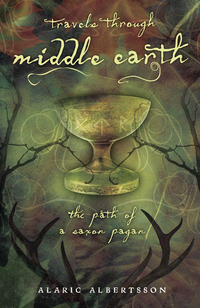
Book Review - Travels Through Middle Earth: the Path of a Saxon Pagan, by Alaric Albertsson
Travels Through Middle Earth: The Path of a Saxon Pagan is a lovely introduction to Saxon Neo-Paganism. Many different aspects of the path are covered, from the Deities and the Spirits all the way to making your own mead! I did read the other recommended books for an Anglo-Saxon hearth culture (Brian Branston's Lost Gods of England and The Real Middle Earth by Brian Bates) but was left unfulfilled - Branston's work was very academic and interesting, but lacked spiritual recommendations; and Bates's book was a bit too loose with history for my tastes. Then I read Travels Through Middle Earth, and it was exactly the kind of book on Anglo-Saxon Paganism that I had been looking for; a good mix of scholarship and the personal experience of a man who has been walking this path for many years.
Travels Through Middle Earth is an introduction to Anglo-Saxon Paganism, and because of that it contains a lot of the usual 101 information - basic overviews of deities and holidays, many of which you can find in other Pagan introduction books. But where this book stands out is Alaric's careful attention to the mindset and world-view of the Anglo-Saxons. I particularly resonated with his point about language and culture; they are inextricably intertwined in the common phrases we use every day, without thinking. And of course, a people's religion is intimately bound up with their culture. This makes the English-speaking world particularly suited to the worldview of the Anglo-Saxons (though of course not limited to it - I myself also honor a Celtic hearth culture, and I wasn't raised speaking a Gaelic language).
Alaric also, while introducing the usual 101 holidays of the Wheel of the Year, goes deeper into their older meanings; and even talks about some interesting holidays that are much less well known in the general Pagan community, such as Mother's Night, a celebration of female ancestral spirits. He also gives many good ideas for celebrating these occasions, while staying true to the history and allowing for the fact that most of these customs are much more recent than our Pagan ancestors, but still applicable.
I have used some of the ideas in this book already in my own practice, setting up a wéofod (shrine) for Thunor and Frige. I appreciate Alaric's emphasis on consistent practice, and the book has inspired me to be more regular in my interactions with the Deities and Spirits. I would absolutely recommend this book to anyone interested in Anglo-Saxon, or any sort of Germanic Paganism; I feel Travels Through Middle Earth is a fantastic resource to those who may just be starting out, and also contains some wonderful gems for those who have been walking the path for awhile now.
Travels Through Middle Earth is an introduction to Anglo-Saxon Paganism, and because of that it contains a lot of the usual 101 information - basic overviews of deities and holidays, many of which you can find in other Pagan introduction books. But where this book stands out is Alaric's careful attention to the mindset and world-view of the Anglo-Saxons. I particularly resonated with his point about language and culture; they are inextricably intertwined in the common phrases we use every day, without thinking. And of course, a people's religion is intimately bound up with their culture. This makes the English-speaking world particularly suited to the worldview of the Anglo-Saxons (though of course not limited to it - I myself also honor a Celtic hearth culture, and I wasn't raised speaking a Gaelic language).
Alaric also, while introducing the usual 101 holidays of the Wheel of the Year, goes deeper into their older meanings; and even talks about some interesting holidays that are much less well known in the general Pagan community, such as Mother's Night, a celebration of female ancestral spirits. He also gives many good ideas for celebrating these occasions, while staying true to the history and allowing for the fact that most of these customs are much more recent than our Pagan ancestors, but still applicable.
I have used some of the ideas in this book already in my own practice, setting up a wéofod (shrine) for Thunor and Frige. I appreciate Alaric's emphasis on consistent practice, and the book has inspired me to be more regular in my interactions with the Deities and Spirits. I would absolutely recommend this book to anyone interested in Anglo-Saxon, or any sort of Germanic Paganism; I feel Travels Through Middle Earth is a fantastic resource to those who may just be starting out, and also contains some wonderful gems for those who have been walking the path for awhile now.
Q is for Quarters
The Eight-Fold Year! Though I'm on a Druidic path now, I come from a Wiccish background, and have been celebrating these eight holidays for more than ten years now. And still, I cannot for the life of me remember which are the cross-quarters and which are the quarters! So today I'll write about all of them, or the idea of the Wheel in general.
Isaac Bonewitz, the founder of Ár nDraíocht Féin, my Druidic home, wasn't crazy about Wiccan techniques in his system of Druidry. Not that he had anything in particular against Wiccans, but he set out to create something different. There are no circles cast in ADF rituals, no calling of the four elements, no duo-theistic divisions of God and Goddess. But the one thing he did keep was the holidays of the Wheel of the Year.
For starters, it helps that the holidays the Wheel is based on, mostly ancient Celtic and Germanic practices, are a part of the Indo-European cultures Isaac was building his religion on; so it wasn't unreasonable to keep them as main holidays. But there are many other Indo-European celebrations that could have made the cut for High Days as well. Though Isaac and the early members of ADF were adamant about a more accurate ritual structure, they also wanted ADF to become a public religion, a face of Paganism to the general public - and this meant a certain amount of unity with other Pagan practice. And so, the eight holidays of the Wheel of the Year became the sanctioned High Days of ADF, on which every Grove must hold a public ritual.
Of course, there are many individual ADF members who choose not to mark some or all of the eight days for their own reasons; and since personal practice is just that - personal - nobody minds. But I still follow this calendar, and I am happy that the original ADF members chose to adopt it. Though there are very few ADF members in my state, I can still go to other rituals for these High Days and have fellowship with a larger Pagan community, and also find some personal meaning in the rituals as well. Though my practices are largely different from the majority of Pagans I've met near me, I can still share this commonality with a larger group, and that is something that strengthens and deepens Our Own Druidry.
Isaac Bonewitz, the founder of Ár nDraíocht Féin, my Druidic home, wasn't crazy about Wiccan techniques in his system of Druidry. Not that he had anything in particular against Wiccans, but he set out to create something different. There are no circles cast in ADF rituals, no calling of the four elements, no duo-theistic divisions of God and Goddess. But the one thing he did keep was the holidays of the Wheel of the Year.
For starters, it helps that the holidays the Wheel is based on, mostly ancient Celtic and Germanic practices, are a part of the Indo-European cultures Isaac was building his religion on; so it wasn't unreasonable to keep them as main holidays. But there are many other Indo-European celebrations that could have made the cut for High Days as well. Though Isaac and the early members of ADF were adamant about a more accurate ritual structure, they also wanted ADF to become a public religion, a face of Paganism to the general public - and this meant a certain amount of unity with other Pagan practice. And so, the eight holidays of the Wheel of the Year became the sanctioned High Days of ADF, on which every Grove must hold a public ritual.
Of course, there are many individual ADF members who choose not to mark some or all of the eight days for their own reasons; and since personal practice is just that - personal - nobody minds. But I still follow this calendar, and I am happy that the original ADF members chose to adopt it. Though there are very few ADF members in my state, I can still go to other rituals for these High Days and have fellowship with a larger Pagan community, and also find some personal meaning in the rituals as well. Though my practices are largely different from the majority of Pagans I've met near me, I can still share this commonality with a larger group, and that is something that strengthens and deepens Our Own Druidry.
Saturday, August 17, 2013
Q is for Quartz (and Thor)
Q is for Quartz - and since discussing it and all of its properties is a bit much to bite off, I'd like to talk about its relation to Thunder and the Germanic deities associated with it.
Recently I was reading Alaric Albertsson's Travels Through Middle Earth, which details a possible Anglo-Saxon Pagan path. He mentions that quartz crystals, in the England of the Anglo-Saxons, were called Thunderstones and were considered sacred to the god Thunor (who is roughly equivalent to the Norse god Thor), because they were placed in the ground by Him when lightning struck.
I've been honoring Thunor for a while, trying to build a friendlier relationship with Him and a few other Anglo-Saxon deities. He was very much a deity of the people, honored by many commoners and farmers, and has a reputation for being approachable. This has been my experience as well. But it was difficult for me to connect His status as a thunder god with one of His other roles, that of protection. Reading about His connection with quartz crystals really solidified it for me. I've carried a small quartz marble in my pocket for a few years now, because of its ability to absorb negativity and output a positive energy; this is almost the definition of 'protection' for me. Taking away the bad, bringing in some good - that is the role of a protector. Since I had never found a good image of Thunor (or Thor) that I really liked, I now use a quartz sphere to represent Him on my altar, and both He and I appreciate the connection.
I'll be writing my review of the book I mentioned, Travels Through Middle Earth, soon; but for now I'd like to mention that it's a great read for anyone interested in a Germanic path. It's pretty 101, so easy to understand, but there's little tidbits like this one about quartz hidden within it that make it a valuable read for just about anyone!
Recently I was reading Alaric Albertsson's Travels Through Middle Earth, which details a possible Anglo-Saxon Pagan path. He mentions that quartz crystals, in the England of the Anglo-Saxons, were called Thunderstones and were considered sacred to the god Thunor (who is roughly equivalent to the Norse god Thor), because they were placed in the ground by Him when lightning struck.
I've been honoring Thunor for a while, trying to build a friendlier relationship with Him and a few other Anglo-Saxon deities. He was very much a deity of the people, honored by many commoners and farmers, and has a reputation for being approachable. This has been my experience as well. But it was difficult for me to connect His status as a thunder god with one of His other roles, that of protection. Reading about His connection with quartz crystals really solidified it for me. I've carried a small quartz marble in my pocket for a few years now, because of its ability to absorb negativity and output a positive energy; this is almost the definition of 'protection' for me. Taking away the bad, bringing in some good - that is the role of a protector. Since I had never found a good image of Thunor (or Thor) that I really liked, I now use a quartz sphere to represent Him on my altar, and both He and I appreciate the connection.
I'll be writing my review of the book I mentioned, Travels Through Middle Earth, soon; but for now I'd like to mention that it's a great read for anyone interested in a Germanic path. It's pretty 101, so easy to understand, but there's little tidbits like this one about quartz hidden within it that make it a valuable read for just about anyone!
Subscribe to:
Posts (Atom)