Thursday, October 10, 2013

Brigid, the Hearth Fire, and the Furnace

This time of year, it starts to get cold here on the prairie.  For a few weeks, we can get away with turning on the individual heaters in our bedrooms at night, but the time comes when the thermostat must be switched from 'cool' to 'heat', and the furnace is lighted and used for the first time that year.  I don't know much about mechanics and I don't know how my current furnace works - I switch the switch and a few minutes later the heat comes on, though it smells a bit funny that first time.  But as a child, our furnace had a pilot light, and if it ever went out (which it did often), it got cold.  We'd wake up two or three times a month during the winter season to find that the pilot light had gone out overnight and it was now under 50 degrees in the house.  A few times it got below freezing, and once we had the pipes in our basement all freeze up - my father the handyman wasn't very happy when we finally got the heat back on and water started spraying everywhere!

This experience in my youth has given me an appreciation for the harshness of winter, and our utter helplessness when faced with the loss of our warmth.  The furnace (or fireplace if you're lucky enough to have a working one) is the most essential part of a house in the winter-time.  It keeps the home cozy, keeps water flowing freely, and protects us from the dangerous elements outside.

In Pagan times, the hearth fire was often seen as a personified Goddess, the most sacred part of any home.  There are many Goddesses in the Indo-European group of pantheons who combined the sacred flame with the domestic business of the house, among them Hestia, Brigid, and Vesta.  I honor Brigid as my hearth goddess, most often at Imbolc when I am clearing things out and doing some spring cleaning.  But it occurred to me as I turned on the furnace for the first time this weekend that She deserves special recognition as the bringer of warmth as well.

And so began a new family tradition.  As the weather turns cold and we retreat into our houses more and more, as we light our first fires and turn on our heaters, now we recognize the Goddess who blesses us with this heat, and all the feelings of warm, cozy family and filling meals that go along with it.  In the cold, dark winters, all of these things go hand in hand; just as Brigid is both domestic and fiery.


Tuesday, October 8, 2013

Animism, Disease, and Elf-Shot

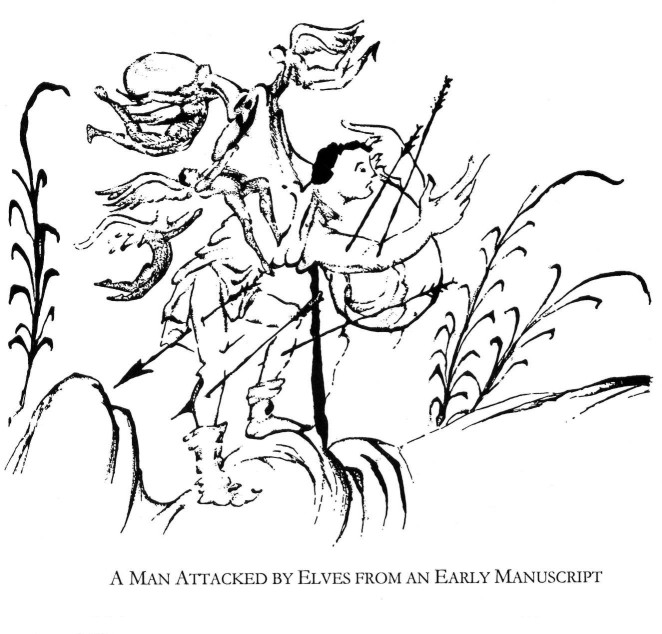
In Anglo-Saxon England, some diseases and many sudden pains were blamed on elf-shot, that is tiny or invisible arrows shot by elves into humans.  By the later middle ages, elves and fairies had become synonymous, and stone age arrowheads seen as evidence of their mischief; but this was not the case in the Anglo-Saxon era.

For a while I've had a hard time wrapping my head around this.  I'm a scientific person, married to an atheist with zero belief in the supernatural, and when hit with an ailment my first instinct is to take an aspirin and get some sleep.  It just wasn't in my worldview to believe there could be something more behind a lot of the sicknesses that science has pretty clearly identified.

But a thread on a forum I frequent has recently given me a new perspective on this issue.  It began with a poster asking about how animists treat bugs and other pests; can you kill something with a clear conscience if you believe it has a spirit?  For me, it was an easy answer - I don't generally bother things that don't bother me, but I don't feel badly about getting rid of bugs that are negatively affecting the life of me or my family in our own home.  But another poster in the thread brought up a good point about bacteria and even viruses - do animists believe that these have a spirit?

Que the "Aha!" moment for me!  As an animist, I do believe that bacteria and viruses have a spirit - but as beings that live on the sickness of humans or other animals, they are certainly negative spirits in our eyes.  And I believe now that this is where the entire notion of evil spirits comes from - early healers, trained both medically and spiritually, sensed the presence of these spirits who intended harm to human life, and developed both medicines and spiritual techniques to fight them.  This makes sense to me on a scientific and a spiritual level; and honestly, these are the kind of moments I live for - when something finally just makes sense.

Sunday, October 6, 2013

T is for Trees

I'm Molly, and I'm a tree hugger.  From when I was a little girl, my grandmother took me around to different parks, putting my hands and face on the trees and really experiencing what they were.  We hugged maples, walnuts, birches and oaks.  We walked under their boughs and listened to their songs.  We scaled their heights and swayed with their bodies.  The trees were my first friends, and have remained so throughout my life.

I have a few trees in my yard now that I've built relationships with, and a few in the park near my house.  But the one I'm closest to is a beautiful oak tree.  It's fairly young as oaks go, maybe thirty or forty years old, and its trunk is still rather slender.  But it is strong and sturdy, with lovely glossy green leaves in the summer and a bumper crop of acorns.  In the fall, its leaves turn a shining mahogany color, a rich brown that fills the back yard.  When I first moved here more than three years ago, it caught my attention as being the most climbable tree in the yard - I just needed a step stool to give me a boost, not like the extension ladder I'd need to reach the lowest branches of the nearby maple.

I approached it as I would a new neighbor.  I brought cool clean water and a cookie that I had baked, and offered them.  I sat with the tree for awhile, getting to know its energies and showing it some of my own.  For the next few days, I continued to offer water every day and stay for awhile to become more familiar.  We didn't exactly communicate, I can't hear the voice of the tree or anything like that - but I began to get a sense of familiarity when I offered the water, as if the oak was growing glad of my presence.  The next day I asked permission to climb the tree; and sensing no opposition, I got out my footstool and got up there.  It hadn't been cared for in awhile, and there were many dead branches that had caught on their way down and needed to be cleared out.  I got as many as I could, and then stayed for awhile in the swaying branches.

Since then we have begun what feels like the comfortable relationship of good friends.  When I am outside, I make it a point to take a cup of water from the tap and pour it out near the base.  I try to get up in its branches fairly regularly to help keep them clear of debris.  This year, I've begun a nature journal to chronicle its changes from year to year.

I've heard many people say that the nature spirits are angry, that they are not interested in relationships with humans because of the large amount of damage our species has inflicted on the land.  I have to say, this has not been my experience.  I feel that, in general, the spirits of the land such as the trees are glad to be recognized.  There are people like my grandmother who, though they are certainly not Pagan and in fact may be staunch Christians, have still acknowledged them throughout the years.  I believe the nature spirits have missed us, and are waiting for conscientious humans to try and reconnect with them.  So next time you're at the park, or if you have a special tree in your back yard, try and get to know it!  I think they're truly interested in building relationships with us again.

Monday, September 30, 2013

High Holy Day Essay: Mabon (take 2)

For the Autumn Equinox, I attended a ritual held by the Order of the Red Grail. I had attended one Full Moon ritual with the group in August and enjoyed it very much. Again, the ritual was typically Wiccan in structure, using a procession into a circle to begin the rite. The quarters were called by four different participants, the God and Goddess invited by the two High Priestesses. The centerpiece of the ritual was a piece of ritual drama featuring Persephone's Descent into the Underworld. Each participant became an actor as well, playing the dead souls that lived in Hades' realm. Persephone was taken to the Underworld and was said to embark on a quest to build a better world for the dead to live in. Persephone then led a dance of the dead, each person getting an instrument such as a tambourine to play while they danced, raising energy by increasing the tempo until a final crescendo. I don't know much about Hellenic lore and couldn't say how accurate to it the play was, but it was quite enjoyable to participate in. Then the God and Goddess and the quarters were bid farewell, and the circle was closed. Afterwards, the group holds a potluck to encourage community which was very nice.

 I enjoyed this ritual a great deal more than the Lughnasadh ritual I attended. Those with reading parts were either very good readers or had practiced a bit beforehand, and that little bit of effort contributed greatly to the energy of the ritual. Also introducing something new and novel like the ritual drama, and pairing it with movement and active participation in the ritual dance, had a great effect. I was a solitary Wiccan for about 8 years before deciding to pursue Druidry, and when the elements were invoked in this circle I felt their familiar presence wash over me. I also felt very connected to the other ritual participants, and had a great deal of fun at the potluck despite my usual shyness.

Friday, September 27, 2013

T is for Temple

Alright, so Stonehenge may not have been a temple (we don't really know), and it certainly wasn't a Druid temple, but it's still the most easily-recognized and impactful image of pre-Christian European worship.  Ritual for Celtic and Germanic Pagans seems to fit best under the stars, out in the open or within a sacred grove of trees.  This is something that I want very much for myself - a permanent area of outdoor worship, that I can use for its intended purpose and also isn't altogether obvious to visiting relatives or passers-by!

There is a large area in my backyard that was once a garden, but the previous owner let it go and it has collected a great deal of weeds and other detritus.  Last winter we put tarp over a lot of it, and this winter we'll be tarping over the rest to prevent weeds coming up in the spring.  And then, next spring, I plan to begin the "construction" of my own temple.  I put construction in quotes, as there will be a lot more growing and planting involved then actual building!

The area is square, but I will be bricking off a small circular area in the center to be the main ritual site.  Inside the circle will be a decorative pole (Sacred Tree in ADF), and at its foot will be a small birdbath (the Well for my ADF rituals), and a space for my larger cauldron that I also use as a small fire pit.  Outside this circle will be a small circular bricked path, which will branch out like the spokes of a wheel, and it will be between the spokes that my garden will be growing.  What I'm most excited about is imitating Stonehenge and other solar-aligned standing stones by building an astrological garden into the plans.  For this I'll use small bricks that will mark the shadow of the pole at sunrise, noon, and sunset on the solstices and equinoxes; which should add up to nine bricks; they'll be inscribed with runes or ogham and half-buried.  They'll be small and unobtrusive, but will represent a long-time project, and will connect my own little temple with the many that have come before.  It will be relatively small, and probably wouldn't support a group larger than my children and I, but I think on its completion, it will be worthy of the name temple.

Obviously, not everyone has the time or the resources to make their own outdoor temple, and I can't even begin to express how blessed I feel to be able to do this.  I hope my plans have been inspiring to some of you, and that you can find a way to make your own space into sacred space!

Sources: The 2012 Farmer's Almanac, on astrological gardens


Wednesday, September 25, 2013

On Being Involved, and Being Busy

I am a passionate person.  What that means to me is that I like to learn, and get involved in whatever it is that I'm exploring at the moment.  When I was younger, my interests often meant that I was the poor kid in a room full of kids with pretentious parents; so I've always felt I have to prove myself by doing more and being more than they were.  It instilled a deep love of learning in me.

Enter: Paganism.  Around age 15, I found Wicca for the Solitary Practitioner by Scott Cunningham - I'm not sure that I'd recommend it nowadays that there's so much more available, but at the time, it was a huge find for me.  I stayed mostly Wiccish in my practice until I found ADF about a year and a half ago, and have been exploring Heathenry for the last six months as well.

Lately, I've also been making efforts to make connections with local Pagan groups.  It's highlighted how important community is in my spiritual life.  I've enjoyed the Wiccan and Wiccish rituals I've attended, loved the sumbel I attended last week, and I'm very much looking forward to the Druid group starting up.  Though honestly, I feel a little out of place in attending All of the Things.  I am a religious person; I grew up attending church Saturdays, Sundays, and Wednesdays - so groups that meet once a month for ritual honestly feel strange to me.  I want to learn as much as I can; I want to try being a student of a coven here in town, I want to finish the ADF Dedicant's Path, and I want to continue going to study groups - but I don't want to get burned out.  I'd even like to delve further into Heathenry and join the Troth, and possibly organize some kind of Pagan children's group, but again.. don't want to get burned out.

To be even more honest, I'm also afraid of the ever-looming label of eclectic.  I know this is not necessarily a negative thing, but it's a label I have never applied to myself because I really don't feel that it fits.  I'm a pretty hard polytheist, and I like to keep my cultures and my traditions separate and distinct - but as a potential student of both Wicca, Druidry and Heathenry, I think eclectic is probably a pretty reasonable label for me.  This is one reason inter-Pagan gatherings are so important to me.  Pagan Pride Day was held this weekend and I had a wonderful time.

As I am in this phase of deep learning, I'm going to give most everything a try.  And if it doesn't work out, or if I don't have the energy to keep it up, I am always able to scale things down; of course being careful not to make long-term commitments to things I may later have to bow out of.  But for now I am full of energy, and ready to tackle all the learning and involvement the Pagan community can throw my way!

Monday, September 23, 2013

S is for Small Pagans

Okay, so I cheated on the title, but I haven't made a PBP post yet this week, and this has been on my mind a lot lately.

There are almost as many opinions about parenting and Paganism in the Pagan community as their are Pagans!  Now that's a mouthful - but it's true.  With each person, comes a different religious background, a different upbringing, and a different attitude towards their childhood religious experiences.

I've met many Pagans who are refusing to raise their children in their own religion, many because of bad experiences having been raised in fundamentalist Christian households.  I can understand the worry that these people have.  Having been indoctrinated in a religion as a child, that's the last thing they want to do to their own children.  It's something that I fear for my kiddos - I don't want to dictate their beliefs, or tell them how to represent themselves to others.  They deserve the ability to decide for themselves.

However, I am of the opinion that a tabula rasa is not the best way to go about choosing a religion or spiritual path.  I believe it would be doing my children a great disservice to have them grow up and enter the public sphere without any knowledge of the many different beliefs the people around them hold.  We talk about Jesus occasionally, we celebrate Muslim holidays, and I generally try to give a small education on most of the major world religions.  But, it's a big step from education about a variety of religions to educating a child about your religion.

I feel it's important for children to not only be educated in religion, but to also experience religious community.  For a child growing up without that, it's awfully easy for one of the more evangelistic religions to jump in with the promise of unconditional love and community - not that I'd be unwilling to accept it if one of my children chose Christianity, but I want it to be an honest and informed choice, not something they turn to because they don't have a spiritual community.

Which brings me to my final point - for Pagans with kids who want their children raised in their religion, there are some hurdles in place.  Granted, I've never been to a big festival with a dedicated and organized kid area, but in my experiences with a few area groups, there's a distinct lack of kid stuff.  It's not that they aren't welcome - everyone is always very friendly and seems happy to see them at gatherings - but there's nothing for them.  Children are often welcomed at ritual, which is great, and I appreciate it; but it's not exactly easy for them.  It's like asking a kid to sit through a church service, which is tricky at the best of times.  Kids like to move, to talk, and they don't like standing around and listening to other people go on!  Other events have an area with kid activities, or let kids play while the ritual goes on; but then they're not having any sort of spiritual experience.

I think what a few larger Pagan groups really need is a time for children - small children who just can't be expected to sit through and understand adult ritual - to have their own spiritual space and experience.  I've been working on a ritual script that's just about ready to test out with my own kiddos; and after I've refined it a bit, I'd really like to invite some of the local Pagan children to come and enjoy it with us.  But having a group of small Pagans is contingent on having a group of Pagan parents who want their children educated in the basics of Pagan religion.

Reading back through this, my writing may be coming off as judge-y of other parents who choose not to raise their children in a Pagan religion.  To clarify, I think every parent has the right to raise their child exactly how they feel is best - I'm just lamenting a small gap in support for parents who do want to raise their children in their traditions.