Monday, October 28, 2013

Crafting the Runes: Ur


The aurochs is proud and has great horns;
it is a very savage beast and fights with its horns;
a great ranger of the moors, it is a creature of mettle.


For the rune Ur, I have again quoted the Anglo-Saxon rune poem, a translation of which can be found here.  The Norwegian and Icelandic poems are debatable, but I personally do not associate the second stanzas of those poems with this Rune.

I have always seen this rune, in a Elder Futhark context, represented as Strength.  Which is fair - the aurochs is incredibly large and strong.  But that's not exactly what the poem is saying.  It talks about the pride of the aurochs, it's bravery.  Now of course, the aurochs can be brave and prideful because of its great strength; it has the power to back up its claims.  In fact, it is a savage beast, and will prove its power beyond a shadow of a doubt with sufficient provocation (and reading about aurochs, it seems like 'sufficient provocation' could have been pretty minimal!).  This rune makes claims of strength because it has that strength, and will not hesitate to show it off when confronted.

Friday, October 25, 2013

Crafting the Runes: Fehu


Wealth is a comfort to all men;
yet every man must bestow it freely
if he wish to gain honor in the sight of the Lord.


The quote above is from the first few lines of the Anglo-Saxon Rune poem, a poem composed around the 8th century, after the Germanic religions of the Angles, Saxons, Jutes and others had been supplanted by Christianity - hence the occasional Christian references.  It was first written in Old English, but there's a modern English translation available here.  There are also Norwegian and Icelandic Rune poems, composed later and yet more Pagan in nature.

At first glance, I assumed the slightly negative slant on wealth in the quote above was a Christian overlay; however the Icelandic and Norwegian poems are much more negative in nature, saying "wealth is a source of discord among kinsmen; the wolf lives in the forest," and "source of discord among kinsmen // and fire of the sea // and path of the serpent."  Clearly the Germanic peoples realized the power of greed; it is this that causes the fights even among families.  The Anglo-Saxon Rune poem offers us a solution, however: do not hold on too tightly to your wealth, but bestow it freely, and greed will not haunt your house.

It's interesting and sheds a great deal of light on early Germanic culture that cattle (the literal meaning of 'fehu') is synonymous with wealth.  The more cattle you were able to sustain, the more milk you would have in the early spring, and more meat in the fall and through the winter.  Clearly, however, having too much wealth - or just being rich for the sake of being rich - was very undesirable.

V is for Vigil

As a Pagan, my number one goal is to build a path full of traditions that I can pass down to my children.  Part of it is modifying traditions that I grew up with - we give presents at Christmas without talking about Jesus, and the Summer Solstice has become another Christmas with a fairy delivering the presents instead of Santa.  Part of it is also the addition of new traditions, often drawn from old cultural practices that have only been lost in the last couple of generations of my family.

One of these is keeping a vigil for the Winter Solstice.  Some of my most wonder-filled childhood memories are of going to church on Christmas Eve.  It was always cold, and still, usually with snow crunching underfoot.  Once we got there, it was nice and warm with all the people gathered together; but since it was a candlelight service it was very dark and more than a little somber.  It was like the pause in the breath during those last second waiting for something amazing - everything was poised, on the brink of celebration.. and that night was the celebration of that pause.  I have always held a conviction, though I have no sources, that this Christmas Eve attitude is a carry-over from waiting for the sun to rise higher and higher in the sky on those few days after the solstice.

So the tradition I began was an all-night vigil, a single candle and the lights turned out, facing the east and waiting for the sun to rise.  I'll often bring my guitar and play some of the Christmas Eve carols from my youth; treating them in a more metaphorical Christ-as-the-sun kind of way.  Last year, I invited my oldest daughter to join me.  We made hot cocoa, munched on a few cookies, and sat in relative quiet with the still night.  She bravely struggled for a few hours, but soon it was just me again.  As she gets older, I hope she'll be interested in continuing to carry on this new tradition with me.

Wednesday, October 23, 2013

Crafting the Runes: A Beginning

Since I began my work with an Anglo-Saxon hearth, I've been wanting to acquire a set of Anglo-Saxon runes to work with.  I've looked around (a bit half-heartedly, I must admit) and nothing struck my fancy.  Then about a week ago, I was getting ready to mow my lawn.  It's a multi-step process for me, the procrastinator that I am, and the first is to clear up all the tree branches lying in the grass that have been knocked loose by these crazy prairie winds.  This particular day, I found a nice branch, about three feet long, that was almost exactly the same thickness all along its length.  "How perfect that would be for making runes," I thought as I threw it on the stick pile.  I spent the next few days thinking about that branch - I couldn't get it out of my head.  It really was perfect for this project.  So I went outside and rescued it, and now am beginning my adventures in rune-crafting!

First, I performed a fairly simple ritual for Woden, asking Him to bless the branch I was going to work on.  Now, when I say "fairly simple", I mean very simple.  It was very impromptu as well, but I'll try to recreate it as a bit of a guide.

"Woden, you who drank the mead of poetry, and hung from the Tree for nine nights and nine days, and who drank from the Well of Mimir.  Mighty Woden who sees all Runecraft, bless this branch from which my runes are made.  I offer you this gift (libation of mead) so that I may see with wisdom, speak with wisdom, live with wisdom."

After the ritual, I sawed off some circles for the first Aett and sanded them down until they were smooth.  With all the bark gone, they are a bit smaller than I anticipated, but I think my already over-laden altar will be happier for it.  I plan to make one rune each day, spending the day meditating on its meaning, and hopefully doing a summarizing blog post at the end of each day.  (And hopefully also helping me out with the meditation requirement for the Dedicant's Path - I have a much easier time meditating when I have something to think about!)

The fantastic thing about the Anglo-Saxon runes is that there is a fully intact Rune poem that describes what the runes meant to the people of the land.  Being post-Christian, there's definitely some questionable stuff in there, but it's nothing that can't be figured out with some good old UPG!  I'll be quoting the relevant portion each day as I continue to study the runes.  Hopefully this will be a helpful resource for future students to come!

Tuesday, October 22, 2013

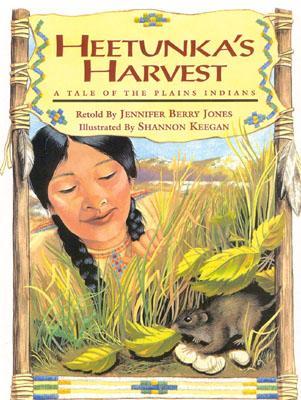
Children's Book Review: Heetunka's Harvest

Heetunka's Harvest: A Tale of the Plains Indians
Retold by Jennifer Berry Jones

I picked this book up from the library's pile of Fall-themed children's books because the mouse was cute.  I usually do a bit of a content preview because there's often either a bit of Jesus or unnecessary violence hiding in this midwestern library's children's section; but I didn't have the time, and so grabbed a couple of titles that looked promising.  Maybe I should do that more often!

This is a wonderful story for any Pagan children, regardless of their cultures or the deities their parents honor.  It is a story about sharing with and caring for nature and the nature spirits all around us; a story about our essential connection to them.

Heetunka is a plains mouse that gathers little white beans every winter.  In the story, a group of Souix Indians come to trade with her in the fall season, leaving corn or suet in place of the beans they take from her storehouse.  One woman, not considering the life of Heetunka, decides to be greedy and take all the beans without leaving anything in trade.  Because of her rash actions and haughty attitude, eventually she is punished by a prairie fire burning the tipi to the ground.

This story has a wonderful message about the interconnctedness of all life, and the importance of being good and kind even to those who seem like they can't do anything to harm us.  There is an end of fall/harvest theme that would work well around Mabon, Samhain or Winterfinding.  One word of warning: there is a brief speech by the woman's husband which came across rather rudely; but as a parent I'm very used to selectively editing stories as I read them.  If this is something you'd like to have an older child read, it may be good to discuss the actions of the husband as inappropriate also.  Otherwise, the book sparked a wonderful discussion between my five year old and I about the web of life, and how our actions affect many other beings that we share our world with.

Saturday, October 19, 2013

U is for Unitarian Universalism

This post has been a long time coming.  For the past eight months, Unitarian Universalism has been a huge part of my spiritual life, but largely unrecognized in my writing.  I'm not an expert, but I've taken enough of the classes to give a good idea of what UU is about; and I also want to share some personal experiences and give an idea of what UU has to offer those of the Pagan persuasion.

Unitarian Universalism is a liberal religious tradition.  It's not a Christian tradition, though there are members who are Christian.  In fact, you could say that about almost any major religious tradition in the world (though the percentages will naturally be smaller) - it's not an Islamic tradition, though there are members who are Muslim.  It's not a Humanist tradition, though there are members who are Atheists and Humanists.  It's not a Pagan tradition, though there are members who are Pagan.

What it is, is a way for people to come together and have a faith community without having to agree on the specifics.  Unitarian Universalist tradition draws from a variety of sources (see here for more info), including "spiritual teachings of earth-centered traditions".  It promotes seven basic principles, though UUs by no means have to agree with all of them - the last of these is "respect for the interdependent web of all existence".  These Pagan principles were added in 1996, after a great deal of debate at the annual General Assembly.

I first began attending my local UU church for two reasons.  First, I want my children to be raised and educated in a diverse religious background.  They have about five different religions in their family anyway; I wanted a faith community that would grow and encourage these differences.  I wanted somewhere with lots of kids, where they could go to Sunday school and feel 'normal', but not be subjected to "Jesus is the only way" propaganda.  Second, I wanted a faith community for myself.  I grew up in a larger church; and while Paganism in its many facets is amazing and I love it, there is a part of me that attends gatherings of 10-20 and wishes there was an entire congregation of people.  I also really enjoy the interactions with different religions - I am somewhat of an amateur student myself, and I am always up for a good religious discussion!

I have found that both of my desires from the UU church are well and truly met.  My local church doesn't have a CUUPS (Covenant of Unitarian Universalist Pagans) chapter, but honestly that's not what I'm there for.  There are a few exclusively-Pagan groups around that I enjoy attending when I want to hang out with just Pagans.  But I really enjoy the diversity and range of belief within Unitarian Universalism.  It's kept me coming back for eight months now, and I think it will keep me coming long into the future.

Friday, October 11, 2013

Zorya Utrennyaya: Sometimes Things Don't Work Out

Sometimes, I get really great ideas that I know must work out just because they're such darn good ideas.  I don't think a lot about how practical these ideas are, or how to go about implementing them, or whether I even have the time or energy to invest.  I dive head-first and don't look back until about two weeks later when I realize that it might not have been such a great idea after all.

My first really big Pagan Fail was with a Slavic Goddess, Zorya Utrennyaya.  I had recently started mapping my ancestry and talking to my grandmother about her family's history, and learned that my German ancestors on that side actually considered themselves Polish, and at various historical points the family land had also been under Russian control.  I don't think that's unusual for that part of the world, but it got me thinking a lot about Slavic culture.  There's not a lot out there on Slavic Paganism that's not in one of the Slavic languages, and in my excitement I wasn't all that interested in resources, anyway.  I decided to just look around at the well-known deities and see if I could find one that clicked.  (Turns out this isn't the best way to honor one's ancestry.  Who knew?)

Zorya Utrennyaya is one of a pair of deities, often referred to collectively as the Zorya.  She is the Goddess of the morning star, who opens the gates for Her father, the son, in the morning.  I've always had a certain affection for the morning star, and so I sort of latched on to Her, ignoring or not bothering to research Her attestations as a Goddess of war and a horse Goddess.  Being a horse goddess is often connected to sovereignty and the dangerous sides of female nature, as compared to a cow goddess who provides for and feeds the people in a more motherly capacity.  And of course, in my mind, being a goddess of the dawn automatically made Her a spring goddess as well, with all those fertility and renewing characteristics!

I held a rather elaborate ritual, crafted to reflect the dawn and spring and flowers and all those fluffy-love-new-life things, and invited Zorya Utrennyaya to be my deity of the occasion.  I spoke to Her about my ancestry and all these wonderful plans I'd made to honor Her just as they would have, and would do so in the future every spring equinox.  It was here that I finally received a "stop it right now" vibe.  I wasn't really sure what to do, but everything was just feeling all wrong.  In ADF Druidry, you typically use some sort of divination towards the end of the right to get a feel for what the deity of the occasion is feeling; I pulled a few runes to see why things were going so badly all of a sudden.  I'm usually a bit of a waffler when interpreting - it could be this, could mean that - but the message was so clear.  "Turn around.  This is not your place".

What?  At the time, I didn't understand at all why things hadn't gone well.  In retrospect, I could have been way more respectful in the way I approached Her; but I think the biggest issue was my conception of Her wasn't at all an accurate reflection of any part of Her.  Of course deities are big and have many 'jobs', but I still get the overwhelming sense that spring-fertility-flowers is not within the provenance of Zorya Utrennyaya.

The story has a happy ending.  I'm not sure if it was a pull from the Saxon deities or a push from the Zorya, but when I'd recovered somewhat from licking my wounds, I picked up Alaric Albertssons's wonderful book Travels Through Middle Earth : The Path of a Saxon Pagan.  My bookmark rested on a page bearing the heading 'Eostre' - who is a dawn goddess, and\ a spring-fertility-flowers goddess as well!  Happily She has been much more receptive to my (much more respectful) overtures.

The lesson learned: when approaching a deity, or any sort of spirit really, take some time to learn about who they really are.  Cross-cultural comparison can be extremely helpful to hard polytheists like me, but we also must remember that the deities most often do not fit perfectly into archetypes (even Proto-Indo-European ones!)