Sunday, November 10, 2013

Crafting the Runes: Rad


Riding seems easy to every warrior while he is indoors
and very courageous to him who traverses the high-roads
on the back of a stout horse.


The above stanza taken from the Anglo-Saxon Rune Poem is one of the more interesting I've read since embarking on this study.  This rune is usually characterized as one of the simpler ones: the translation is "to ride", which often sees it telling of travel, journeys and transportation.  But reading through the various rune poems leads me to believe that this simplicity is rather deceptive.  Consider the Norwegian Rune Poem, which says "Riding is said to be the worst thing for horses", or the Icelandic Rune Poem, which specifically mentions that although "Riding // joy of the horsemen // and speedy journey" it is also "and toil of the steed".

All of these poems have something in common: dual perspectives.  In the Anglo-Saxon, the two perspectives are those of someone indoors, not having to actually face the danger of riding a horse; and that of someone on the back of a horse, taking dangerous roads with a potentially less-than-reliable animal.  The other poems reveal exactly why the horse may be slightly dangerous - while riding can be great for those doing the riding, the animal that has to carry that person is working very hard.

So while this rune is most obviously about travel, riding, and our modes of transportation; I think it's worth considering in a reading that this rune may be trying to show another side to the story.  Consider an outside perspective, perhaps one that is normally overlooked or brushed aside.

Saturday, November 9, 2013

High Holy Day Essay: Samhain

I ended up attending a few more functions put on by Pagans of Nebraska, and it was there that I met fellow ADF member Amber Doty, at the time the only other ADF member in Nebraska. We talked about starting up a group, and it was on the 18th of October that Prairie Shadow Protogrove was born. Our first ritual was held at Samhain. Amber wrote the ritual with a Hellenic hearth culture, and the ritual was focused mainly on the Ancestors. There was a processional between two sticks of incense into the ritual area, held in Amber's large and open backyard. After the processional was a brief meditation, followed by prayers of welcome and offerings to Gaia, the Earth Mother. Offerings were made to the Fire, Well, and Tree, Hermes was called as the Gatekeeper, and there was another brief guided meditation for opening the Gates. The Kindreds were welcomed and offered to. For the main body of the ritual, the participants were invited to talk about their Ancestors; Amber told us about a man named Dale, a friend of hers who had passed on but inspired her to found Prairie Shadow Protogrove. The final offerings were made, a favorable omen was taken, and cider was used as the Waters of Life, held up and blessed by all the Kindred. The Waters were taken around the half-circle that had formed, and poured for each person. The Kindreds were thanked, the Gates were closed with another meditation, Gaia was thanked, and the rite was closed.


 This was my first group ADF rite. While it wasn't without its flaws, most of these were natural to a first-time ritual with any group. The energy was not as present as I had felt in other rituals, but no one was visibly distracted or not paying attention. The Fire had some problems staying lit when several offerings were poured on it in a row, a lesson we took to heart for the next ritual. Honestly, it was so refreshing to be doing ADF ritual, pretty obviously written for a group of people, with an actual group of people! I know there are many solitaries who happily use the Core Order of Ritual, but I could never quite make it feel right for myself - but in a group of 10-12, it seemed that just the right dynamics were present. The energy created by Amber and I's excitement at the group's first ritual was strong enough to overcome the hurdles that we discovered along the way.

W is for Web Ritual

A brief introduction: I am a member of Ár nDraíocht Féin: A Druid Fellowship, a group focusing on recreating (in a modern context) many various religions of ancient Indo-European peoples.  Though it's the largest Druid group in America, until recently (luckily a Protogrove just started in my area!) I haven't been able to attend any rituals with other members.

Luckily for all members outside of driving distance of a Grove, the idea of 'web rituals' was recently talked about on the lists.  Nicholas Egelhoff, a member of the Norse kin (a group within ADF devoted to the Norse pantheon) set up the first 'Druid Moon Ritual' on Google Hangout.  Called the 'Druid Moon Ritual' because of its location on the 6th day of the new moon, about eight people were on video (from different locations!) performing the ritual for a larger group of ADF members.  You can watch the video of the ritual here on youtube.  There were a few technical issues at first (which is why I linked it some 30 minutes in), but overall I felt it was a wonderful success!  The use of more tech-heavy imagery, as well as the invocation of pioneering technology Ancestors, was an amazing touch that really made the ritual work.

Before trying it out, I wasn't sure how to feel about virtual ritual.  On the one hand, coming from a Christian background, I'm used to the notion of believers from around the world being able to 'link together', as it were.  On the other hand, it's a concept I've tried to minimize in my own practice - believing as I do that contact with land spirits is best done on the land, talking to ancestors is best received near their graves, etc; my spirituality is generally more about direct contact than linking energy over great distances.  And yet, once the ritual begun, I largely forgot my misgivings.  The energy did flow.  Though the Kindreds were being invited and sacrificed to many miles from me, I still felt Their presence.

The leaders of the Druid Moon Ritual are hoping to have one each month on the 6th day of the new moon.  If you're interested in watching or participating, you can check out ADF's Google+ page, where I believe more announcements will be made as the time for the next ritual draws nearer.  Personally, I'd like to see as many people as possible - it's a wonderful experience, and I think largely due to its nature, would only become more powerful as more people join in.

Thursday, November 7, 2013

Crafting the Runes: Os


The mouth is the source of all language,
a pillar of wisdom and a comfort to wise men,
a blessing and a joy to every knight.


The Anglo-Saxon rune Os (according to a Wikipedia article which steadfastly refuses to cite its sources!) is one of three Anglo-Saxon runes that split from the Ansuz rune of the Elder Futhark.  Because of the development of vowels in England at the time, the 'a' rune was split into an 'o' sound, an 'æ' sound and an 'a' sound.  If I'm remembering my diction class correctly (which is debatable), the 'o' sounds like the o in 'moat', 'æ' sounds like 'cat' and, and 'a' sounds like the a in 'caller'.  Os is our 'o' rune.

There is also a bit of controversy over the translation of the name of this rune.  I discovered, by googling some of the information in the before-mentioned Wikipedia article with no sources, a lovely volume titled The Anglo-Saxon Minor Poems, Volume 6 by Elliot Van Kirk Dobbie.  One of the poems he analyzes is the Anglo-Saxon rune poem, and his commentary has a great deal of information on the runes, as well as what seems like a wealth of sources - which I am, unfortunately, unable to see with the brief Google Books preview; I'll be ordering it through inter-library loan and will hopefully be able to update with more direct sources soon.

 "The name os, given for this rune by Hickes, is perhaps the Anglo-Saxon word os, "(heathen) god"."  He goes on to say: "In the Iclandic rune poem the rune (in a somewhat different form) stands for óss (or áss), "god," but in the Norwegian rune poem it stands for óss, "river-mouth, estuary."  An alternative translation of the Anglo-Saxon rune name, by Kemble, Archaeologia XXVIII, 340, favored by Dickens and accepted by Keller, Anglia LX, 142, takes os as the Latin noun, "mouth."  This meaning fits better with the [stanza of the Anglo-Saxon rune poem], "source of every language," but no other foreign words are found in the poem as the names of runes."

Given this evidence, I think it is reasonable to discount the Latin translation 'mouth' as a Heathen interpretation of the runes.  I believe that Van Kirk Dobbie is quite correct in his supposition that the name for this rune translates to 'god', especially since the Icelandic rune poem, as noted in the quote, quite specifically mentions it (God // aged Gautr // and prince of Ásgarðr // and lord of Valhalla).  Given the connections we know Woden has to the runes, language, and poetry; I don't think it's outside the realm of possibility that the line "the source of all language" may be referring to Him.  Again considering the Icelandic rune poem, who would be the "lord of Valhalla" but Odin?

Now that we've analyzed the possible translations of Os, it's time to discuss the meaning of this rune and its possible implications in divination.  My take on this is obviously going to be informed by my association of the Anglo-Saxon rune poem's stanza with Woden, so bear with my potentially over-reaching conclusions!  I see this as Woden's rune, much like Tyr is associated with Tiw.  We don't know much about how the Anglo-Saxons viewed Woden, and how those views may have been similar or different to the view of the Norse; and this rune poem was written a few generations off from un-Christianized Heathens.  Nevertheless, I feel this rune's strongest associations are with Woden as a god of language and poetry; a poet's rune.  To me, it would represent creativity, and the struggle that must so often be engaged in to let the creation come to light.

Tuesday, November 5, 2013

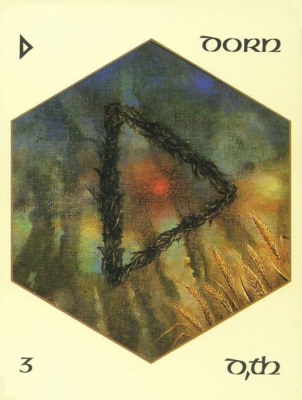
Crafting the Runes: Thorn


The thorn is exceedingly sharp,
an evil thing for any knight to touch,
uncommonly severe on all who sit among them.


Well, my rune crafting and studies are not turning out to be as 'every day' as I intended.  Still, I am plugging away on them, and today I write about the rune Thorn (or Thurisaz, or any number of Germanic variations; I tend to use the Old English names).  As you might expect, the translation is rather simple - Thorn.  The poem above comes from a stanza of the Anglo-Saxon rune poem, which warns of the dangers of this rune.  The third rune in the sequence of the Norwegian and Icelandic rune poems is Giant; it has been speculated (though I cannot find a source for the original speculator) that the Thorn was a metaphor for a Giant.  The Norwegian poem states: "Giant causes anguish to women // misfortune makes few men cheerful", while the Icelandic poem elaborates further: "torturer of women // and cliff-dweller // and husband of a giantess".

I am currently reading Kveldulf Gundarsson's Elves, Wights and Trolls; which is a fantastic study on various supernatural beings from a Germanic perspective; and he noted the definition of giant as "husband of a giantess".  He speculates, with more supporting evidence that I can't recall at the moment (just go read the book, it's fantastic!) that giantesses were viewed as more wild, more primal than even their male counterparts.  This gives rise to an interesting idea: if Thorn is a metaphor for a male giant specifically, than it represents a dangerous warning that may yet lead to an even greater, more chaotic danger.

Altogether, it is fairly obvious that this is a rune of danger, and a bad omen.  Not a rune I'd like to pull very often!

Monday, November 4, 2013

Samhain with Prairie Shadow Protogrove, ADF

Photo by Shanda Hahn Kinkade
The day was clear and warm-ish, and the space for our ritual was huge and green, covered with a smattering of fallen autumn leaves.  It really was the best possible setting one could want for a Samhain ritual in Nebraska.  I'd met Amber, the Protogrove founder, a few times before at various places around town, and a little meet-and-greet held at her house a few weeks beforehand.  I don't think I've ever met anyone so passionate about an organization and a community as she is.  When I arrived at her house a few hours before the ritual, she was bringing out tables to be used as altars and a giant tote full of offerings, decorations, and various other ritual necessities.  In the next few hours we did some cooking (as my clumsy self destroyed her kitchen!) and lots of set-up as her husband built the fire we'd be using.  Others began to arrive, and a community was being built.

Photo by Shanda Hahn Kinkade
Prairie Shadow Protogrove is a brand-new group, the first official branch of ADF in Nebraska.  The ritual we were setting up for was the very first: a new beginning in a season usually thought of for its endings.  A smattering of people from the local Pagan community attended - including some friends from Nebraska Heathens United - one person drove in from out of state, and another nearby ADF member came out to join us.  The ritual was Hellenic, inviting Hestia and Gaea, and Hermes as our gatekeeper.  I've always had a soft spot in my heart for Hestia, and was especially happy to welcome the Goddess of hearth and home to help build and strengthen our little community.  For the main body of the ritual, we honored our ancestors of blood, land, and hearth - Amber spoke about her old friend Dale, and how he had once inspired her to begin a Druid group here in Nebraska; Prairie Shadow Protogrove, named after his old production company, is the realization of a dream they shared years ago.  There were some others in attendance who had known him also; even though I never knew him, the outpouring of emotion and memories of him was so strong I was brought to tears.  It was my job to pull the omen, asking the Kindreds if our offerings were accepted and what blessings they would give to us in return.  I pulled the King of Cups (the outpouring of love and remembrance for Dale was most pleasing), and the Nine of Cups, showing a content man with all he had ever wanted; the Kindreds gifted us with blessings of happiness and contentment in our lives.  We passed out the waters of life (or the cider of life, in this case!), drank deeply, and thanked all those who had come.  For a first foray into ritual, Prairie Shadow Protogrove did quite well!

After ritual, we had a potluck and lots of community-building.  Watching some friends I'd gotten to know recently meet one another was amazing, and getting to know some new faces was perhaps the best part!  I'm always up for a good religious conversation - especially when my husband gets tired of listening to me enumerate the differences between the Morrigan and Macha - and there was plenty to be had.  I honestly couldn't have been happier with how the day went, and couldn't be more thankful to everyone who helped put it together - setting up, writing liturgy, or simply bringing their presence.  It was an amazing day, and a wonderful start to what will hopefully be a long tradition for Prairie Shadow Protogrove.

Sunday, November 3, 2013

Family Samhain Adventure


I was reading an interesting post this week on the nature of Samhain, and its two-fold nature.  The night of Halloween, the author proposes, is about local community; with all the kids out trick-or-treating.  Samhain itself, the day of November 1st, is about the historical community - those who have passed on.  My family and I have celebrated in this way for the past three years or so, but I've never quite been able to articulate how trick-or-treating is related to my religious practices!

Walking around the neighborhood on the 31st, we get to see many neighbors that rarely get more than a passing 'hello' through the rest of the year.  There were several of my oldest daughter's classmates walking around this year, and many parents that I had talked to waiting to pick her up from school.  It really was a night where the local community came together to create fun for all of the children.

The next day, November 1st, we woke up early to gather offerings for our ancestors.  In past years, I've made bits of pie for my women ancestors (big pie makers!) and brought tobacco for the men; but this year my middle daughter insisted that we make and bring cookies!  With my recipe book (with the family recipe for the best chocolate chip cookies ever) still in a box somewhere, we instead made sugar cookies - a big Christmas tradition in my family.  Since the weather was so beautiful this year, we made it out to three different places and honored many of our ancestors: my grandfather-in-law, my great-grandparents and their siblings, and we even managed to find the graves of my great-great-great grandparents who came over from Germany with their young son in the 1800s.  At each of these places, we would sit for a while, offering the ancestors cookies and water (too many alcoholics in my family to bring anything harder), and talk about memories of them - and in the case of those more distant in time, things I had learned about them and how they are related to us.  I was so pleased this year when I began telling a story about my great-grandpa and my oldest remembered it exactly, and was able to finish the story for her younger siblings.  It really hit home at that moment that I am creating a tradition - that part of the job of first-generation Pagan parents is creating a tradition.  I can talk about tribal ways and the deep love and loyalty for family until I'm blue in the face; but my children are really learning it through the traditions and actions that I'm passing down to them.  Even if they grow up to find another religion - and, realistically, they probably won't be Heathens or Druids as adults - they will remember the stories.  They will remember where they came from, and how it is such a large part of who they are.  Even if they don't grow up to worship Thunor or Brigid, they may still come in the fall to put flowers on the graves of their ancestors, and tell their children the stories.