Friday, February 20, 2015

Ritual is Ritual

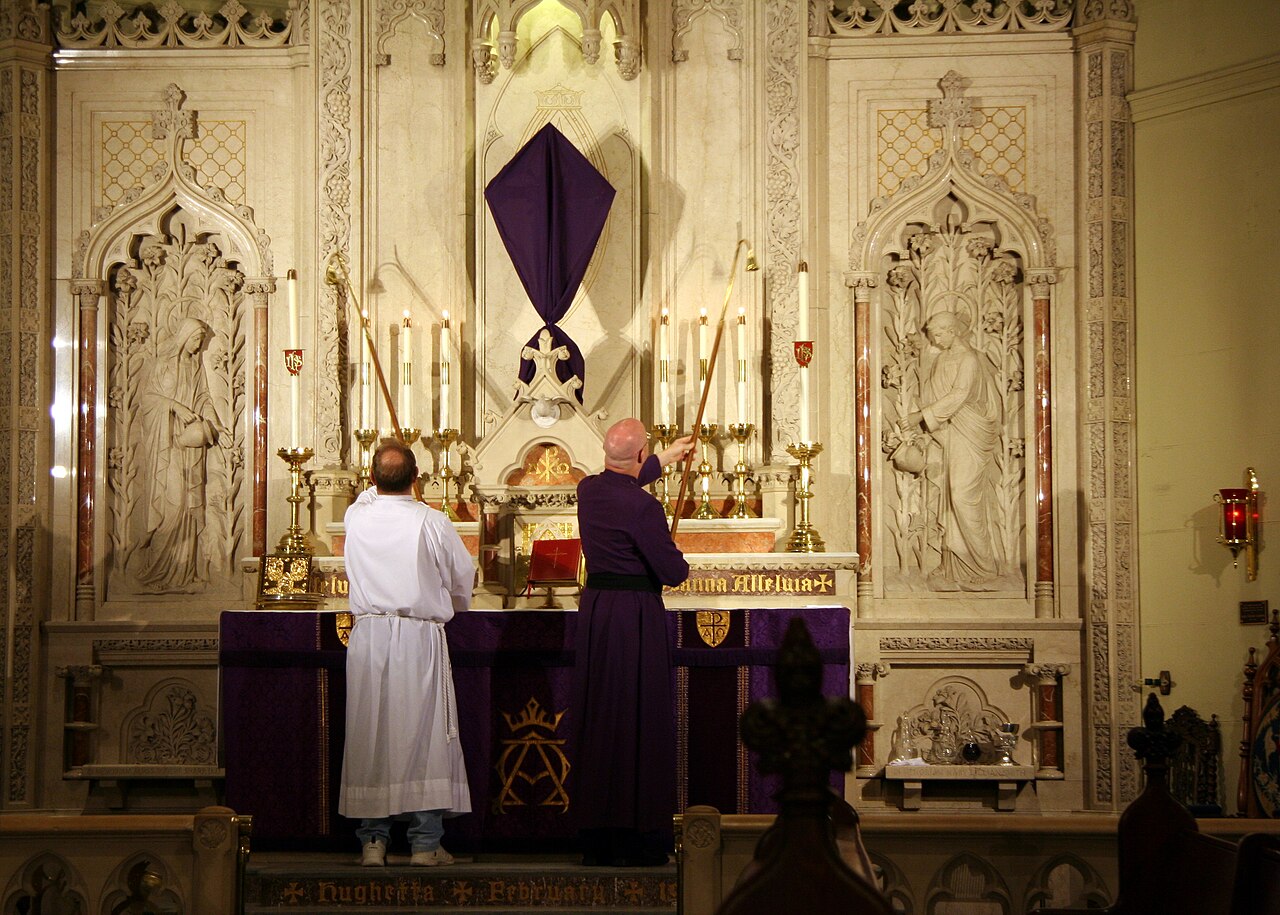
"AshWednesdayAltar" by Jonathunder 
This is going to sound strange, but - I just love Catholic mass.  I was raised in an Evangelical household but I attended Catholic school for four years, including mass every morning.  I can unequivocally place my love of elaborate ritual at the foot of that Catholic church.  The Stations of the Cross, the Candlemass throat-blessing, even the tinkling bells that rang out when the bread was supposedly being changed into the body of Christ - I loved them all.  Now, dogma wise I completely disagreed with the church and still do, but in my opinion that doesn't make the way they do ritual any less beautiful.

I think my favorite of all was Ash Wednesday.  The entire church processes forward (even those that aren't Catholic) and is marked with the ashes of last year's celebratory palms, as the priest intones "From dust you are made, and to dust you shall return."  I have always loved that phrase.  Usually read at funerals and on solemn church days, it has nonetheless always seemed lively to me.  Rather than an ominous proposition, it was a reminder of who I was - where I came from and where I was going.  As with all living things, I was made of and sustained by the cool soil beneath my feet; and when it came time for me to die, I would become part of that magnificent giver of life once again.  The phrase affirmed my place in the huge expanse of everything that is the earth.

I've written here before about being raised in a tradition other than Paganism, and how important I think it is to honor the words and ideas that first inflamed my passion for the spiritual.  I'm not interested in being a Christian with a Pagan veneer (honestly I feel like that ship sailed a long, long time ago for me) but I also don't want to toss out the baby with the bathwater.  Ian Corrigan has a wonderful Yule ritual over on the ADF website that perfectly mirrors the Tenebrae rite practiced in some churches on Good Friday - all candles are slowly extinguished but for one, which is used to relight all the others and bring light back into the world.  I love that sentiment, the power of the darkness and the returning of the light, and I've used a modified version of that ritual in my own Grove's Yule celebrations.  I'm so thankful that we as Pagans don't have to throw it out because of its association with a Christian ritual.

Wednesday, February 18, 2015

Februalia with Prairie Shadow Protogrove

 I haven't written about most of the group rituals I've participated in lately - it was a requirement for the Dedicant's Path, but since I've finished that bit up it's fallen to the wayside.  I feel like I should, though.  I know before I started being a social Pagan I googled the groups in my area; and there was not a lot of information out there.  For most, there just a listing on Witchvox and, if I was lucky, a public ritual schedule.  Just in case anyone is googling Prairie Shadow Protogrove (or Prairie Shadow Grove!), hopefully I'll have summaries of recent rituals that will give you an idea of what to expect.

As an ADF Grove, we perform rituals near each of the High Days (more commonly known as the Wheel of the Year).  Since we are a pan-Indo-European group though, these rituals aren't always what you'd expect.  This February, we celebrated a Roman rite called Februalia - a festival of purification.  It was written by our resident expert on all things Roman and Greek, Senior Druid Amber Doty.  We celebrated Februus, the patron of the festival, as our deity of occasion; and invited Janus and Hestia as well.  The purification portion of the ritual particularly spoke to me - I had a frightening encounter earlier that week, and being able to wash that feeling away was absolutely a blessing.  All in all, it was a fantastic ritual, and I couldn't be more appreciative of what Amber has done in building this grove!

Sunday, February 15, 2015

Tea Time with my Ancestors

Each month, The Pagan Experience devotes one week to writing about 'deities and divinity'.  I feel it's important for me to not only write about my Gods, but also the other divinities that I honor.  For me as a Heathen, the Gods are of course a big deal.  But the spirits I feel closest to, in a more intimate, familiar way, are the land wights and my ancestors.  For me, the Gods often need to be called, welcomed into my home and heart.  But my ancestors?  They're already there - have always been there.  They are just as much family as my brothers or my children.

For quite awhile now, I've been following the old tradition of leaving a bit of the family meal out for the ancestors.  My husband is an atheist and slightly uncomfortable around religious rituals, so the plate isn't left on the table.  Instead, I make a point of placing it on my altar before sitting down to dinner.  This lacks a feeling of 'sharing' though - as if I've sent part of the family to their room and am serving them there.

Recently I've begun making tea for myself in the morning.  It's cold
outside, and the hot beverage is awesome - but I've found that few minutes of time to myself while I watch the water boil is just as valuable.  It occurred to me a few weeks ago that this was a fantastic ritual to share with my ancestors.  I pour the tea into two cups, one to place on my altar.  As I wait for mine to cool, I welcome my beloved dead and offer them the drink.  Then I will stand for awhile, sipping my tea, looking at their pictures and belongings - remembering their stories, their voices.  It's such a strong moment of communion, one in which I can completely focus on something I really care about.  It's calming and almost meditative, a quiet moment when the spirits speak to me through memories.

Friday, February 13, 2015

Divining with the Deities (or any of the Kindred!)

Ancient runestone from Sweden
via Creative Commons
I have been practicing divination for a long time now.  I made my own set of "clow cards" (yes, it was a tv show for little girls, and yes, in the absence of anything else occult, I totally lapped it up) at age twelve, staring at the beautiful art and assigning fairly arbitrary meanings.  It wasn't until I moved out of my mother's house at sixteen that I was able to get my hands on an actual set of tarot cards, but it became something of an obsession after that.  I've learned a lot of different methods, have participated endlessly in the assigned meanings vs. intuition debate (I fall somewhere in between), and even spent two years as an email tarot reader.

But now, I'm trying something new.  When Prairie Shadow Protogrove started up, I was usually designated the Seer during ritual since I had more experience with divination systems.  Actually contacting the Kindred through divination was a very new experience for me, and honestly it was also pretty overwhelming.  I'm not as adept at hearing Their voices or receiving inspiration than others, and I'm afraid the Omen portion of those rituals may fallen rather flat.  I also don't do a whole lot of personal divination anymore; it's difficult to find the time and proper concentration with three little ones running around.

That's something that needs to change for me.  After receiving a rather scary sign in my own home, a friend prodded me to look into it further via divination.  At first I wasn't really sure who to go to with my request - I like to use the runes nowadays, but Odhinn and I have a rocky relationship at best.  Most of my offerings these days go to the Vanic deities.  So eventually I mustered the courage and offered some honey to Freya, asking for some answers to the lingering questions the event had left.  The runes aren't Her favorite (my UPG), but She was helpful enough in answering my questions.

It's a powerful experience, communicating with a deity.  After I was told that Frey was the source of the omen I received, I made offerings to Him and asked some pointed questions - things like "why'd you have to scare me so darn bad?"  The answer I received?  "I am a God, vast and more powerful than you can conceive - that the functions of nature scare you isn't really my concern."  Now, this is the type of answer I would expect from Nerthus, and a feeling I've gotten from Her many times.  But Frey has always seemed so friendly and jovial.  In my efforts to find the answers to my questions, I'd forgotten what an amazing thing was already taking place right there on my porch.  It shook me up almost as much as the original sign had.

I'm about ready to finish up my Dedicant's Path for ADF - I've submitted the work, but have some revisions to do before I can be approved.  I'm thinking about moving forward on the Initiate's Path, a guided journey designed to deepen one's inner connection with the Kindred.  One of the classes is Divination 1, where daily draws and journaling are heavily encouraged.  I think this is something I'd like to start pursuing even now.  When communication becomes too one-sided, strange things start happening - including scary omens that show up in houses.  It's time for me to open the door.

Sunday, February 8, 2015

Week 6: The Earth is Full of Life


Ah, the earth.  Is there anything more ubiquitous in modern Paganism?  Many, if not most, Pagans will use terms like 'earth-centered' or 'nature honoring' to describe their religion or practice; and those who do not usually make a point of letting people know since it's such a common assumption.  I also identify as having an earth-centered spiritual path; but this means something a bit different to me than many Pagans.

Rather than a pantheistic view of the earth as mother-of-all, all-encompassing Goddess, my idea of honoring the earth is a recognition of the incredibly varied tapestry of spirits that dwell on and within it.  The Goddess I am dedicated to, Nerthus, is typically described as an earth mother; but this is not the best descriptor for Her.  She is not found in all places with dirt, or indoors, without being called or welcomed there.  I also honor other deities with ties to the earth or planting and cultivation: Freyr, Gerda, Gefjon, and others.

In addition to the deities, there is a whole world of spirits to welcome and build relationships with.  The altar I've built in my garden specifically honors a tree Goddess, while also acting as a shrine for many of the land wights - earthworms, squirrels, tree spirits, the local river Goddess, etc.  These relationships make up a huge part of my personal spiritual practice, forming the backbone of how I relate to the world around me.  Learning to identify each individual voice in the chorus of wights that make up the land around me was a huge challenge as I moved from a pantheistic worldview to a more animistic one, but it was a challenge that broadened my spiritual horizons hugely.

As I prepare to plant my garden this spring, I also continue to build relationship with the many wights that dwell in and pass through this land.  It's a blend of the concept of getting out and experiencing the land and spiritual appreciation of the many beings that share this home with me.  The earth is alive with many spirits, many stories, many personalities that are all worthy of attention.

Sunday, February 1, 2015

Week 5: Humanity is Community

Pagan Pride 2014
I've been thinking about this post topic a lot.  Humanity is not something I think a lot about when I think about my religion.  I write prayers and give offerings to the spirits, I research and meditate on their natures - they're generally the center of my spirituality.

There's a few Heathens out there that will tell you Heathenry is entirely about culture, that if you're not raised German or Swedish or in some other Germanic culture, you're out of luck.  You just don't have the cultural reference to be a Heathen.  Now, I tend to think that is just plain wrong.  But it does occur to me that the 'human' side of my practice is something I don't think about because it comes so naturally to me.  It is part of who I am, how I was raised - but that doesn't make it any less a part of my religion.

I am involved in a lot of groups locally.  I hang with the Wiccans three or four times a month, I plan and lead rituals with the Druids, I'm always there for a sumbel with the Heathens (if the kids aren't sick!).  I do a lot to help these groups function - and they do a lot for me too.  Having a large group of friends, a circle of people that I can count on and call on if something goes wrong, has positively impacted my life in so many ways.  It's also not something that I'm used to; I'm usually a bit of a loner.  I haven't really had friends of my own since I left college almost eight years ago.

In ancient Heathen culture, the giving of gifts and the reciprocity of these gifts was essential both to spiritual practice and to everyday life with those close to you.  Exchanging gifts established a relationship.  This is something I've practiced with the spirits for a long time, but it was only after entering into my community and giving of my time and talents that I realized how deep and profound a relationship it brings to people as well.  It certainly doesn't have to be with fellow Heathens, either!  Joining a group, making an active contribution and receiving fellowship and service in return can be a profound human experience - and also inherently religious.

Wednesday, January 28, 2015

Cauldron Blog Project: Doorways

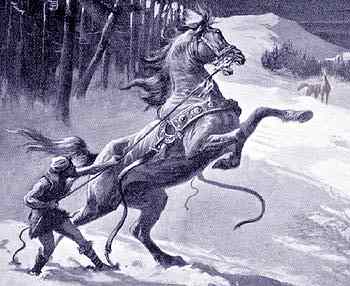
Loki and Svadilfari by Dorothy Hardy
public domain
I've never been a Roman recon or honored any deities originating farther south than Germany and England, but I must admit I'm a little obsessed with Janus and everything that He represents.  A deity just for doorways?  Weird.  And awesome.  Boundaries, and the thresholds where these boundaries meet, is a recurring theme in Indo-European lore and mythology.  Both Celtic and Germanic sources speak of rituals where people parade objects around the boundary of farmland, of the home, of the town, to bless these spaces.  Establishing the boundary is seen as a sacred act.

I often wonder about the implications of these rituals when considering the story of the walling of Asgard.  Told in the Gylfaginning of the Prose Edda and the Völuspá of the Poetic Edda, the tale recounts a giant who comes to Asgard, offering to build an impenetrable wall around it in exchange for the hand of Freya, and the sun and the moon.  The Gods give him a time limit that seems impossible, but the giant comes close to completing his task.  Loki is sent to stop him and succeeds - and for the giant's "failure", Thor kills him with his hammer.  Of course, that's a very concise version, but it's the very beginning that's of interest to me.

The being that walls and encircles Asgard, certainly a holy and protective function, is not one of the Aesir.  The threshold of the home of the Gods is not established by its inhabitants or a sacred, appointed spirit - instead, it is built by a giant, a member of the apparent "savage" race that the Gods are trying to keep out.  There's no evidence either here or in later writings that the giant is attempting to trick the Aesir with shoddy building or a hidden door so he can later attack - he is the honorable one in this exchange, serving a sacred function for the Gods who unfortunately prove themselves unworthy.

Another Jotun, a giantess named Gerd, is said to have later married the God Frey and is listed by Snorri as one of the Asynjur.  The etomology of Her name is an interesting one, with many concluding it means either 'walled field' or that it simply denotes the action of walling (from Rudolf Simek's Dictionary of Northern Mythology).  How fascinating that She also is so linked to this bounding of space, separating the inside from the outside, while She is really a product of both.  While of course I honor Gerd in my garden, I see Her also as a deity of these boundaries, and I offer to Her when I ward my doorways and the edges of my land.

It's clear that doorways and boundaries were very important to the ancient Indo-European peoples.  How interesting that two spirits strongly associated with these boundaries are giants, so often overlooked or pushed aside in modern Heathenry.