Showing posts with label Hredmonath. Show all posts

Sunday, March 15, 2015

When UPG Trumps the Lore: Hreda

Via Creative Commons
This is the month when many Anglo-Saxon Heathens (and many Pagans in general) focus on Eostre, and so I thought I'd be a bit stubborn and write about a deity associated with March by the Venerable Bede.  I've written about Her before, covering most of the lore and speculation that's available to us at this time, and I've lamented its utter incompleteness.  How is it that Eostre, with basically the same amount of information relating to Her, became such a central figure in the Pagan springtime festivities while it's difficult to find even Heathens who know who Hreda is?

My personal opinion is that Eostre's associations just are easier to understand for us in English-speaking, Christian-heritage countries.  Everyone in this culture knows Easter and all that it entails, and since the Goddess Herself lent Her name to the festival - the connections are readily made.  Hreda has no such similar festival, no cultural markers that I'm aware of to lend Her importance in our modern age.  But that doesn't mean She's not there, waiting.

My devotional relationship with Hreda has been something of an experiment for me.  I'm usually pretty hidebound when it comes to matters of lore; I'll build a practice up around it using some UPG, but in matters of disagreement?  The lore wins hands down.  It's one method I use as a check and balance.  But for Hreda, we have less information than even Nerthus; only a possible etymology, and even those are conflicting.  Is it 'swift', 'glory', or 'victorious' - each of these have such different implications as to the kind of deity She could be.  And maybe the etymology matters not at all, and it's just a name unrelated to Her function or areas of interest.  We just don't know.

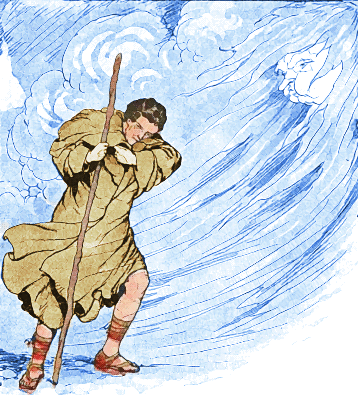
And so I reached out to Her.  This has been going on for a few years now; Her presence is certainly strongest for me in March, so that's when I get my best ideas of Her.  Each year, consistently, I find Her in the wind that drives out the winter.  All of a sudden, around this time of year, the winds start shifting.  Instead of howling out of the north biting cold, they begin to blow up from the south.  They are no more gentle - in fact, often the winds are strongest this time of year.  But the southern winds don't carry snow and ice; they tend to drive away the clouds so that ever-earlier rising sun can shine down on the land.  To me, these winds are a manifestation of Hreda.  She is swift.  She is victorious (eventually!).  She drives away the clouds to reveal the glory of the light. 

Every time I think of Her, I am reminded of a particular statue that I loved in my art history class, The Winged Victory of Samothrace.  I am not a Hellenist and don't know the story behind the statue, but when I think of Hreda it is forcibly brought to my mind.  The way She stands, leaning into the wind, the raggedness of Her clothes and feathered wings - She fights a long battle, but She is not cowed.  She is Victory.

Just to be clear - there is absolutely no indication in the lore that Hreda is this kind of deity.  I don't know much about British weather, but I think this time of year is usually much more mild than it is on the plains of the Midwest, so it doesn't even hold up historically.  I don't care.  I have been reaching out, making offerings, honoring Hreda for three years now; and this is how She comes to me.  I won't argue with anyone over their personal interpretation of Her.  At this point, I'm not really up for arguing with anyone over my interpretation of Her.  She is who She is to me, and I could not be more grateful for the gifts She brings and Her influence in my life.

Monday, March 24, 2014

Hreda and the Month of March

Public Domain
The Venerable Bede, an English monk and scholar writing in the 8th century, leaves us a very incomplete, but helpful picture of the Anglo-Saxon ritual year.  One such celebration is Solmonath (Solmōnaþ), roughly equivalent to the month of February, when cakes were offered to the Gods.  I find it reasonable to assume, based on the Æcerbot where cakes are offered to the earth in exchange for growth and fertility of the crops, that the deity honored in the rituals of Solmonath was the Anglo-Saxon idea of the earth mother Goddess.  Bede also mentions two deities of the Anglo-Saxons by name: Rheda (a Latinized form of the word Hrêða) and Eostre, from the month names Rhedmonath and Eosturmonath (Ēostermōnaþ).  Eostre is a fairly popular Pagan deity nowadays, and I've written about Her before; but I'd like to dedicate at least one post this month to Hreda (or Hretha) - the much less popular Goddess of March.

Bede tells us little besides that the month of March is named for Her.  Some modern Heathens identify Her with Hertha, a deity similar to Nerthus attested in northern Germany, but I feel that the linguistic links between them are tenuous.  Also, since I honor the Earthy Mother deity of the Anglo-Saxons during February, my personal UPG is that Hreda is a different sort of being - though not completely dissimilar, as we see with Eostre, who is still very much a deity of growth and spring.  Hreda's name can be linked to a few Anglo-Saxon words: primarily 'glory', 'victorious', and 'swift'.  Philip Shaw, in his book Pagan Goddesses in the Early Germanic World: Eostre, Hreda, and the Cult of the Matrons, argues that Hreda is the matron of a specific kin group.

Lately I've been thinking about the Christian idea of Lent, which often coincides with much of our modern March.  The word Lent comes from the Anglo-Saxon 'lencten', which means spring.  It's been speculated that Lent, a traditional period of fasting before the Christian Easter, was a natural result of the food shortage at the end of winter and beginning of spring - when supplies were running out, and milk from the ewes was often all people had to sustain them.  It seems possible that Hreda, a victorious and glorious deity, was associated with this lean time with the purpose of Her eventually triumphing over the difficulties and ushering in a more prosperous time of year.

I was born in the month of March, and have always had a certain affinity with the strange weather that can happen in the midwestern US at this time of year.  The wind is said to roar like a lion, and temperatures can fluctuate wildly: from beautiful balmy days to heavy dumps of snow.  Hreda comes to me in the weather of my own country, different as it may be from Britain's; I see Her primarily as the late winter/early spring wind that can be so powerful here.  She too roars.  Eventually all that blustering wind blows in warmer weather, just as Hreda ushers in Eostre as the months continue to turn.

There is so little concrete information on this Goddess, I feel there are few wrong ways to honor Her.  However She chooses to manifest in a person's life, I do think it is important to continue to offer to this lesser-known Goddess, who was obviously important enough to the Anglo-Saxons that an entire month was named for Her.  This weekend is the full moon, when I choose to observe the mid-point of the Anglo-Saxon months and also their festivals; so this weekend I will be doing a ritual in honor of Hreda.  I've written a  prayer that incorporates mostly my UPG surrounding Her (how could it not, given the lack of information), feel free to use it or modify it to better reflect your own experience of the Goddess of March.

Hreda, Goddess of March,
roaring lion and swift wind.
Drive out the snow
and bring the shining sun,
the glorious warmth of spring.
That the plants may grow,
that animals may mate,
that life may wake from the land.

Francesco La Barbera
Creative Commons license