Showing posts with label musings. Show all posts

Sunday, April 19, 2015

Nature Spirits, Nerthus, and Celebrating Earth Day

photo by David Luther Thomas
creative commons license
What does Earth Day mean to you as a Pagan?  For me, Earth Day (and its constant Nebraskan companion, Arbor Day) is a secular holiday that nonetheless holds a great deal of religious meaning.  I hate to say things like "the nature spirits are the most important part of my practice" because of course my ancestors and the deities are also incredibly important.  But the land wights are certainly more present in my day-to-day life.  Just looking out my windows, walking my daughter to school, or even driving down the street on my way to work, I encounter hundreds of them, and there's no ignoring it.  People who would never think to discuss their God(s) or ancestors will comment often on the weather, the flowers, etc.  We are always thinking about our fellow earth-dwellers, all the time.

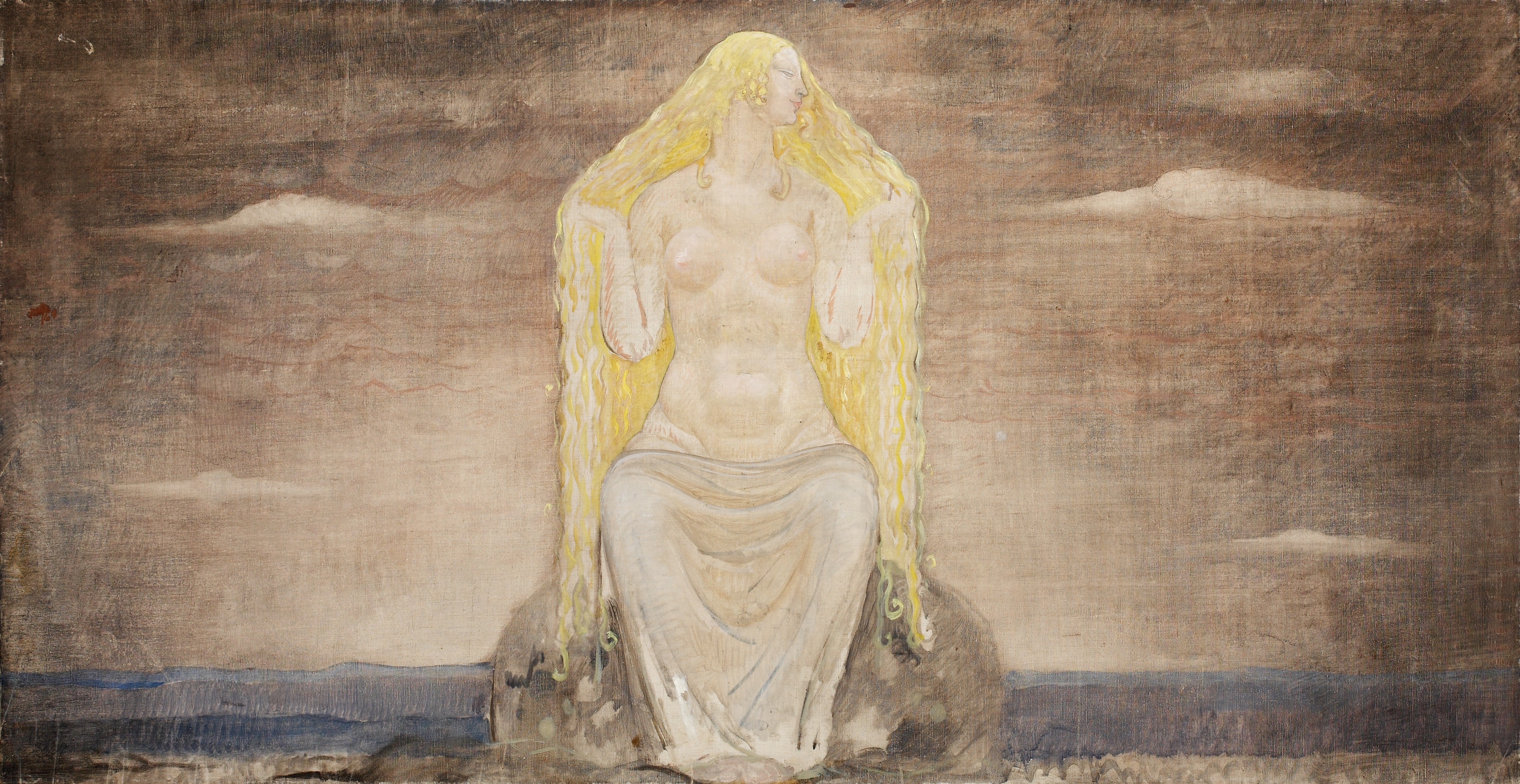
This is a ritual I wrote to celebrate the Germanic Goddess of the Earth, Nerthus.  I have written about Her before, a relatively 'dark' mother Goddess who allegedly received human sacrifice after parading about the land bestowing Her bounty.  Of course I am Her devotee and fairly biased, but I believe that as the earth becomes more and more damaged by human actions, more people will begin to see the darker side of the land.  I find it powerful and motivating to stand in awe of Her, not motivated by love or trust; but sometimes by genuine fear.  In my mind, it is She who sustains all life, and if She so chose could end that sustenance at any time.  She is truly awe-worthy.  It is my hope that this Earth Day ritual captures some of that wonder.

There are a few rituals for Nerthus out there, most centering on the journey of Her wagon bringing peace and feasting to every village She visited.  Since this is an Earth Day ritual, however, I find it more appropriate to focus on the things I can do for Nerthus, rather than parading Her about and asking Her blessings on the people who hold partial responsibility for the damage done to the land.

Set up a small shrine out of doors; in your backyard, a local park, or wherever you can be relatively assured of solitude.  If absolutely necessary this can be done indoors as well, be sure to face a window or have some reminder of your local land available.

Needed items:
Representation of Nerthus - something as simple as a bowl of water to represent Her lake will work
Found objects from the land to decorate shrine - my permanent shrine has dried leaves and twigs from each tree in my yard, as well as feathers and other found things; this is a good place to start if you're not sure what to use
Offerings for Nerthus and land wights - I often use birdseed or dried corn, but anything that does not
actively harm the land would probably be acceptable

Plans for an Earth Day activity to help the Earth

Approach the shrine, calling out:
"I call to all the spirits of this land:
the dancing wights of stream and creek,
the swaying spirits of the trees,
the singing grasses played by the wind.
I call to the stones, solid and stoic,
to the dark and fertile earth beneath my feet,
to the flowers that fly open and fade away.
I call to the furred spirits, waiting for twilight,
the feathered wights that serenade the dawn,
the tiny crawling beings, spirits of scales and slick skin,
to all the spirits of this land.
Be welcome and pray welcome me.
Accept this offering!"
Scatter or place offerings for the wights before the shrine.

Bending or sitting as you are able, place your hands upon the earth.
"Hail Nerthus, veiled Goddess,
dark and silent in your sacred grove,
hiding your eyes from the hurt of the Earth.
Vibrant with life, shining with death,
keeper of the never-ending circles all things dwell within,
green that grows from dark decay.
I see the broken land, I work to right it;
join your power to mine, and bring life from this death,
lend your aid to me and mine as we heal the hurts."
Scatter or place offerings to Nerthus before the shrine.

This is a great time to actually do some kind of service to the Earth - perhaps going around picking up trash, planting a tree, or any other activity you may have planned for Earth Day.  If you are not able to do it right away, simply tell the spirits what you plan to do in service to the cause of helping the land.

"Hail to Nerthus, sweet mother of earth,
and all the wights that dwell here in this place.
I thank you for your gifts of sustenance, gifts of beauty.
Remember me as I will remember you.
Hail and farewell!"

The found objects should be left to continue to give beauty to this piece of land, unless you feel one is meant to come home with you.


Sunday, April 12, 2015

In Defense of Formal Ritual

Online, I run in a lot of circles that are very informal in their ideas of ritual and honoring the deities.  I mostly talk to Vanatru folks and read their blogs, and as a group they tend to be more off-the-cuff and extemporaneous in their words and actions.  I do a lot of this as well - my morning ancestor offering is a cup of tea and a quiet moment of contemplation, and the nature spirits usually are tossed some birdseed with few flowery words.  But I also have some moments of my day that are very formalized: when I first rise and greet the sun in the morning, I say the same prayer every day, in the same stance.  My bigger celebrations tend to vary; some holidays are just what I feel up to that day, and some are highly formalized.  It's those I'd like to talk about today.

Formal ritual gets talked down about in parts of the Pagan community; there are people who believe that prescribed actions and words make it very difficult, if not impossible, to connect with the spirits or deities one is calling to.  While I'm not opposed to informal ritual - obviously, since it makes up a decent chunk of my practice - I believe that it doesn't have the same energy or impact as formal ritual, and doesn't allow the same sort of experimentation that working within a structure can offer.

I express my Heathenry first and foremost through the model of ADF Druidry, which sounds a bit ironic, but actually works very well for me.  ADF is a pan-Indo-European organization, which means the Heathen Gods fit squarely in its purview.  The unifying factor in ADF is its conception and framework for ritual - it is the same framework for all groups, everywhere there is an ADF Grove.  That structure is loose enough to allow many Indo-European pantheons to work within it (there are Heathen, Hellenic, and Vedic ADF Druids.. and more cultures that are less common!) and yet structured enough that it's easy to recognize an ADF-style rite once you're familiar with the Core Order of Ritual.  I have been working within this structure for more than three years now.  At first, I loved the Core Order because it made things easier for me.  I didn't have to plan an entire ritual, I just had to write prayers to fit the appropriate parts and everything was ready to go.  After working in this framework for years, I love the Core Order because the formality of it, the structure it provides, has freed me in so many ways.  It's like a heartfelt song to which I know all the lyrics and can belt at the top of my lungs, instead of meekly stumbling along and cringing every time I get a word wrong.  Even when doing informal, small ritual, the Core Order in a very condensed form comes naturally to me - invite the spirits, give them offerings, ask for or thank for blessings, and bid the spirits farewell.  This structure has given me a ritual mindset to operate in that ultimately has made my rituals more effective and easier for me to slip into.  Like tarot decks with their defined structure but endless variations, ritual is easier to understand when it's similar each time.

Of course, everyone is different and not all people will benefit from a formal structure or way of doing ritual.  But I believe it can be a powerful tool, and one that many Pagans may be overlooking.  It doesn't have to be "call the elements, cast a circle" and it doesn't have to be ADF's Core Order either.  I do think it can be a good learning experience to just pick a format and stick with it for awhile, even if it doesn't seem to resonate at first; you never know what will come out of that structure after you've become completely comfortable with it.

Sunday, April 5, 2015

River Goddesses, Water of the Earth, and Local Cultus

Platte River by Jetuusp, Creative Commons License
This week's topic for the Pagan Experience is Water.  I'm sure I'll get to read quite a few posts on Monday about the element of Water in a Wiccan or Neo-Wiccan context, and I'll enjoy them - but I've come to the point where it's not really relevant to my practice at all.  Rather than the overarching idea of Water as a being or spirit that encompasses all that is wet in the world, I have instead begun honoring many local spirits.  They are certainly related to water, but that is not all that they are.

The first is my river Goddess, the lady of the Platte River that spreads brown and wide across the prairie.  She extends Her tendrils into hundreds, maybe thousands of tributaries across the land where I live, and as a child I grew up near and found refuge in several of them.  She has been with me nearly all the days of my life.  I understand Her as the life-bringer to our dry land; farmers use Her water for irrigation for their crops, so much so that Her volume is much lower today than it was before mass European immigration.  In this way, Her giving of life is a very real and visceral thing - it is not an endless resource to bestow on all, but instead as we use this precious water, it directly takes away from Her vitality and the habitat of all who dwell in Her ecosystem.  Part of my work in honoring Her is educating the future generations that I work with about good water management practices, and how the river contributes to the entire ecosystem that we must live within.  I also make it a point to visit one of Her tributaries (it is just across the street from me) and leave an offering once a week - something biodegradable, that will hopefully aid the river and its life.

The second great spirit of water that I recognize is the Ogallala Aquifer.  This is a huge lake that spans many of the midwestern states, located far underground.  I don't have any direct experience with this water (other than drinking only well-water for several years of my life, which of course came directly from that source), but it is a place and a spirit that I frequently visit in my meditations.  From my experiences there, this is a deeply ancient spirit, dark and cold and clear where the Platte is warm and brown with sunshine.  Being deep under the earth, it is a place where nothing grows, where nothing lives - an old, old spirit of water surrounded by even older rocks for many years.  Its personality seems to be equally as different from my river Goddess.  I haven't ever gotten a feeling of gender from this spirit.  It seems to be outside of those kinds of concerns of things that live and breathe on the surface of the earth, where life comes and is gone in the blink of an eye.  It can be deeply hostile - the aquifer is also being drained at an astounding rate by farmers always seeking more irrigation, and to me it feels as if it resents this strongly.  I have spent many years building this relationship, and yet I am still very much a stranger in a strange land when I try to approach the aquifer on its own turf.

These are my primary spiritual interactions with the idea of water, these two spirits that hold the vast majority of the water in my region, who have always sustained me with water to drink, who water and give life to much of what I eat.  They are not the element of Water, they are not associated with emotions or changeability in particular - they are distinct spirits, beautiful and strange deities, and they are directly responsible for my family's ability to live here in this arid land.  I feel as if I cannot honor them enough for these gifts.

Sunday, March 15, 2015

When UPG Trumps the Lore: Hreda

Via Creative Commons
This is the month when many Anglo-Saxon Heathens (and many Pagans in general) focus on Eostre, and so I thought I'd be a bit stubborn and write about a deity associated with March by the Venerable Bede.  I've written about Her before, covering most of the lore and speculation that's available to us at this time, and I've lamented its utter incompleteness.  How is it that Eostre, with basically the same amount of information relating to Her, became such a central figure in the Pagan springtime festivities while it's difficult to find even Heathens who know who Hreda is?

My personal opinion is that Eostre's associations just are easier to understand for us in English-speaking, Christian-heritage countries.  Everyone in this culture knows Easter and all that it entails, and since the Goddess Herself lent Her name to the festival - the connections are readily made.  Hreda has no such similar festival, no cultural markers that I'm aware of to lend Her importance in our modern age.  But that doesn't mean She's not there, waiting.

My devotional relationship with Hreda has been something of an experiment for me.  I'm usually pretty hidebound when it comes to matters of lore; I'll build a practice up around it using some UPG, but in matters of disagreement?  The lore wins hands down.  It's one method I use as a check and balance.  But for Hreda, we have less information than even Nerthus; only a possible etymology, and even those are conflicting.  Is it 'swift', 'glory', or 'victorious' - each of these have such different implications as to the kind of deity She could be.  And maybe the etymology matters not at all, and it's just a name unrelated to Her function or areas of interest.  We just don't know.

And so I reached out to Her.  This has been going on for a few years now; Her presence is certainly strongest for me in March, so that's when I get my best ideas of Her.  Each year, consistently, I find Her in the wind that drives out the winter.  All of a sudden, around this time of year, the winds start shifting.  Instead of howling out of the north biting cold, they begin to blow up from the south.  They are no more gentle - in fact, often the winds are strongest this time of year.  But the southern winds don't carry snow and ice; they tend to drive away the clouds so that ever-earlier rising sun can shine down on the land.  To me, these winds are a manifestation of Hreda.  She is swift.  She is victorious (eventually!).  She drives away the clouds to reveal the glory of the light. 

Every time I think of Her, I am reminded of a particular statue that I loved in my art history class, The Winged Victory of Samothrace.  I am not a Hellenist and don't know the story behind the statue, but when I think of Hreda it is forcibly brought to my mind.  The way She stands, leaning into the wind, the raggedness of Her clothes and feathered wings - She fights a long battle, but She is not cowed.  She is Victory.

Just to be clear - there is absolutely no indication in the lore that Hreda is this kind of deity.  I don't know much about British weather, but I think this time of year is usually much more mild than it is on the plains of the Midwest, so it doesn't even hold up historically.  I don't care.  I have been reaching out, making offerings, honoring Hreda for three years now; and this is how She comes to me.  I won't argue with anyone over their personal interpretation of Her.  At this point, I'm not really up for arguing with anyone over my interpretation of Her.  She is who She is to me, and I could not be more grateful for the gifts She brings and Her influence in my life.

Friday, February 27, 2015

The Earth Lies Fallow, and So Do I

Philip Halling, via Creative Commons
I am at a point in my life where a lot of things are poised on the brink - waiting, wanting to change, but just not quite there yet.  It can be a very frustrating time.  I want so much to just get on with it, to blaze ahead, to make those changes and live inside them and grow used to them.  But it's not time yet.

I am an impatient person.  I really, really suck at waiting - even bad things, I just want to get them over with as soon as possible.  The anticipation is almost always worse than the pain itself.  But that's not how life works.  Even simple things like the cycle of the seasons; everything turns slowly, and comes around in its proper time.

Nerthus is teaching me this right now.  I have other Gods, other spirits, knocking down my door to tell me about this change, to prepare me for what's ahead, to bid me goodbye as I move on to the next stage of my life.  But Nerthus - it's a human thing, a human concern, and She honestly couldn't care less.  A song keeps running through my head: "we'll sleep out in the garden, and when it rains, we'll just sink into the mud," it says.  She is calling me.  To forget my human concerns, this silly impatience, all the surrounding pain; instead, I must sink into the mud.  A time of pause.  This time, before the first green shoots poke their way out of the soil, is for resting.  I must lay in the lake, let the dark water wash over my head, breathe that darkness into me while I wait.

On the other side of this coin is new growth, blooming flowers, a warm and inviting spring - I know that it's waiting to come forth.  In the gnostic gospel of Thomas, Jesus says "If they ask 'what is the sign of the Father in you?', tell them: 'movement and repose'."  That cycle is inherent in my life, and from what I can see, in all of nature.  The sacred is working within me - there is movement, there is rest.  This time of waiting will turn, and new and exciting things will happen; but now is not that time.  And so I lay down in the soil and wait.


Monday, February 23, 2015

Destruction and Rebuilding

Odin and Fenrir, Freyr and Surt
by Emil Doepler 1905

I am not what most Heathens would consider a 'traditional' Heathen.  Part of this is my unconventional understanding of the idea of Ragnarok, which is usually painted either as a condemnation of Loki or a Christian add-on to a pagan myth.  The story as told in Snorri's Edda basically goes like this: Balder dreams He will die, so His mother Frigg does everything She can to protect Him.  She misses something, Loki learns about it, and uses that information to guide Hodr (Balder's brother) to kill Balder.  A series of unfortunate, reactive events happen because everyone needs vengeance, which leads to Loki, Surt, and some other Jotuns attacking Asgard.  The world is basically destroyed except for two humans who go on to repopulate, Thor's sons, Hodr, and - amazingly - Balder, who comes back from Hel to rule.

There are many interpretations of this whole series of events, and my intent is not to say that anyone is wrong in their understanding.  But I see the death of Balder - the devolution of the gods' honor and authority - and ultimately Ragnarok as a myth of death and rebirth.  In many ways, it is a mirror in large-scale of Odhin's sacrifice to Himself by hanging in the world tree for nine nights.  Many of the gods lost things, from Frigga's loss of Her son to Tyr's loss of His hand; and ultimately of course many of the gods are apparently killed.  Of course, if their deaths are as permanent as Balder's, this is likely to also be cyclical.

We all face times of destruction in our lives, when it seems like everything is falling down around us and there is only pain.  Sometimes it seems our entire lives are being disrupted and changed, and that things will never be the same as they were before.  To be fair, that is likely - after a big change, nothing can be completely the same.  The same happiness you enjoyed prior to this life disruption is unlikely to return just the way it was before.  But after the destruction, after everything has been torn down - then it is time to rebuild.  And the glorious thing about rebuilding is that nothing has to be the same!  In a new world full of fertile fields, you are the one who decides what to plant, what to grow, what to encourage.  Mourning losses is important - but once you are finished, use the blank slate change has left you to build a better life.

Friday, February 20, 2015

Ritual is Ritual

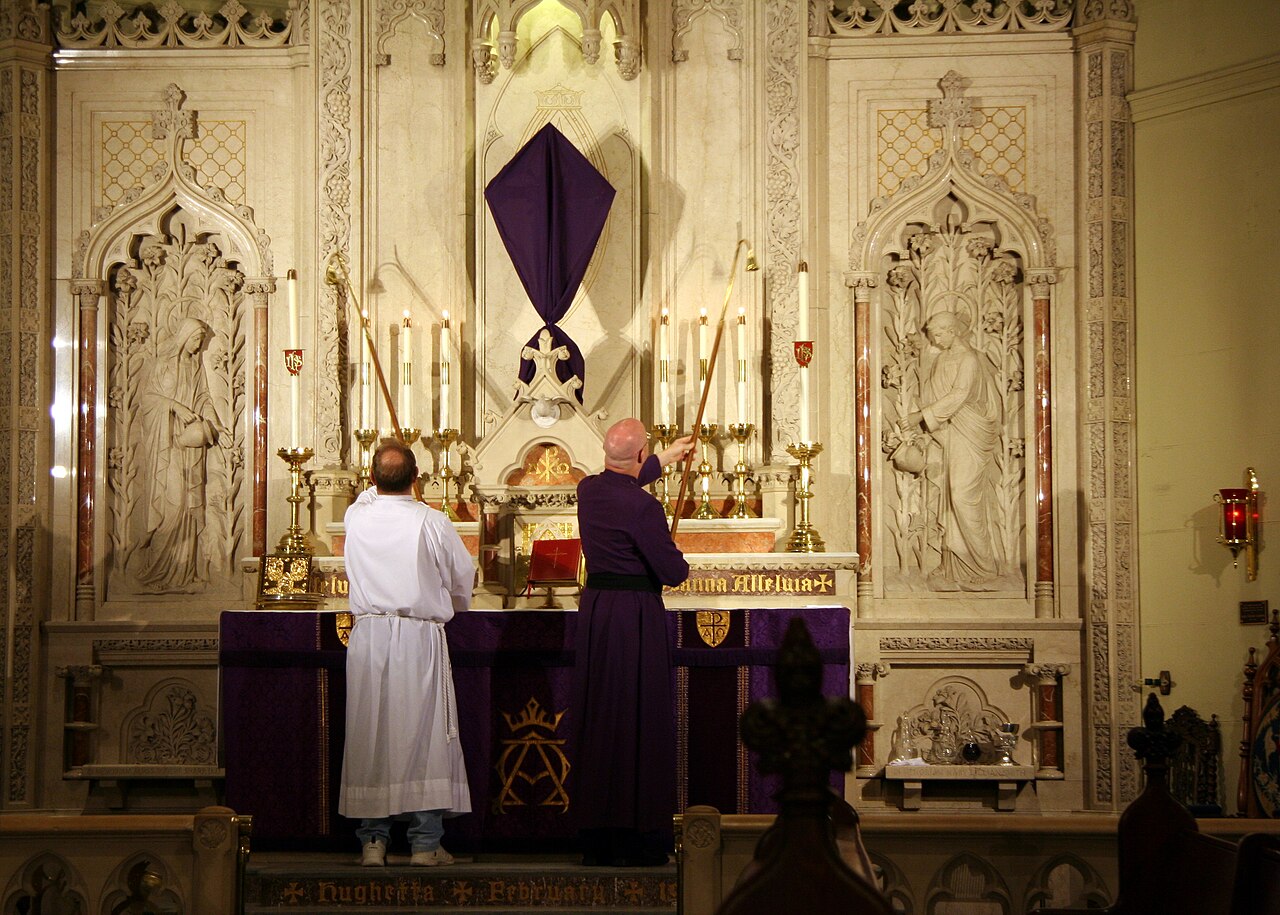
"AshWednesdayAltar" by Jonathunder 
This is going to sound strange, but - I just love Catholic mass.  I was raised in an Evangelical household but I attended Catholic school for four years, including mass every morning.  I can unequivocally place my love of elaborate ritual at the foot of that Catholic church.  The Stations of the Cross, the Candlemass throat-blessing, even the tinkling bells that rang out when the bread was supposedly being changed into the body of Christ - I loved them all.  Now, dogma wise I completely disagreed with the church and still do, but in my opinion that doesn't make the way they do ritual any less beautiful.

I think my favorite of all was Ash Wednesday.  The entire church processes forward (even those that aren't Catholic) and is marked with the ashes of last year's celebratory palms, as the priest intones "From dust you are made, and to dust you shall return."  I have always loved that phrase.  Usually read at funerals and on solemn church days, it has nonetheless always seemed lively to me.  Rather than an ominous proposition, it was a reminder of who I was - where I came from and where I was going.  As with all living things, I was made of and sustained by the cool soil beneath my feet; and when it came time for me to die, I would become part of that magnificent giver of life once again.  The phrase affirmed my place in the huge expanse of everything that is the earth.

I've written here before about being raised in a tradition other than Paganism, and how important I think it is to honor the words and ideas that first inflamed my passion for the spiritual.  I'm not interested in being a Christian with a Pagan veneer (honestly I feel like that ship sailed a long, long time ago for me) but I also don't want to toss out the baby with the bathwater.  Ian Corrigan has a wonderful Yule ritual over on the ADF website that perfectly mirrors the Tenebrae rite practiced in some churches on Good Friday - all candles are slowly extinguished but for one, which is used to relight all the others and bring light back into the world.  I love that sentiment, the power of the darkness and the returning of the light, and I've used a modified version of that ritual in my own Grove's Yule celebrations.  I'm so thankful that we as Pagans don't have to throw it out because of its association with a Christian ritual.

Sunday, February 1, 2015

Week 5: Humanity is Community

Pagan Pride 2014
I've been thinking about this post topic a lot.  Humanity is not something I think a lot about when I think about my religion.  I write prayers and give offerings to the spirits, I research and meditate on their natures - they're generally the center of my spirituality.

There's a few Heathens out there that will tell you Heathenry is entirely about culture, that if you're not raised German or Swedish or in some other Germanic culture, you're out of luck.  You just don't have the cultural reference to be a Heathen.  Now, I tend to think that is just plain wrong.  But it does occur to me that the 'human' side of my practice is something I don't think about because it comes so naturally to me.  It is part of who I am, how I was raised - but that doesn't make it any less a part of my religion.

I am involved in a lot of groups locally.  I hang with the Wiccans three or four times a month, I plan and lead rituals with the Druids, I'm always there for a sumbel with the Heathens (if the kids aren't sick!).  I do a lot to help these groups function - and they do a lot for me too.  Having a large group of friends, a circle of people that I can count on and call on if something goes wrong, has positively impacted my life in so many ways.  It's also not something that I'm used to; I'm usually a bit of a loner.  I haven't really had friends of my own since I left college almost eight years ago.

In ancient Heathen culture, the giving of gifts and the reciprocity of these gifts was essential both to spiritual practice and to everyday life with those close to you.  Exchanging gifts established a relationship.  This is something I've practiced with the spirits for a long time, but it was only after entering into my community and giving of my time and talents that I realized how deep and profound a relationship it brings to people as well.  It certainly doesn't have to be with fellow Heathens, either!  Joining a group, making an active contribution and receiving fellowship and service in return can be a profound human experience - and also inherently religious.

Wednesday, January 28, 2015

Cauldron Blog Project: Doorways

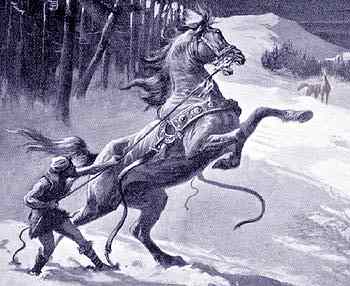
Loki and Svadilfari by Dorothy Hardy
public domain
I've never been a Roman recon or honored any deities originating farther south than Germany and England, but I must admit I'm a little obsessed with Janus and everything that He represents.  A deity just for doorways?  Weird.  And awesome.  Boundaries, and the thresholds where these boundaries meet, is a recurring theme in Indo-European lore and mythology.  Both Celtic and Germanic sources speak of rituals where people parade objects around the boundary of farmland, of the home, of the town, to bless these spaces.  Establishing the boundary is seen as a sacred act.

I often wonder about the implications of these rituals when considering the story of the walling of Asgard.  Told in the Gylfaginning of the Prose Edda and the Völuspá of the Poetic Edda, the tale recounts a giant who comes to Asgard, offering to build an impenetrable wall around it in exchange for the hand of Freya, and the sun and the moon.  The Gods give him a time limit that seems impossible, but the giant comes close to completing his task.  Loki is sent to stop him and succeeds - and for the giant's "failure", Thor kills him with his hammer.  Of course, that's a very concise version, but it's the very beginning that's of interest to me.

The being that walls and encircles Asgard, certainly a holy and protective function, is not one of the Aesir.  The threshold of the home of the Gods is not established by its inhabitants or a sacred, appointed spirit - instead, it is built by a giant, a member of the apparent "savage" race that the Gods are trying to keep out.  There's no evidence either here or in later writings that the giant is attempting to trick the Aesir with shoddy building or a hidden door so he can later attack - he is the honorable one in this exchange, serving a sacred function for the Gods who unfortunately prove themselves unworthy.

Another Jotun, a giantess named Gerd, is said to have later married the God Frey and is listed by Snorri as one of the Asynjur.  The etomology of Her name is an interesting one, with many concluding it means either 'walled field' or that it simply denotes the action of walling (from Rudolf Simek's Dictionary of Northern Mythology).  How fascinating that She also is so linked to this bounding of space, separating the inside from the outside, while She is really a product of both.  While of course I honor Gerd in my garden, I see Her also as a deity of these boundaries, and I offer to Her when I ward my doorways and the edges of my land.

It's clear that doorways and boundaries were very important to the ancient Indo-European peoples.  How interesting that two spirits strongly associated with these boundaries are giants, so often overlooked or pushed aside in modern Heathenry.

Thursday, September 25, 2014

Those Pesky Pagan Holiday Names

from oakwillow.com.au
I read an amazing article The Triumph of Mabon on Jason Mankey's Patheos blog Raise the Horns this morning, and it got me thinking about a topic that has always bugged me just a little bit - the naming of the 'standard' Pagan holidays.  When I was the kind of Pagan who wasn't much bothered about specific cultures or history, they didn't get to me too much; though I must admit I've never been overly fond of the pseudo-historical feel.  Even as a newbie Pagan, I much preferred referring to solstices and equinoxes than I did to Mabon or even Yule.

Now that I am working within a specific cultural framework, and writing for even more for Prairie Shadow Protogrove's rituals, it's become even more complicated.  I just don't feel comfortable inviting people to an Ostara rite that honors Demeter and Persephone, for example - it just feels culturally wrong.  I don't feel like I'm being authentic when I tell my daughters about Samhain, a sacred day when we honor our Ancestors; our traditions are very Heathen, and to call the holiday by a Celtic name just seems disingenuous to me.

I'm certainly not trying to tell anyone else how to practice or what to call holidays - it doesn't matter to me!  But this is how I personally feel when using the 'traditional' Pagan names, so I've tried to come up with some a bit more modern.  Though I am very much a Heathen and very inspired by history and research at this point, I want to help my children see with a wider view; should they want to follow a different path of Paganism or even leave the religion but still remember special traditions from their youth.  I'll still refer to the solstices and equinoxes by their scientific names, that's what makes those days so special, after all.  We've always called Beltane 'May Day', which it is - we just celebrate it a whole lot more than other people here in the midwest.  Lughnasadh has always been simply 'Harvest Festival', easy-peasy but a tad confusing when compared to the Autumnal Equinox.  The difficult ones so far have been Samhain and Imbolc - I'm just not sure what language to use to describe honoring the Ancestors or praying for the spring without resorting to silly and trite-seeming epithets like 'Ancestor Day'.  I have always liked the name 'Candlemas' for Imbolc, and connects it back to my youth, but I'm not sure that stealing Catholic holiday-names is the best way to go.

I think this will always be a tricky topic as Paganism as a whole continues to diversify; with some wanting to retain the standard holidays but wanting them to be more culturally appropriate.  I continue to hope for the wide-spread adoption of more neutral terms, but understand that for many that compromises part of the magic of these names.  Like so much of the work of building a religion, I imagine that as time goes on, these things will be figured out.

Wednesday, September 24, 2014

Feeding Your Fire

Photo by Dirk Beyer
After coming home from Pagan Pride Day, I was exhausted.  That next morning, I didn't have the energy to get up and attend my local UU church with my children, and quickly realized as the day progressed that I didn't have the energy to go out and do much of anything.  After discovering my daughter was sick and taking her to Urgent Care, I honestly really didn't want to attend ritual with my local coven that night.  But I had said I would go, and so I wearily trudged out and attempted to make conversation and engage in my normal cheery attitude.

We talked about the dark time of the year, and the things that keep us going through the darkness.  We talked about those things singular to us, that make us who we are.  I'm not Wiccan, and though I enjoy both the company of those others in the coven and the inter-connectedness of our midwest Pagan community, it's sometimes tricky for me to pull meaning from the metaphors and language so common to Wiccan dialogue.  For instance, the concepts of Maiden, Mother and Crone are not powerful archetypes for me, and discussion of them and their relations to the season can sometimes go over my head.  But at these rituals, there are almost always powerful moments of community relation or introspection that are not specific to Wicca, that go straight through denominational lines and relate a message that is both needed and helpful.

During last night's ritual, we built a fire together as a community.  And together, we discovered within ourselves the things which keep our fire going during the times of darkness, when the sun diminishes and many people naturally feel a little more down, a little more tired.  For me, that thing is a joyful attitude.  Growing up as a sad little kid, my mother always taught me to 'fake it til you make it'; to smile at others no matter what you're feeling inside.  Though I know this can often be a very harmful message, it has ultimately proven to be a good one for me.  I don't talk about it much because of that same childhood conditioning, but I get depressed.  Often, and seriously.  But my smile, and cheerful attitude around others - something that people have often complimented me on throughout my life - often actually helps to lift the fog a bit.  It's so ingrained in me that I honestly can't not be cheerful with people I don't know extremely well; but my smiles spread smiles.  And the more I can brighten others' days, the more mine is brightened in return.  This is why getting out and doing social things can be so difficult sometimes - it's hard to prepare myself to be cheerful when I'm feeling awful or completely apathetic - but once I get out there, the light of others energizes my own heart.  Inspiring happiness in others feeds my fire.

Wednesday, September 17, 2014

Winterfinding, Nebraska Heathens United, and Growth

painted in 1847 by Oluf Olufsen Bagge
I've written before about how much I love Nebraska Heathens United.  A local, but all-inclusive Heathen group that doesn't care if you're hailing Loki, Frigga, or Njordh at sumbel?  Sign me up!  And I did, more than a year ago now.  I've been to sumbels and bloats with these wonderful people, hailed their gods and ancestors, listened to their boasts and their oaths.  

NHU is an open, public group, allowing all who'd like to attend a chance to see what Heathenry is about.  But there is a need in the community for a closer relationship, for a group that comes together more frequently and more privately.  Now that, too, is coming together - NHU's leadership has initiated a plan to build an innangarth, so that the Heathens in Nebraska can have community of their own.

I'm so excited for NHU, the founders, and this next stage of their growth.  I'll be right there, too - there's something about a small group of people sitting around a fire toasting the gods and spirits of Germanic origin that kindles its own fire in me.  These are people who honor that which I also honor.  The tradition of it thrills something inside of me.  

For the Winterfinding bloat, we hailed Odin and each drew a rune that told of His gifts to us.  Now, I don't have much of a relationship with Odin - more standoff-ish nods when our paths happen to cross - but the rune I drew really struck me.  It was Gebo, the Gift.  It speaks of reciprocity, a building of relationships through mutual giving; in some ways, it describes the group dynamic of a Heathen gathering perfectly.  I showed up on the front porch of one of the leaders bearing a bottle of mead and a tupperware full of sweet potatoes, and in return I received community, fellowship with the deities and spirits, and a hearty dinner.  As a group, we showed up before the altar and around the fire bearing alcohol and words of praise for the gods and ancestors, and in return Odin gives me the benefit of those group dynamics.  A gift for a gift.

Tuesday, September 16, 2014

Doing the Work

Druids at Stonehenge
Wikipedia
I know that for many this phrase - "doing the work" - is difficult, conjuring up images and memories of accidentally abandoned plans and waylaid dreams.  For me, it's probably my favorite part of being religious.

Let me back up for a moment.  When I was a child, my mother, an evangelical Christian with the highest of ideals, did her very best to imprint her religion on our hearts and minds.  We prayed five times a day (morning, meals, and bed-time), memorized bible verses, attended Sunday school on weekends and youth-group meetings Wednesday nights; I spent five years in Catholic school and four at a fundie Lutheran institution.  Unfortunately for her, we were born with an innate skeptical outlook; unwilling to accept the contradictions of the Bible we were taught as infallible fact - but that's a story to be told another time.  The point is, I was raised with a great deal of religion, taught from birth that spirituality is something necessary, essential to a well-lived life - and that ideal has stayed with me ever since.  I often tell people that my mother instilled all the religion in me she dreamed of - from her perspective, it just ended up being the wrong one.

So when I make a habit like hailing the sun each morning, or thanking the spirits of nature that helped provide or sacrifice for the food I'm making, it feels right to me.  Natural.  As if I'm slipping back into a familiar, warm territory where the sun of my childhood shines.  It's why I sometimes have difficulty empathizing with others who are having trouble starting up a daily or weekly practice - to me it's like a balm that just makes all of life better.  Then I remember my own difficulty starting up a workout routine, and suddenly it all makes sense!

All jokes aside, what I'm trying to say is: the work is worth it.  Having a daily practice, offering to the Kindred or honoring Someone in particular, is incredibly beneficial.  My relationship to the Land, to my Ancestors, and to the Deities becomes stronger every day.  It helps me also to stay mindful - since I changed my morning devotional to one honoring the deities and spirits of the dawn, I find I am more aware and more appreciative of the work that the sun does in the world.  After acknowledging Sunne in the morning, I feel Her presence throughout the day - each time I look out the window and catch a glimpse of sun-dappled leaves, each time a ray of light enters the house and warms my skin, I remember Her - because I made the time to acknowledge Her.  It's the same with each and every spirit and deity that I make the time to honor.  My house spirit gets milk once a week, but the creek I walk over when I take my daughter to school is greeted twice a day - which spirit do you think I am closer to?  Do the work, relationships will come, and you will be rewarded.

Monday, March 17, 2014

Sorting through Spirituality: Vanatrú in Heathenry

Freja by John Bauer
Public Domain
I have been a devotee of Nerthus for many years, before I knew Her name.  I often hear other Heathens talk about how Heathenry isn't nature-centered - and I know it's not necessarily earth-centered - but my Heathenry is, and always has been.  There's a lot of talk about Óðinn and Thor in the Heathen community, great warrior deities who fight the good fight, delaying Ragnarök.  Frey has His devotees, and Freyja is often talked about as a love deity.  But when people separate Heathenry from generic Paganism by saying that it's not earth-centered, full stop, I think this erases a very important part of the religion of my ancestors.

The Vanir are represented by Snorri as a separate tribe of Gods from the Æsir, and this has prompted the creation of the term Vanatrú (loyal to the Vanir) as opposed to Ásatrú.  Some contend the true separateness of the two tribes, especially in the Anglo-Saxon culture I work in; but there's no question that the deities traditionally identified as Vanir have different attitudes, rites, and expectations than the Æsir.  Frey's priests are described by Saxo Grammaticus as wearing women's clothing and dancing effeminately, and according to the Heimskringla, Njörðr married His sister (suspected to be Nerthus) and had children with Her - an action forbidden among the Æsir.

Though I have honored Nerthus for many years, it's only relatively recently that I began to explore a relationship with Frey and Freya.  Looking for more information on Them, I came across more and more references to the term Vanatrú.  I'd heard it before, mentioned in passing on forums or on some sites talking about Nerthus, but I'd never been very interested in exploring it further.  This time around, I decided to take a look.  Reading websites like Cena Bussey's Wane Wyrds and Gefion Vanirdottir's Adventurs in Vanaheim, and Svartesól's book Visions of Vanaheim, I felt the idea take hold somewhere inside me.  I'm not declaring myself Vanatrú - for one, separating myself from the general Heathen community is not something I'm interested in; and two, I tend to be more lore-based in my Heathenry than many Vanatrú practitioners - but the idea of a truly nature-centered way to practice Heathenry feels like home.

Civilization, culture, and society have their place in many religions; and I think a very important place in Heathenry.  I continue to honor Thunor, Frige, and Woden, because they are the Gods of my ancestors, and because I am a mother, a homemaker, and a scholar.  I can't always wear the hat of eco-activist, and I can't go out and live under the trees and stars, because I have a responsibility to my family and my community.  I can't sacrifice my life to Nerthus like Her slaves of old - but I worship Her.  I continue to honor and offer to the land wights around me.  And now I honor Her children as well; and in doing so I move closer to the cycles of the land, the circles of the Earth.. birth and life, death and decay.  Nerthus is leading me to Her people.  In one of his famous poems, Rumi wrote: "The breeze at dawn has secrets to tell you.  Don't go back to sleep."  In beginning to honor Ing Fréa and Fréo, I can just barely hear mumbled whispers coming from the dark earth.

Sunday, February 23, 2014

The Blogosphere is Erupting Again

There has been a lot of talk in the Pagan community lately about privilege, specifically the privilege that those who follow a Wiccan-based path (eg, circle casting, elements, etc) have in the Pagan community.  Last spring, Yvonne Aburrow posted on Patheos that the Pagan umbrella is leaking, referring to some hard polytheists (or devotional polytheists, there are a few terms used to describe the same basic idea) choosing not to also be identified as 'Pagan'.  Than this fall, Ruadhán posted about (and I believe coined the term) Wiccanate privilege (referring those who follow a path that has many outward commonalities with Wicca).  Then at Pantheacon, Don Frew and P. Sufenas Virius Lupus hosted a discussion about the same topic.

I can't speak to the Pagan community at large - and by that I mean that big, over-arching community that somehow seems to form up across geographical barriers (and is especially apparent at festival-time, a privilege I have thus far been lacking in).  I can only talk for those small corners of the world which I do know fairly well; but I do have quite a bit of experience in those small corners.

When I first started looking for real Pagan community in my area, instead of being a solitary forever, I attended a few rituals and study-groups for a group called Pagans of Nebraska.  Now, I don't want it to sound like I am bad-mouthing them or complaining - one of the admins is a good friend, and I think they are doing some important work in holding open, public rituals anyone is welcome to attend.  However, I did have a few difficulties there that has led me to drawing back - I haven't attended an event of theirs since October.  The first difficulty was study groups.  Though the group's very name, Pagans of Nebraska, makes it out to be a pan-Pagan organization where any path would be welcome, at discussion groups, my input about Heathen holidays or Gaelic traditions was either ignored or interrupted to talk more about Wicca-esque ideals - not by the other participants, but by the leaders of the group.  I was frustrated, but figured the name was disingenuous and just went about my business.  I'm a big believer in "when in Rome, do as the Romans", and so when the group was petitioned for Quarter-callers, I agreed to call the East.  When dismissing, I ended with (what I think is a fairly Wicca-standard!) "hail and farewell!" and.. crickets.  While all others had gotten a rousing "blessed be!", my friend was the only person to repeat the phrase.  If a Heathen at a supposedly pan-Pagan ritual can't even get a response to "hail and farewell!", I just didn't think I had much of a future there.  And so I quietly resolved that the hour drive just wasn't worth it, and stopped coming to events.  I didn't make an effort to talk about why I had felt excluded, or point out the problematic element of the group's name if they only intended to do Wiccan-style rituals and discussions; because that would have caused drama - and I hate drama way more than being (probably unconsciously) excluded.  But that's Wiccanate privilege.  For a person on a path that shares many practices with Wicca, all they have to do is show up to the group and enjoy.  For me to have rituals or discussions that applied to me at all, I would both have had to bring up the topic and strongly resist attempts at being shut down - not because the leaders didn't like me or wanted me to leave, but because they were genuinely uninterested in what I, whose personal spirituality is not Wiccan in any way, had to contribute.

So that was my first example of Wiccanate privilege, and it left me pretty frustrated.  Luckily, I had also been attending another group - the Order of the Red Grail, which is explicitly Wiccan (lineaged from Gardner, actually, though not Gardnerian).  How this group that is explicitly Wiccan got to be more open and accepting of other forms of Paganism than a group called 'Pagans of Nebraska' is beyond me, but that's how it is.  They even sponsored a new-ish local Heathen group, Nebraska Heathens United, so they would also be able to utilize the facilities of the UU church with minimal cost.  Some group members will attend every NHU event, even their educational classes which talk specifically about Norse-related subjects.  And in response, the Heathen leaders almost always attend Red Grail events as well!  It's fantastic.  The leaders of the Red Grail know a lot more about Heathenry than I'd guess most pan-Pagan group leaders do.  I've had to do a bit of education on ADF Druidry vs. the Celtic-only, romantic Druid standard, but they're willing to listen.  After a few confusing conversations, everyone remembers and is really good about me honoring Anglo-Saxon and Gaelic deities.  After a few months of attending their Full Moon rituals, I applied to be a student - for a few reasons, the biggest being that I was thankful to have some Pagan community, especially one that was so welcoming to other paths; and the other important one is that whole Pagan clergy thing I'd like to do.. I kind of have to know a bit about Wicca to do that, because that's the majority of Pagans!  (*grumble grumble* wishing that all Pagan clergy felt a need to learn at least something about the diverse religions under the umbrella *grumble*).  But one of the High Priestesses attended our Protogrove's Yule ritual and told me afterwards that it was lovely, and very interesting as well.  The Red Grail here is using its privilege (privilege gained not only by being Wiccan, but by having been around 20 plus years) to lift up and empower other Pagan traditions here in Nebraska, and I couldn't be more thankful that they are willing to do that.  This shows me that progress can be made - that it is possible for diverse groups to come together without erasing or watering down the various paths represented.  I understand that's not what many on either side want, and that's certainly their right; but I do honestly think that the Pagan (and polytheist) community would be better off keeping its diversity.

Coming up this fall, I am a committee member for Omaha Pagan Pride Day.  Last year, there weren't a lot of groups with tables, and those that had them were the usual Wiccanate.  But I did meet a Heathen from an Omaha kindred there, and my friend was able to give a presentation on ADF, and that gives me hope for this year.  I'd love to be able to get Nebraska Heathens United to have a table, maybe a spot on the presentation list (I haven't spoken with them about it yet, but I think it's so important that a diverse group of traditions come).  I want to reach out and see if I can find some other practitioners in the community who may want to present - I just met a Celtic Reconstructionist in the area, and I know a woman who does Kemetic stuff as part of their practice.  My personal attitude is bring it on!  All the diversity!  Though I know programming slots are limited, and I'm only one of five committee members, so I'm sure compromises will have to be made.  I'm just hoping to steer those compromises in the direction of more inclusion rather than less.

A common criticism leveled at those who talk about Wiccanate privilege is that other traditions just need to get involved, and the problem will naturally solve itself.  Since I started getting out into my local religious community, I've done nothing but get involved.  I am part of interfaith group discussions at the local UU church, I blog openly about my practice, experiences and beliefs, I attend and volunteer my time for many rituals of many different groups and traditions, I have held public Pagan gatherings in my own home for pete's sake!  Honestly, I don't have even a second of spare time to get more involved with the Pagan community.  I know there are many others who are not Wiccanate, who are giving all they can to the Pagan community, and they deserve to stop being told "just show up and things will be okay!".  Because it hasn't always been okay.  There is definitely a problem, shown by my earlier experience - and the first step to fixing it is taking the time to listen to people who practice differently from us.  When we listen, instead of assuming qualities like an earth-centered practice or belief in the unity of the divine, we learn something about the people we're interacting with - who may have none of those qualities at all!  Or they may have all of them.  But the best way to figure it out is to listen, instead of telling someone else what they believe, or how they must practice.

Friday, February 14, 2014

D is for Dates with Deities

No, I'm not writing about about Valentine's Day or Godspouses - instead, these 'dates with deities' are one way I've found to help create and maintain a consistent practice.  Picking a certain day of the week or month on which to give offerings to a deity or spirit, it becomes easier both to remember and stay motivated to do that.

I first realized this when I began Flamekeeping for Brigid.  My Cill uses a 20-day shift, which means that every twenty days, I have one full day set aside for honoring Brigid.  Having one day specifically set aside, combined with the fact that my Cill-mates were relying on me to tend the flame on my day, made it so that I haven't missed a shift.  Noticing this, I decided I would experiment with one more 'date' - every Thursday, I make an offering to the house spirits.  Once I decided a day on which I needed to make an offering, it became so much easier to consistently do it.  Since then, I've added a few more days for other deities and spirits, and it's amazing how helpful it's been to my spiritual practice.

Though it may seem crass or undignified to some to schedule time for the Gods, when you have a busy life or tend to procrastinate, you have to find a way to make time for those things that are important to you.  If scheduling days for specific deities doesn't work for you, even scheduling a specific time during the day to do devotionals can be helpful.  Whether you wake up early, stay up a bit later, or if you have an extra bit of time mid-afternoon, setting aside some special time helps to create and also establish a routine that you can stick with even when things get busy - and that's the core of any devotional practice.

Wednesday, February 12, 2014

TC Blog Project: Family


This time of year, we start to hear a lot of talk about love.  And love in February is almost never referenced as the love between friends, the love of family, or even *gasp* a love for things.  No, our entire culture frames Valentine's Day - a celebration of love - as celebrating only romantic love.  Those who don't have romantic partners are said to be "alone on Valentine's", whether they will actually be physically alone or not.

I'd rather talk today about one of my favorite aspects of Heathenry: familial love.  For a long time, I considered myself the 'odd duck out' in many Heathen circles, being generally the most leftist of the US-politics liberals.  It's taken awhile, but I've come to realize that perhaps I found Heathenry because some part of me understood that, deep down, I actually hold a few traditional values.  One of the most important of these values, to me, is the importance of family.

Growing up, my immediate family was sort of the odd one in the extended family.  We were poor in a family full of middle-class, my mother was too Evangelical and my father too atheist, us kids were socially-awkward brainiacs and always wanted to play with the wrong genders.  And yet, despite the unspoken uncomfortableness surrounding those topics, the entire family was always warm and welcoming.  We were weird, but it didn't ultimately matter, because we were family.  There weren't any family feuds or in-fighting; we all got together on Thanksgiving, Christmas, and Easter and made generally pleasant dinner conversation with each other.

Growing up, I didn't exactly appreciate how rare and precious a family like this is.  When I went to college, I basically cut all ties with everyone - I didn't speak to even my parents for about a year.  It wasn't until I found myself pregnant, faced with beginning my own family, that I began to appreciate just how amazing a good family can be.  The biggest recent influence on my concept of family has been my mother-in-law; she comes from a very traditional culture where it is a woman's duty to care for her house and her family.  She welcomed me with open arms, took me in as her daughter, claimed me as part of her family.  She cares for her elderly mother together with her three local sisters, all of whom work full-time, because it is her duty to love and honor her mother the way her mother loved and raised her.  I have watched her pour out her heart into the food she makes for our family dinner every Sunday; all of her love and good wishes and affection goes directly into the meal.  She holds the most love for family of anyone I've ever known - and though I aspire to be like her in caring for my own family, I must admit that I seldom hit the mark.

I'd like to be clear that by valuing family, I am not referencing only a traditional nuclear family.  That's how mine worked out, but it's certainly not the be-all, end-all.  I spent a large part of my life with my mother and step-father on one hand, and a single father on the other, and we were just as much family as anyone else.  Same goes for gay, poly, or whatever relationships - if you think of yourself as a family, you are.  This is a special kind of love, and no matter how some conservatives would like to play it, it is there for everyone to experience.

I try to give my children the good things I had growing up, while skipping over the worse ones.  We eat dinner together every night, no TV or other interruptions, and talk about our days.  I make it a point to talk to my kids in the car when we're driving somewhere.  I plan family celebrations - not just for my own holidays; I throw a darn good party for Eid twice a year too!  Just as my mother and grandmother did growing up, I tell stories of the ancestors I remember, and those that are still with us but who we don't have the opportunity to visit.  These are all religious acts for me.  The simple act of loving my family - and expressing that love by caring for them, cooking for them, making sure their lives are organized and also enriching - is a big part of my religious devotion.  In Heathenry, your family's honor is incredibly important - it is simultaneously your legacy and your gift to your ancestors.  Caring for my children, loving them, and teaching them the ways of my ancestors is an offering to those who have gone before.  It is also an offering to those I will leave behind.

Friday, January 10, 2014

Returning Home

Welcome back everyone!  I hope your holidays were lovely, and filled with family and fun.

The holidays and transition to the new year always have their ups and downs.  I stopped writing around the middle of the month of December due to a combination of factors - with the holidays coming, there's always so much to prepare for and so little time to do it; and also, my ipod on which I keep my huge list of blog ideas went through the washer one night and has been unable to recover.  After all that, I decided to take a break from the world wide web for a bit and spend some quality time with my family.

So after a couple weeks rest, here I am again!  My hope for this blog in the new year is to write one Pagan Blog Project and one other post once a week, and also continue through my rune-making series.  I'm also writing for the Pagan Families blog over at Patheos (read my first contribution here).  Personally, I'm also determined to finish ADF's Dedicant Path this year, hopefully ready to turn in sometime after the Summer Solstice.  I'd also really like to start the Troth's Lore program, but I won't be turning 1 year as a member until autumn, so we'll see how busy things are at the time!

All in all, it looks to be a full and busy year, and I can't wait to share it with all of you!

Tuesday, December 17, 2013

The Pagan Umbrella can be a Community

Last Saturday, I attended a Yule party, put together jointly by the Order of the Red Grail and Nebraska Heathens United.  Yes, you heard me correctly - some Wiccans got together with some Heathens, and managed to put on a fantastic party that most everyone in the community enjoyed.

The way that a lot of Pagans talk on the internet, a person might assume that different branches of Pagans don't have anything in common.  Not all Pagans are earth-centered, not all Pagans are polytheistic, not all Pagans celebrate the eight Sabbats, etc.  This is all true.  There is a huge amount of diversity and difference in the Pagan umbrella, and that's okay.  In fact, it's awesome.  Since most Pagan paths are rather tolerant of other people's ideas of religion or spirituality, there's no reason for us not to celebrate that diversity.  Unlike different Christian denominations that have argued for centuries about, for example, whether Mary had other kids or not; we as Pagans can accept that each of us has a different view of deity (or deities).

I see Paganism as a giant Venn diagram, with many circles.  In each path, and in each person, those circles will overlap differently - and some will not include some of the circles at all.  But what connects an urban-centered, hard-polytheistic Hellenismos follower with an earth-centered, pantheistic eclectic Wiccan is other Pagans, that each incorporate some of those circles in their own path (see example at left).  So the Wiccan who complains that they have zero in common with a Hellenismos follower is incorrect - they have other Pagans in common.

Now I've seen this argued over endlessly on the internet.  But do you know where I don't see it argued about?  My local community.  If a group of eclectic Wiccans and a group of Heathens can get together and plan a successful party, at which most people are enjoying themselves, then we as Pagans can have community with one another.  I think this is made infinitely easier in-person, because there are so many things that can be said over the internet that would not be said to a person's face.  It's difficult to look someone in the eye and insult them unless they truly deserve it.

I am, admittedly, a bit biased.  The Pagan community is something I care deeply about.  Though I am fairly specific in my own practice, I really want to be able to reach out to others who are different from me, learn from them and just.. exist in community with them.  This is part of the reason that my ultimate goal is to become a well-rounded Pagan clergy-person.  I want to be able to help and bring together people on many different paths.  This is a big part of the reason why I'm currently learning with a Wiccan coven - I'm not a Wiccan in my personal practice and haven't been for a long time - but there are many Pagans who are, and I want to be able to understand and help them as much as I would be able to understand a fellow ADF member.  And because all the people in that group are fantastic people, and I enjoy knowing them and spending time with them, regardless of the fact that we have different theological positions on the nature of the Gods.  While I acknowledge and accept that there are some Pagans who are happier remaining only among those who share their views; I think the majority of the Pagan community would be a happier and better place if we learned to work together with one another rather than at odds with each other.  It can be done!

Tuesday, December 10, 2013

Reconceptualizing the Power of Myth


When I was first getting started in Paganism in the early 2000s, all the beginner Wiccan books I read made a point of mentioning the "real" origins of Wicca.  There was no early Goddess-worshiping, peace-filled matriarchy, no nine million witches burned, no ancient lineages passed down through the generations; only an old British guy with a liking for Margaret Murray, Aleister Crowley, and nudity.  I read a lot of debunking, but never actually explored what was being debunked.

So when I first read Triumph of the Moon, with its rather dispassionate, scholarly take on the origins of Wicca, I was completely baffled as to why some people in the Pagan community seemed so offended by it.  Facts are facts; and Murray's pseudo-history was most certainly not that.  I wasn't one of those Pagans, the ones who held on to their antiquated and disproven beliefs; because I believed at the time beliefs must be factually accurate to have religious meaning.  I now understand that this was rooted in my fundamentalist Christian background - it can be hard to shed the idea of a literal religious interpretation.

Since my own path long ago veered away from Wicca into paths that are a bit more academically based, I hadn't really gone back and re-examined those basic ideas of who is 'right' and 'wrong' when it comes to religious truth.  In reconstructionist religion, things can be a lot clearer - something either is or is not attested in the lore.  In my efforts to find community and gain a broader understanding and knowledge of the Pagan community, I have recently become a student of a local Wiccan coven.  Reading my study assignments, I am forcibly confronted with this idea and the preconceived notions I carry about it - facts vs. not facts, 'not facts' being the clear loser.

And yet, with these views, I am a complete hypocrite.  I rarely talk about it because I know it's controversial in Pagan circles, and because I don't want to be looked at the same way I originally viewed those Pagans who still find value in the idea of an ancient, Goddess-worshiping matriarchy.  But I do honor some *gasp* fictional deities.  At least, that's how others would describe them - I consider them just as real as the other Gods and Goddesses I honor.  See the double standard?  How I can I mentally reject a person for finding value and worship-deserving entities in the myths of King Arthur, while at the same time finding inspiration and religious truth in a work of fiction?

This is something I'm still grappling with.  On the one hand, I think it's incredibly important to be accurate when talking about facts - especially with the Wicca's history of unclear information.  On the other, I think that some of Wicca's early shared mythos, while historically inaccurate, has been cast aside too easily by some newer to the faith.  There are many lessons to be learned in myths, whether they are ancient or recent.  Just because something is not factually true or historically attested doesn't mean it can't hold value.  As a polytheist, I am already adept at holding multiple truths simultaneously - the values Brigid calls me to are certainly not the same as those Thunor calls me to honor -  is it so absurd to imagine that, while there was no historical Camelot, a valid and fulfilling religious tradition can be built from those myths?

While the evidence tells us there was no peaceful Goddess-loving matriarchy in ancient Europe, that doesn't mean a peaceful Goddess-loving matriarchy can't be created as a valid practice today.  And it doesn't mean the myth isn't very powerful to a large number of traditions doing good work today.  It's still not the path I walk; but I'm starting to understand, at least a little bit, those who do.