Showing posts with label Saxon. Show all posts

Wednesday, April 29, 2015

Daily Devotional - Evening

photo by Michael J Bennet
creative commons license
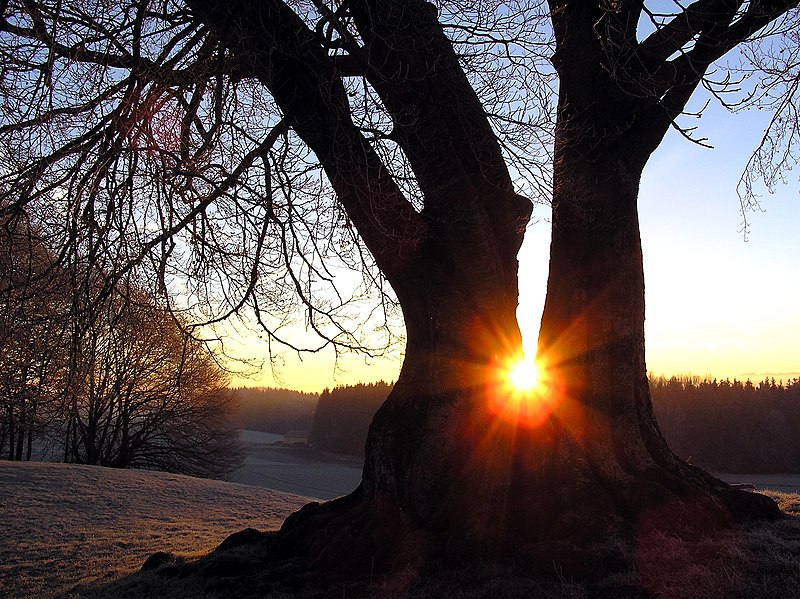
I've been feeling the need lately to round out my day with a night-time devotional to mirror my morning routine.  I chose to honor Earendel and Niht, the evening star and the personification of the night.

Hail Earendel, evening Star,
bearer of light before the Sun and Moon.
Bright above me every evening,
star in the darkness, jewel of the sunset.

Hail to Niht, the darkness of night,
Mother of the good earth.
Joy of sleep and goddess of dreams,
black that blankets all.

I smoor the sacred fire
as the light of day wanes.
May it bring rest and sweet dreams
to me and mine.


Sunday, April 5, 2015

Prayer and Offering for Eostre

by Norbert Nagel, Creative Commons License
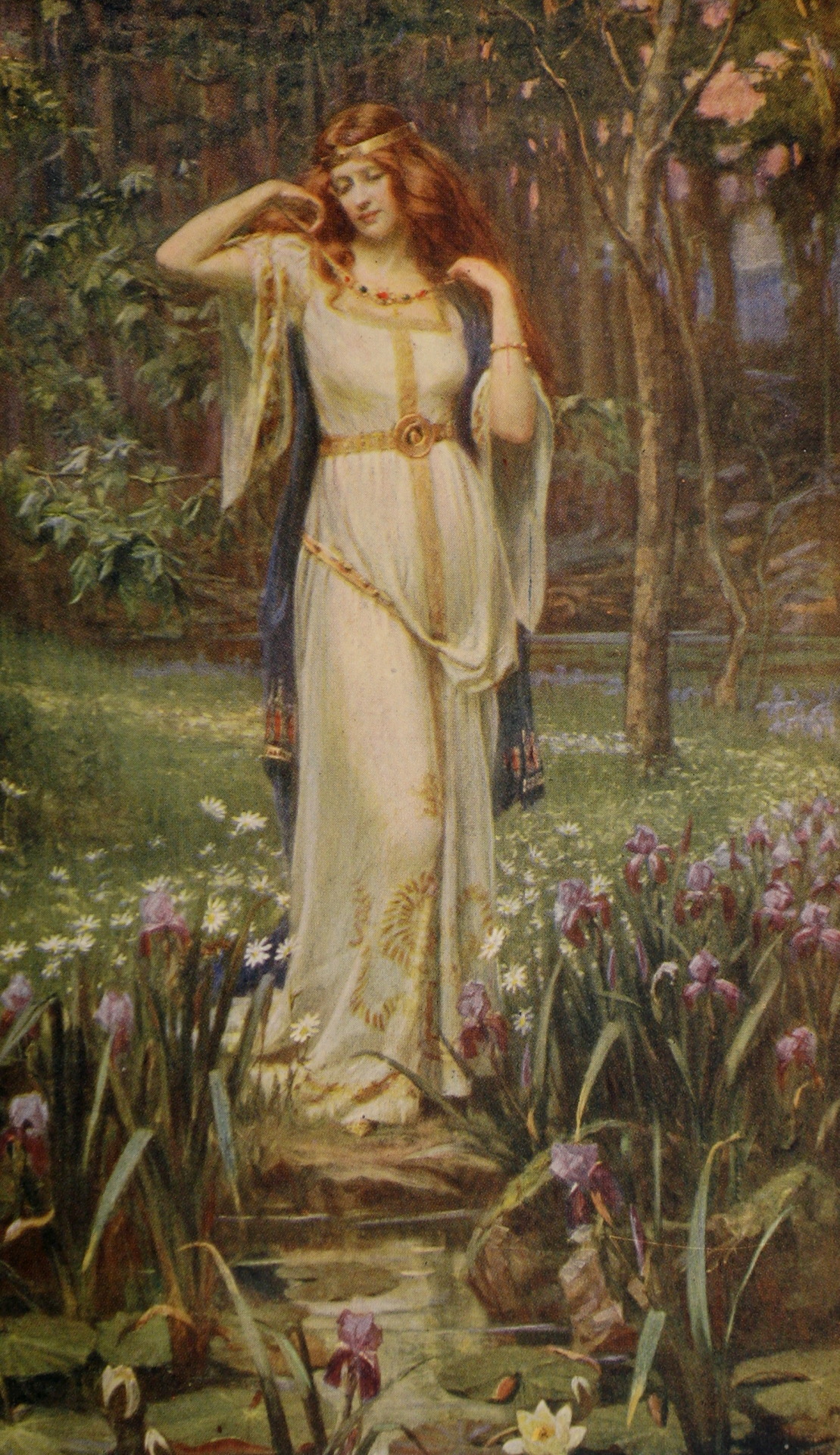
Hail Eostre, the rising dawn and the coming spring!
As Your golden rays gleam above the horizon,
the buds begin to bloom and open,
heralding the return of light and life!
Beautiful Goddess framed in flowers,
the beginnings of apples, peppers,
all fruit that flourishes on branch and vine,
bring brilliance and bounty to me and mine.

My favorite offering for Her this time of year is dyed eggshells.  First poke two holes at either end of an egg, and blow the contents out into a little dish to save for omelettes or whatever you like.  Then the eggshell can be dyed in natural dyes, and it will color both the inside and outside of the egg.  I have had a good time crushing several eggs together until they form a colorful sort of eggshell gravel, but they can certainly be offered whole as well depending on what you’d like!

Sunday, March 29, 2015

Prayers to the Gods

In times of difficulty, I often feel so drained or exhausted that even thinking about praying or giving an offering seems to much.  It feels there are no right words for the circumstances, no flowery phrases that can directly translate the pain and heartache that must be dealt with.  In these times, I find it best to use a simple prayer, a good prayer that affirms the order of the world and calls down blessings.  One such prayer can be found in the Sigrdrífumál, part of the Poetic Edda.  This version was translated by Bellows in 1936, and reads:

Hail Day!  Hail sons of Day!
And Night and Her daughter now!
Look on us here with loving eyes,
that waiting we victory win.

Hail to the Gods!  Ye Goddesses, hail,
and all the generous Earth!
Give to us wisdom and goodly speech,
and healing hands, life-long.

This is such a powerful prayer for me.  I have written my own version that I like to use when I can't find the words but feel the urge to pray, to affirm my place in the cosmos and ask for the good favor of the Gods and spirits.

Hail to the Day that rises,
hail Sunne who brings light and life!
Hail to the Night that brings joyful sleep,
hail Mani who keeps the time and tides!
Ever keeping Your circles,
look on us with loving eyes,
bring blessings like shining light.

Hail to the Gods and Goddesses,
to the lands and the living waters,
to the ancestors, ancient and wise,
to all the generous Earth!
Give to me wisdom and a happy heart,
a voice and hands that heal hurts,
for all the days of my life.

Monday, March 23, 2015

Another Post About Eostre

Okay, they've been everywhere this past week - posts about Ostara the holiday, about Eostre, debating Her claim to historical fame, Her attributes, Her associations.  She has been paired with foxes, described as young and perhaps childish.  So as we head into the Anglo-Saxon month of Eosturmonath (rougly equivalent with our modern April), I'd like to write about some of my own impressions of Her.

For me, She is not just a Goddess of the spring.  It is one of Her domains, yes, and a very important one.  But primarily for me, She is the Goddess of the dawn.  The linguistics of Her name supports this - Eostre is etymologically linked to *austrōn, a Proto-Germanic reconstruction meaning 'dawn'.  Through this, She is linked to a fair number of Indo-European dawn deities, including the Vedic Ushas, the Roman Aurora, and Greek Eos.

This time of year, I am still rising just a bit before dawn.  As I wake to dark windows and a silent home, I remember a bit of a poem by Rumi that I loved as a teen: "The breeze at dawn has secrets to tell you.  Don't go back to sleep!".  I come before my east-facing patio door, a large window that looks out over my backyard, and say my prayers to the deities of the sun and the morning that I honor: to the morning star, to the sun, to the opener of the gates of dawn. 

It is Eostre who holds that honor for me, afire in a blaze of golden and red and pink glory.  She throws open the gates, Her face shining with the holy light of the sun as Sunne passes by.  Her arms are raised, drinking in the glory, Her gown whipping against Her with the wind raised by the force of the sun.  She looks to the heavens above the earth in acknowledgement, but also with a sense of triumph: the stars will be put out, and She will be responsible for bringing real light to the world.  She is fire and glory and too bright to comprehend, a deity who will not tone down Her shining, holy light for my sake.  This is my Eostre, how She appears to me each morning as I implore Her to please open the gates.

Wednesday, March 18, 2015

My Heathen Religious Calendar 2015

I made a post about this last year, and have had a few requests for an update, so I thought I'd finally get around to posting even though it's already March!  It's not all Anglo-Saxon this time - I've added a few Icelandic holidays for spirits that seemed to want to catch my attention this past year.

January 23rd - Thorrabloat (welcoming and appeasement of Thorri, a spirit of winter)

February 3 - The Charming of the Plow (in which cakes are offered to the earth, a practice attested to by Bede for the month of Solmonað)


February 22 - Konudagur (celebration of Góa, an Icelandic spirit of spring)

March 5 - Festival for Hreða (the full moon, and midpoint, of Hredmonað)

April 4 - Eostara, spring festival for the goddess Eostre (the full moon, and midpoint, of the month Eostara)

June 17 - Litha (placed on the new moon closest to the solstice; this would have been the day between two months called Before-Litha and After-Litha)

August 29 - Hlæfmæst (literally 'loaf-feast', on the full moon midpoint of Háligmonað)

September 27 - Freyfaxi (unattested in England, but an important Heathen harvest festival; I chose the full moon of September as it often lines up with other Freyfaxi celebrations)

October 27 - Winterfylleð (Winterfinding is the name of the month; given similar holidays attested in Norse sources, I have chosen to honor it with a feast-day, again on the full moon)

November 25 - Winternights (again, this is not a historical English celebration, but its importance in modern Heathenry brings me to celebrate it)

December 21 - Mōdraniht (I have chosen to celebrate this the night before the solstice, though there is some debate on where in December it should be celebrated)

December 22 - Solstice (I choose to honor Sunne on this day, though as far as I know this is historically unattested)

Jan 1 - Twelfthnight (this is attested in Norse sources, but given the history of the 'twelve days of Christmas' in England, I find it perfectly acceptable to extend the festive holiday season)

Sunday, March 15, 2015

When UPG Trumps the Lore: Hreda

Via Creative Commons
This is the month when many Anglo-Saxon Heathens (and many Pagans in general) focus on Eostre, and so I thought I'd be a bit stubborn and write about a deity associated with March by the Venerable Bede.  I've written about Her before, covering most of the lore and speculation that's available to us at this time, and I've lamented its utter incompleteness.  How is it that Eostre, with basically the same amount of information relating to Her, became such a central figure in the Pagan springtime festivities while it's difficult to find even Heathens who know who Hreda is?

My personal opinion is that Eostre's associations just are easier to understand for us in English-speaking, Christian-heritage countries.  Everyone in this culture knows Easter and all that it entails, and since the Goddess Herself lent Her name to the festival - the connections are readily made.  Hreda has no such similar festival, no cultural markers that I'm aware of to lend Her importance in our modern age.  But that doesn't mean She's not there, waiting.

My devotional relationship with Hreda has been something of an experiment for me.  I'm usually pretty hidebound when it comes to matters of lore; I'll build a practice up around it using some UPG, but in matters of disagreement?  The lore wins hands down.  It's one method I use as a check and balance.  But for Hreda, we have less information than even Nerthus; only a possible etymology, and even those are conflicting.  Is it 'swift', 'glory', or 'victorious' - each of these have such different implications as to the kind of deity She could be.  And maybe the etymology matters not at all, and it's just a name unrelated to Her function or areas of interest.  We just don't know.

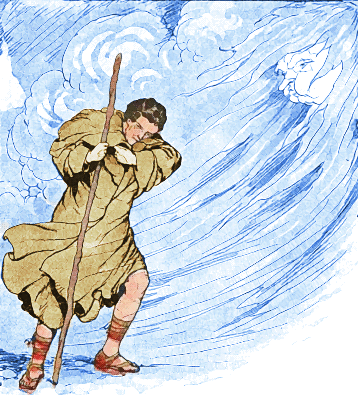
And so I reached out to Her.  This has been going on for a few years now; Her presence is certainly strongest for me in March, so that's when I get my best ideas of Her.  Each year, consistently, I find Her in the wind that drives out the winter.  All of a sudden, around this time of year, the winds start shifting.  Instead of howling out of the north biting cold, they begin to blow up from the south.  They are no more gentle - in fact, often the winds are strongest this time of year.  But the southern winds don't carry snow and ice; they tend to drive away the clouds so that ever-earlier rising sun can shine down on the land.  To me, these winds are a manifestation of Hreda.  She is swift.  She is victorious (eventually!).  She drives away the clouds to reveal the glory of the light. 

Every time I think of Her, I am reminded of a particular statue that I loved in my art history class, The Winged Victory of Samothrace.  I am not a Hellenist and don't know the story behind the statue, but when I think of Hreda it is forcibly brought to my mind.  The way She stands, leaning into the wind, the raggedness of Her clothes and feathered wings - She fights a long battle, but She is not cowed.  She is Victory.

Just to be clear - there is absolutely no indication in the lore that Hreda is this kind of deity.  I don't know much about British weather, but I think this time of year is usually much more mild than it is on the plains of the Midwest, so it doesn't even hold up historically.  I don't care.  I have been reaching out, making offerings, honoring Hreda for three years now; and this is how She comes to me.  I won't argue with anyone over their personal interpretation of Her.  At this point, I'm not really up for arguing with anyone over my interpretation of Her.  She is who She is to me, and I could not be more grateful for the gifts She brings and Her influence in my life.

Wednesday, October 8, 2014

Blōtmōnath, Winter Nights, Dísablót, Samhain - All the Holidays!

by Boschfoto on Wikicommons
Creative Commons License
Sometimes, being a Heathen with a leaning towards the historical can get a little confusing.  Depending on exactly what Germanic culture you're working within, this time of year is good to sacrifice cattle to the gods (Anglo-Saxon Blōtmōnath), offer to the Dísir (Scandinavian Dísablót), or possibly even to honor Odhinn as may have been done during the Icelandic Winter Nights.  For those who follow a more pan-Germanic approach, or draw inspiration from more than one tribe or geographical area, this is a lot to sift through.  For a great discussion of Winter Nights, head over to tumblr blog The Frozen Oak.

I personally tend towards the Anglo-Saxon direction, and so I save honoring the Dísir for Mōdraniht in December.  That leaves Blōtmōnath, the month of sacrifices when cattle would be dedicated to the gods.  According to Swain Wodening's reconstructed Anglo-Saxon calendar,  Blōtmōnath starts on November 3rd this year.  There's a lot of talk in Neo-Pagan circles about Samhain being the 'meat harvest' and I think this is one of the inspirations of that idea.  This time of year, our ancestors who had to carefully ration food to make it through the winter would figure up just how much feed they had, and how long that would last their current herd of cattle.  Usually, it wouldn't go quite far enough - and then the cattle would be ritually slaughtered, and the meat feasted upon and saved for the winter.

Now, modern-day Heathens, especially those living in suburban or urban areas, are not generally going to be able to ritually slaughter their own animals.  Instead, I choose to observe this time of year as one of awareness and remembrance for the gifts given to me: both by the animals who gave their lives that I could eat, and by the gods who create and sustain the lives of all things on this earth.  In keeping with that idea, not only do I like to have one large family feast featuring a roast or some other delicious meat dish, but I find it helpful to remember to address a prayer to the spirit of the animal, and the gods that went into its growth, each time I cook or eat something using meat.  This is one I wrote to use when honoring the cow from which our roast will come this year.

Nerthus, Sunna, Thor, and Frey:
For the black earth,
for the shining sun,
for the pouring rain,
for the sweet grass,
I thank you.

Strong cow who roamed the black earth,
lay in the shining sun,
drank the pouring rain,
grazed on the sweet grass,
for your gift of life,
I thank you.

Wednesday, October 1, 2014

A Charm to Halt the Rain

From Wikicommons
In my little corner of the midwest, any group that does magick or prays to natural gods has probably done a spell or ritual to bring the rain.  It gets dry and hot here, and our economy depends a lot on agriculture; so any prolonged drought has a ripple effect, first on the farmers, then on local businesses, and then on the employees of those businesses, and on and on.  Everyone is impacted.

So it's not very often that you'll find someone from my region talking about prayers to stop the rain.  But it does occasionally happen that we get just too much in too short a time, and it all runs off and creates dangerous conditions, carrying valuable topsoil with it.  This isn't exactly ideal either.

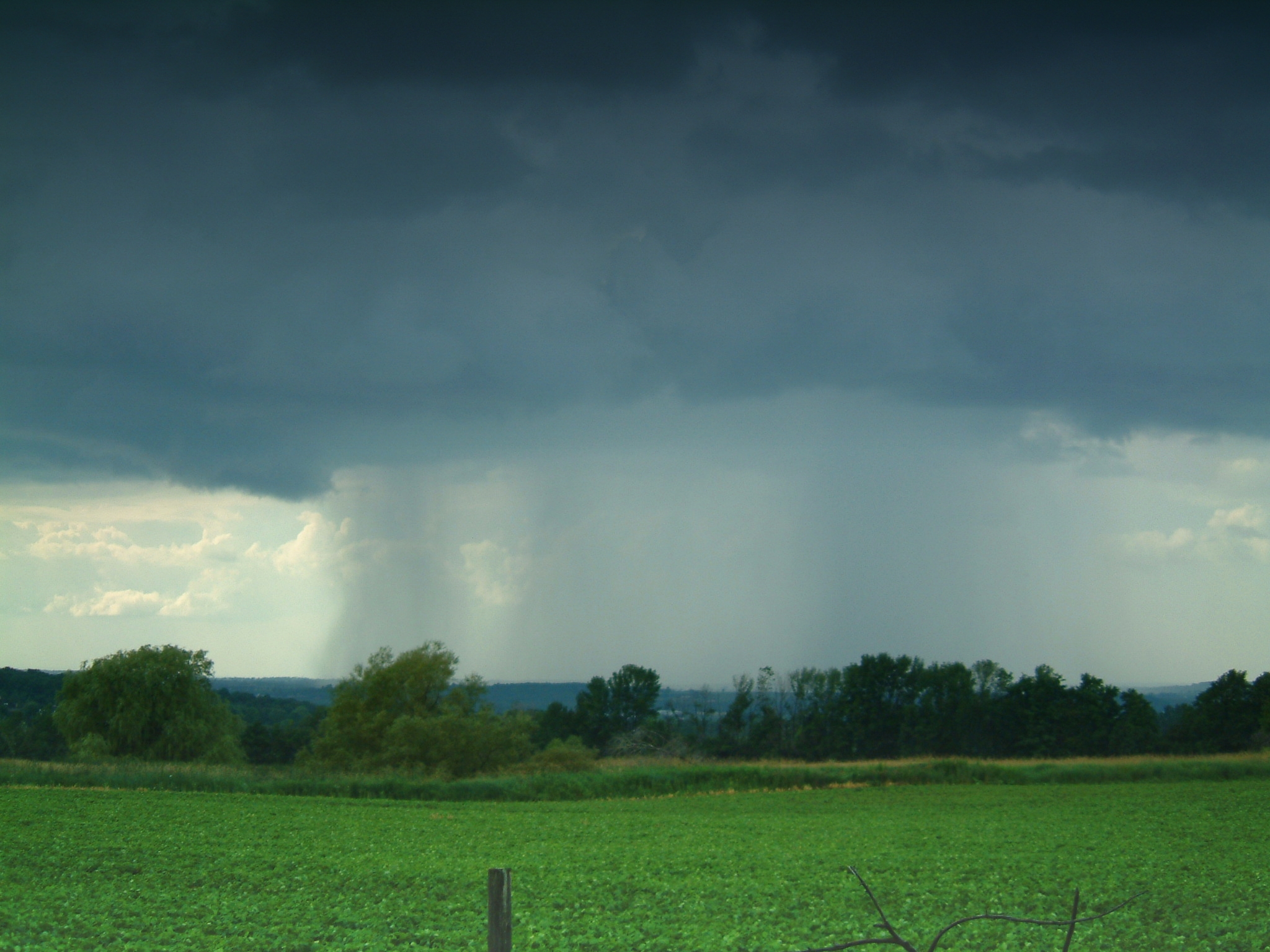
The past month, we've had far greater than our average amount of rain, which for a time was great, because we were rather behind.  It's getting to be too much, though.  We've already had more than two inches today as I write this, and it's supposed to be raining until early this morning.  So what can we do to gently ask the deities to halt the rain for a bit?  Why, write a charm, of course!

Hail Thunor the Thunderer!
You whose mighty storms cover the sky!
The rains have grown great,
laying our lands with water,
flooding our fields.
You who rule the wind and weather,
dry the rain, scatter the clouds,
return only when you are needed.

Hail Ingvi Frey, God of the World!
You who rule the rain and the shining of the sun!
The water is rising,
choking the green things,
stealing the soil.
You who bless the fields with growth,
dry the rain, scatter the clouds,
bring forth the shining sun!

Saturday, September 27, 2014

Winterfinding Ritual


As the daylight begins to wane, cooler nights settle over the land and cause all sorts of changes in the world around us. Many ancient Germanic peoples held sacrifices or festivals to honor this time of the year and to give thanks for a good harvest - and when building a relationship with the land, it is always good to say thanks.

Swain Wodening’s reconstruction of the Anglo-Saxon calendar, unfortunately no longer available online, sets today as the start of the month Winterfylleð. According to the Venerable Bede this translates to ‘winter full moon’. Called Haustblót in Icelandic (autumn sacrifice) or Álfablót (elves’ sacrifice) in Scandinavian sources, the end of autumn was a good time to offer to the land and the spirits. Whether you’d like to try it today, on the full moon, or at a seasonally appropriate time for your locale, this is a simple but powerful ritual to acknowledge the gifts of the harvest and the coming of winter.

Things to gather: representation of Frey, locally harvested produce that can be made into a meal or left fresh, mead or other celebratory drink


Carry the representation of Frey around the space set out for the ritual, whether that be your home, yard, or other area, saying “Frey, who blessed the fields and gives bounty to humankind, we thank you and offer you gifts now in return for your kindness.”

Set the image of Frey before you, and walk the edge of the space again, noticing the changes that are coming over the land. Use your own words that resonate with your local land, or say “Trees that have begun blazing with color, squirrels that are hastily gathering nuts, cold earth ready and waiting to rest: you herald the coming of winter. Landvaettir, wights, alfar that surround this place, I thank you for your bounty, and offer you gifts now to see you through the coming cold.”

Come back to the center or your altar, and lift the cup of drink in a toast. After each hail, pour out some drink, drink some yourself, and offer a portion of the produce.
“Hail my ancestors who prepared well for the dark of winter! Watch over me in these days of coming cold. Feast and drink with me, in thanks for your protection!”
“Hail the alfar and wights of the land, fertile soil and growing food! Feast and drink with me, in thanks for your harvest!”
“Hail Frey, Lord of Alfheim, who blessed the fields to grow! Feast and drink with me, in thanks for your bounty!”


If you have some things in particular to be thankful for this season, you should also toast the gods or wights responsible and share with them as well. When you are finished, pour out the rest of the drink and leave the produce to be composted or where it will be found by wild things.

Tuesday, September 16, 2014

Doing the Work

Druids at Stonehenge
Wikipedia
I know that for many this phrase - "doing the work" - is difficult, conjuring up images and memories of accidentally abandoned plans and waylaid dreams.  For me, it's probably my favorite part of being religious.

Let me back up for a moment.  When I was a child, my mother, an evangelical Christian with the highest of ideals, did her very best to imprint her religion on our hearts and minds.  We prayed five times a day (morning, meals, and bed-time), memorized bible verses, attended Sunday school on weekends and youth-group meetings Wednesday nights; I spent five years in Catholic school and four at a fundie Lutheran institution.  Unfortunately for her, we were born with an innate skeptical outlook; unwilling to accept the contradictions of the Bible we were taught as infallible fact - but that's a story to be told another time.  The point is, I was raised with a great deal of religion, taught from birth that spirituality is something necessary, essential to a well-lived life - and that ideal has stayed with me ever since.  I often tell people that my mother instilled all the religion in me she dreamed of - from her perspective, it just ended up being the wrong one.

So when I make a habit like hailing the sun each morning, or thanking the spirits of nature that helped provide or sacrifice for the food I'm making, it feels right to me.  Natural.  As if I'm slipping back into a familiar, warm territory where the sun of my childhood shines.  It's why I sometimes have difficulty empathizing with others who are having trouble starting up a daily or weekly practice - to me it's like a balm that just makes all of life better.  Then I remember my own difficulty starting up a workout routine, and suddenly it all makes sense!

All jokes aside, what I'm trying to say is: the work is worth it.  Having a daily practice, offering to the Kindred or honoring Someone in particular, is incredibly beneficial.  My relationship to the Land, to my Ancestors, and to the Deities becomes stronger every day.  It helps me also to stay mindful - since I changed my morning devotional to one honoring the deities and spirits of the dawn, I find I am more aware and more appreciative of the work that the sun does in the world.  After acknowledging Sunne in the morning, I feel Her presence throughout the day - each time I look out the window and catch a glimpse of sun-dappled leaves, each time a ray of light enters the house and warms my skin, I remember Her - because I made the time to acknowledge Her.  It's the same with each and every spirit and deity that I make the time to honor.  My house spirit gets milk once a week, but the creek I walk over when I take my daughter to school is greeted twice a day - which spirit do you think I am closer to?  Do the work, relationships will come, and you will be rewarded.

Monday, March 24, 2014

Hreda and the Month of March

Public Domain
The Venerable Bede, an English monk and scholar writing in the 8th century, leaves us a very incomplete, but helpful picture of the Anglo-Saxon ritual year.  One such celebration is Solmonath (Solmōnaþ), roughly equivalent to the month of February, when cakes were offered to the Gods.  I find it reasonable to assume, based on the Æcerbot where cakes are offered to the earth in exchange for growth and fertility of the crops, that the deity honored in the rituals of Solmonath was the Anglo-Saxon idea of the earth mother Goddess.  Bede also mentions two deities of the Anglo-Saxons by name: Rheda (a Latinized form of the word Hrêða) and Eostre, from the month names Rhedmonath and Eosturmonath (Ēostermōnaþ).  Eostre is a fairly popular Pagan deity nowadays, and I've written about Her before; but I'd like to dedicate at least one post this month to Hreda (or Hretha) - the much less popular Goddess of March.

Bede tells us little besides that the month of March is named for Her.  Some modern Heathens identify Her with Hertha, a deity similar to Nerthus attested in northern Germany, but I feel that the linguistic links between them are tenuous.  Also, since I honor the Earthy Mother deity of the Anglo-Saxons during February, my personal UPG is that Hreda is a different sort of being - though not completely dissimilar, as we see with Eostre, who is still very much a deity of growth and spring.  Hreda's name can be linked to a few Anglo-Saxon words: primarily 'glory', 'victorious', and 'swift'.  Philip Shaw, in his book Pagan Goddesses in the Early Germanic World: Eostre, Hreda, and the Cult of the Matrons, argues that Hreda is the matron of a specific kin group.

Lately I've been thinking about the Christian idea of Lent, which often coincides with much of our modern March.  The word Lent comes from the Anglo-Saxon 'lencten', which means spring.  It's been speculated that Lent, a traditional period of fasting before the Christian Easter, was a natural result of the food shortage at the end of winter and beginning of spring - when supplies were running out, and milk from the ewes was often all people had to sustain them.  It seems possible that Hreda, a victorious and glorious deity, was associated with this lean time with the purpose of Her eventually triumphing over the difficulties and ushering in a more prosperous time of year.

I was born in the month of March, and have always had a certain affinity with the strange weather that can happen in the midwestern US at this time of year.  The wind is said to roar like a lion, and temperatures can fluctuate wildly: from beautiful balmy days to heavy dumps of snow.  Hreda comes to me in the weather of my own country, different as it may be from Britain's; I see Her primarily as the late winter/early spring wind that can be so powerful here.  She too roars.  Eventually all that blustering wind blows in warmer weather, just as Hreda ushers in Eostre as the months continue to turn.

There is so little concrete information on this Goddess, I feel there are few wrong ways to honor Her.  However She chooses to manifest in a person's life, I do think it is important to continue to offer to this lesser-known Goddess, who was obviously important enough to the Anglo-Saxons that an entire month was named for Her.  This weekend is the full moon, when I choose to observe the mid-point of the Anglo-Saxon months and also their festivals; so this weekend I will be doing a ritual in honor of Hreda.  I've written a  prayer that incorporates mostly my UPG surrounding Her (how could it not, given the lack of information), feel free to use it or modify it to better reflect your own experience of the Goddess of March.

Hreda, Goddess of March,
roaring lion and swift wind.
Drive out the snow
and bring the shining sun,
the glorious warmth of spring.
That the plants may grow,
that animals may mate,
that life may wake from the land.

Francesco La Barbera
Creative Commons license

Friday, March 14, 2014

F is for Fréo

Freya and the Necklace
James Doyle Penrose (Public Domain)
Fréo of the cat-drawn chariot,
Fréo of the falcon cloak,
Fréo of the passions of all men:
with your vitality, with your passion, with your magic,
come and bless me and mine.
Fréo of the amber and gold,
Fréo of the soveriegn land,
Fréo of the boundless seidh:
with your vitality, with your passion, with your magic,
come and bless me and mine.
Fréo, strength of women,
Fréo, golden beauty,
Fréo, fierce in battle:
with your vitality, with your passion, with your magic,
come and bless me and mine.
- prayer to Fréo

Fréo is an Anglo-Saxon Goddess, experienced by many Anglo-Saxon Pagans, though not obviously attested - though one reason for this may be the similarity between Her name and Frige's, making it difficult to discern who place-names are referencing.  I experience the AS deities as separate, though similar to Their Germanic counterparts; Fréo is linguistically related to the Goddess Freya, of whom we have many reports.

She is a member of the tribe of the Vanir (the Wanes in Anglo-Saxon), a tribe of deities closely associated with nature and the earth.  Talking for a moment about Freya, there are many stories describing Her skill at magic (particularly seiðr), Her multiple sexual partners, Her warrior associations, and Her sovereignty.  Many see Her as originally being a sovereignty Goddess, granting Odin His power over the land through sexual relations - this is corroborated by the Sörla þáttr, in which not only is Freya described as a 'concubine' of Odin, but He becomes extremely jealous when He discovers She has given Her sexual favors to others.  Whatever Her function originally, it is clear in the many other stories of Her that She has become much more.  In Gylfaginning, it is said that "whenever She rides into battle She takes half of the slain," clearly marking Her as also a warrior Goddess.  She is also said to have taught seiðr magic to Odin - whether seiðr is Her own power or knowledge common among the Vanir, we do not know.  She is also portrayed as sorrowful; Her husband Óðr is frequently gone, and She is described as weeping tears of red gold for Him.  Her associations with fertility and the Earth are obvious.  It is speculated that many plants now named after Saint Mary in Northern Europe were originally named after Freya.

It is my impression that Fréo is a Goddess of the land, but not as much so as Her mother or Her brother, Ing Fréa.  She is associated with those parts of our lives that are still very much tied to our animal instincts: sexuality, hunger, etc.  And yet She also calls us to the mystery that lies behind these seemingly simple pleasures, the mystical experience of otherworldly trance and magic that stems from that which is green and growing.

Friday, March 7, 2014

E is for Eostre, the Holiday


This is not a post about the NeoPagan holiday of Ostara, but rather about the word from which early Wiccans borrowed the name of their holiday.  Ostara is a reconstructed Old High German word, reconstructed based on the Anglo-Saxon word Eostre.  The origin of Eostre itself is somewhat questionable.   The venerable Bede, writing De temporum ratione in the 700s, gives Ēosturmōnaþ as a name for a month in the Anglo-Saxon calendar that corresponds roughly with April (for more about the Anglo-Saxon calendar, Wednesbury Shire's website has some fantastic info).  He also notes that the month is named after the Goddess Eostre, whom the Pagans would honor with feasts during this month.  She is not attested in any other works, but her name can be linguistically linked with several other Indo-European dawn goddesses.

As an Anglo-Saxon Heathen, I think that celebrating the month of Ēosturmōnaþ is vitally important to my religion - in his writing, Bede references very few beings worshiped by his ancestors, which leads me to believe that the customs he does mention were very important that that time.  I choose to celebrate this holiday as a one or two-day affair rather than the entire month, though I do give honor to Eostre through all of the spring (which is considerably longer than a month here in the midwest).  Given that the Anglo-Saxons had a lunar-based calendar, I have chosen to celebrate Eostre's holiday on the day following the Full Moon - which usually ends up falling quite close to Easter, given that Easter is calculated as the first Sunday after the Full Moon after the spring equinox.  This year I'll be celebrating on April 15th, almost a full week before Easter.

In De temporum ratione, Bede specifically references feasts being given in honor of Eostre.  The feasting at least is very much practiced in our culture today - every Easter, my family and many like mine get together and enjoy a ham or turkey.  In our culture, which is becoming more secular, good times and good food with family are the markers of many holidays (which works out great for a Heathen!).  According to the Wednesbury Shire, many of the English-speaking world's Easter customs, such as egg decorating and the celebration of hares, go back almost to Anglo-Saxon times.  Alaric Albertsson in his book Travels through Middle Earth talks about the effects of light on the egg production of hens: by Eostremonath, the hen's eggs would have been an abundant food source, making them both an important symbol of the season and an object worthy of reverence.

So much like my Christian childhood, my children and I will be decorating eggs, cutting out bunnies from paper, and cooking up a delicious feast this mid-April - only instead of hauling them off to church that Tuesday morning, I'll be taking my children outside to explore all the changes happening around us: what flowers are sprouting, which trees have nests in them, what birds have brought their song back to our prairie now that the winter is over.  We'll rise with the dawn to give honor and thanks to Eostre for the return of the light and the warmth.  And that night, we'll all sit down and enjoy a feast together, leaving Eostre Her due on the altar.  For us, this is how Eostre's holy day is celebrated.

Saturday, March 1, 2014

Fréo and Ing Fréa - More Fun with Salt Dough

For the past month or so, I've felt a pull towards the Wanic deities.  Well, that's not exactly right - I've been honoring Nerthus since before I knew Her name.  But recently, I feel as if I'm being asked to explore Her children as well.  Nerthus was the earth-mother Goddess of the Saxons before their migration to England, and it is assumed She was still very important to them, especially considering the Æcerbot's reference to the earth as a mother deity all the way in the 11th century.  Ing Fréa, whose name can be linguistically traced to Freyr and is thought to have many of the same qualities, was one of the three most important Gods in Anglo-Saxon times (the other two being Woden and Thunor).  Fréo, however, seems to have managed a complete vanishing act - though according to Alaric Albertsson in Travels Through Middle Earth, it's very possible that Her place-names are now impossible to distinguish from Frige's.

My interest catalyzed this past weekend when the local Heathen group offered a class exclusively focused on Freyja.  It was so interesting to discuss Her roles and stories.  As a hard polytheist, I do consider Her and Her Anglo-Saxon counterpart Fréo to be different deities; but in my opinion they are like close cousins.  Learning about Freyja has increased my desire to try to connect with both Fréo and Her brother, Ing.


After a few offerings, I've decided to make representations of Them to sit on my nature altar next to Nerthus.   I made them out of salt-dough, which is almost like playdough to work with, and super cheap to make.  I shaped them based off of an image of Freyr from an archaeological dig in Sweden (though no visible penis - this is being displayed in my kitchen, after all!).  After drying them out in the oven, I painted them with greens and golds to imitate vegetation and wheat.  I painted Fréo an amber necklace, though I don't believe She was connected with an Anglo-Saxon version of Brísingamen - however, since we know so little of Her, there's no way to say Fréo didn't have an amber necklace of her own either.

I've been offering Ing and Fréo birdseed, which is what I keep to offer to Nerthus, but I may begin experimenting with other offerings related to the earth or plants.  I've been saving some rose petal powder to burn as incense that I'd like to see if Fréo enjoys.  If my readers have any offerings suggestions, please let me know in the comments!

Friday, February 28, 2014

E is for Eostre the Goddess

Ostara by Johannes Gehrts
Eostre, the fiery dawn,
the waxing sun,
the warmth of spring:
Open the gates and bring to me
the growth of joy,
the light of life,
the glow of beauty.

Though it's a bit early in the year to be talking about Her (even earlier than most Pagans might think, but that's a topic for the next 'E' post) the letter is 'E' and it is coming up on spring - so Eostre it is!

Eostre is a rather elusive deity.  In the lore, She is attested to only by the Venerable Bede in De Temporum Ratione, where he talks about the Anglo-Saxon month of Ēostermōnaþ; claiming it is named for the Goddess Eostre who was honored that month.  Normally, if all the evidence we had for a deity was one post-conversion scholar, I would probably dismiss it.  But the curious thing about Eostre is, though Her existence is not attested to by other authors or place-names, She is rather easy to trace through the etomology of Her name.

According to Ceisiwr Serith, an expert on Proto-Indo-European religious reconstruction based on linguistics, there was probably a PIE Goddess whose name was similar to Xáusōs - in fact, She's one of the only PIE Goddesses we can pin down.  Her name, and probably Her functions, are the etomological source of many Indo-European Goddesses, such as Eos, Aurora, Saule, and our Goddess, Eostre.  This indicates that She is a Goddess related to the dawn - to the liminal time between light and dark - but it does not tell us anything specific about an association with the spring.  No other Indo-European dawn Goddesses that I could find have specific spring associations.  However, Bede tells us that the entire month (near our modern-day April) was named after Her.  Her association with the season was apparently so strong in Anglo-Saxon England that Her name supplanted the more traditional, and Christian, European name for Easter (variations of Paschal).

It is my opinion that the Anglo-Saxons who dedicated the month of Ēostermōnaþ to their dawn Goddess did so because of the symbolic connections between dawn and spring - dawn is the beginning of a new day, of light and warmth, just as spring is the beginning of a new year, of that same light and warmth.  I'll discuss this more next week as well; but until 1751, the new year of the British calendar began on March 25th, the traditional date of the vernal equinox - making an obvious 'beginning' connection.

In this way, I think of and honor Eostre in Her dual roles: that of Goddess of the Dawn, and also Goddess of Spring.  Her associations with eggs, flowers, and rabbits have been touted for years, but I feel it's also important to recognize Her fiery sun aspect, and also Her association with in-betweenness and liminality.  Straddling the gap between day and night, summer and winter, She is the Goddess who is ultimately responsible for the changing of unfortunate circumstances into blessings.

Friday, February 21, 2014

D is for Disting, and other Heathen Holidays in February

Heathen holidays are always a going to be a bit different depending on the pantheon a Heathen honors, or the group they are a part of, simply because of the many regional variations in customs and holidays throughout the northern European world.  However, this is the most obvious in February, the time of the year when there are so many different Heathen holidays, it's hard to keep them straight!

The most popular is probably Disting, primarily celebrated by Ásatrúar, but observed by many other Heathens as well.  A tradition that has survived in Sweden since before recorded history, it is now a market, but according to Snorri Sturluson in the Heimskringla, it originally had many other functions as well.  Held in Uppsala, also the location of a great Heathen temple, it also coincided with a Swedish celebration of Dísablót, a celebration of female ancestral spirits.  Today, it has become customary for Swedish-based Heathens to honor their Dísir (the female ancestral spirits) around this time, and many Ásatrúar celebrate this holiday as an anticipation or welcoming of spring.  Snorri also states that the date of this market had been changed to Candlemass, which is how we know to celebrate it at this time.

In his book Travels Through Middle Earth: the Path of a Saxon Pagan, Alaric Albertsson writes about an Anglo-Saxon holiday called Ewemeolc, meaning literally "ewe's milk".  He posits that it comes from the similar Celtic holiday of Imbolc, and gives ideas for celebration that are quite similar.  In looking for historical sources that talk about this holiday, I was unable to find anything - though that certainly doesn't mean there aren't any!

Personally, as an Anglo-Saxon Heathen, I celebrate the Charming of the Plow in February.  The Venderable Bede writes in 725 in his De Temporum Ratione that Solmonath (around our modern February, see more calendar info here) can also be called the Month of Cakes, because the Heathens would offer cakes to their Gods in that month.  It directly translates as "mud-month", which many have speculated is due to newly-plowed soil combined with the typical English rains.  I have written a Paganized version of the Æcerbot, a ritual recorded in England in the 11th century that my children and I perform in our own garden on this day - including some offerings of cake!  I celebrate it on the first full moon in February, based on the idea of the Anglo-Saxons having a lunar calendar in which months begin on the new moon - this year, we began at sunset on the 13th and celebrated through the 14th.  The Charming of the Plow is not limited to Anglo-Saxon Heathens, though - many Heathens celebrate this same idea, though non-AS practitioners will probably not borrow so heavily from the Æcerbot!

And that's just the Heathen holidays I'm aware of in February!  Unlike Imbolc, which has a pretty standard spring-milk-Brigid celebration structure for many Pagans, Heathen holidays around this time of the year are incredibly varied, and have many different purposes.

Monday, February 17, 2014

Charming of the Plow

This past Saturday, my children and I gathered in the garden to perform an old Anglo-Saxon ritual - the Æcerbot, first recorded in the 11th century.  As recorded, it is rather Pagan with a thin Christian veneer; but it has become a seasonal celebration for us because of a passing mention by the Venerable Bede in De Temporum Ratione in 725.  In the passage, he describes the month Solmōnaþ, roughly equivalent with our February and beginning and ending on the new moon.  He translates the name as "cake-month", because he says that the English would offer them to their Gods in that month.  Fast-forward to the Æcerbot a few centuries later, and we see that the ritual calls for digging a furrow in the garden to be planted, and offering cakes to Mother Earth.  And so, we celebrate this holiday - called the Charming of the Plow because it is a common Heathen name for holidays at this time of year, and because the original Æcerbot ritual does just that.  I like to position the holiday and corresponding ritual near the full moon of February; it seems like the best way to condense what may have been a month-long practice into one holiday.  Here is my re-Paganised (and slightly simplified for modern life) version of the ritual:


After sunset on the night of the full moon, go out and dig four small holes in the four corners of the garden, saving the soil.  Mix together oil, honey, and yeast.  If you have any perennial herbs or plants, use twigs from those to drip the mixture onto the soul three times; otherwise, use twigs gathered from nearby trees, saying this each of the three times:

"Grow mightily and fill this earth with fruits; Nerthus bless this soil with your great power."

After that, leave the soil out in a sacred place overnight - perhaps at the foot of a mighty tree or a nearby creek.

The next day, write or inscribe the rune Berkana onto each of the four twigs reserved for this purpose.  Place one into the bottom of each hole, putting the soil back into place, and saying "Grow" nine times over each hole.

In the center of the garden, stretch your arms to the sky and turn clockwise three times, keeping your face lifted to the sky.  Say:

"This soil is filled with plenty.  May its fruitfulness nourish the bodies of me and mine, and may my efforts give honor to the spirits of this place, the land wights, and the Earth, mother of all."

Take some seeds that you are planning to use in that land, and place them in a bowl on the soil before you.  Then say (feel free to substitute some of your own plants for those listed):


"Erce, Erce, Erce, earth's mother,
May Nerthus grant you
fields growing and flourishing,
propagating and strengthening,
tall shafts, bright crops,
and red tomato crops,
and soft sage crops,
and all earth's crops.
May Nerthus grant you
that your produce be guarded against any enemies,
and that it be kept safe from harm,
from poisons sown around the land.
Now I bid the Mother, who shaped this world,
that none shall overturn the words thus spoken."

Dig up a small portion of the land - or more, if you are planning to plant that day - and say:

"Whole may you be Earth, mother of men!
May you be ever-growing and ever-fruitful,
with food filled for the needs of me and mine."
Placing the cake in the soil, just as you would normally plant seeds, say:
"Field full of food for me and mine,
bright-blooming, you are blessed
in the holy name of the one who gives all fruitfulness,
the Earth on which we live;
Nerthus, the one who made the ground,
grant us the gift of growing,
that for us each fruit and leaf might come to use.

Then say three times: "Grow, in the name of Nerthus, be blessed."


Supplies:

Spade or shovel
bucket or container for soil
oil
honey
yeast
twigs from perennial herbs or trees on property
four twigs or small branches to use as rune staves
a few early seeds or bulbs for planting, or seeds for later planting if seasonally appropriate
cakes - these can be either like pancakes or cookies, but flavored with honey rather than sugar

Here's a possible recipe for the cakes, based on a recipe from New Varangian Guard, a re-enactment society in Australia:

Honey Shortbread
1 cup flour
1/4 cup corn starch
3/4 cup butter, softened
1/2 cup honey
Mix the ingredients and form a dough, spoon into a well-greased pan.
Bake at 325 for 30 minutes, let cool and cut into pieces.


Friday, January 17, 2014

B is for Birch

Photo by Cassi Saari.  Creative Commons license.
I have always had a closeness with birch trees.  The stark white bark of many varieties is strikingly beautiful, especially in the midwest where colors rarely vary from green or brown.  I first began to take special note of them when reading JRR Tolkien's The Silmarillion, specifically his myth of the Two Trees, one gold and one silver.  From the silver tree descended the White Tree of Gondor, and my youthful mind conjectured all birch trees must have come from that noble line.  Later, as I began learning more Germanic and Celtic lore, I noticed the birch tree figured in cultures' lettering systems.

Proto-Germanic Rune Berkanan
The birch is repeatedly associated with birth and new beginnings in both Germanic and Celtic cultures, and this is intrinsically tied to the mundane nature of the tree.  They are known as a pioneer species: when a forest fire or other natural disaster happens, the birch tree is one of the first trees to colonize the bare land.  In grazing pastures or open areas, birch seedlings are those cleared most often.  We can see this reflected in the meaning of both the Proto-Germanic rune Berkanan, as well as the Ogham letter Beith.  The pure white bark of the birch, combined with its association with fire-cleared land, explain why it is believed by many to be a purifying tree.  Its rapid colonization of bare land tells us why this tree is associated with birth and new life.  As above, so below is an ancient concept: what a thing does in the mundane world is a good representation of its function on the spiritual or magical plane.

In Lebor Ogaim, also known as the Ogham Tract, is at least as old as 1390; and it tells an account of Ogma's invention of the Ogham alphabet.  Seven Beiths inscribed on a birch tree was the very first message ever recorded using the Ogham script.

The symbolism of purity and new beginnings as embodied in the birch tree has not stayed solely in the realm of Celtic or Germanic Pagans, but has become a symbol recognized by many under the Pagan umbrella.  It has also become strongly associated with mother-type Goddesses, but there is no evidence to suggest that Goddesses such as Brigid or Frige were ever explicitly linked with the birch tree.  The theory that Berkanan's shape is a pictogram for a pair of breasts is probably also nothing but conjecture, considering that its shape was likely adopted from a Latin letter which as far as we know had no relation either to the birch tree or the concept of motherhood.  Nonetheless, it has become so ingrained in Neo-Pagan culture that it is worth acknowledging that this symbolism is helpful to many people.

As with all nature spirits, my opinion is that the best way to get a feel for its energies or to bring its spirit into your life is to go out and get to know one!  Birch trees are often used as an ornamental tree here in the midwest, and so are easily found in public parks or arboretums; I advise finding a particular one that seems most open to interaction.  I find offerings of water are often appreciated by tree spirits, but you may want to bring only a poem or song depending on where the tree is located.  If nothing else, they are fascinating trees to study, and a Pagan can rarely go wrong spending some time beneath trees!

Thursday, January 16, 2014

Crafting the Runes: Haegl

From the Runic Tarot, by Caroline Smith
and John Astrop


Hail is the whitest of grain;
it is whirled from the vault of heaven
and is tossed about by gusts of wind
and then it melts into water.


The rune Haegl translates directly to 'hail'.  The theme comparing hail to grain is found in all three of the extant rune poems, and makes an interesting contrast.  Hail is a frightening weather phenomenon, destroying crops and damaging homes, and a late summer hail storm of the kind that comes once or twice a year here on the prairie would have been devastating to a culture relying on agriculture for survival.  It's important also to note that the seeming loss of the hails power - "it melts into water" - is referenced only in the Christianized version of the poem.  In the Icelandic version, no such ultimate resolution is given; instead it is described as "cold grain, and shower of sleet, and sickness of serpents."  It is clear that the Germanic peoples thought of hail as a bad thing - so why the comparison to grain, the very plant probably most often destroyed by these storms?

In my opinion, it all heralds back to the Germanic idea of ice as the beginning of creation.  Of course ice, like hail, is a destructive force.  But referencing it as a grain, a seed which falls to earth from the sky, seems to say that this destruction also contains the potential for new growth; an ice which melts into nourishing water.

In divination, I absolutely read Haegl as a negative rune.  But it's not the end of the world - after the destruction, the hail melts, and its tiny seeds can grow into something new and perhaps better than what came before.

Friday, January 10, 2014

A is for Altars


As a busy person, altars are very important to me.  In fact, I think my altars are actually the lynchpin that holds my spiritual life together.  I love my grovemates and fellow members of ADF, and I love ritual with them, but that's only once every six weeks or so.  I love the members of my coven, and I love ritual with them; but again, it's only a few times a month.

When first discovering Paganism and moving on from Christianity and that idea of religion, I had trouble understanding why most beginners books only had ritual or prayers for the High Days or the Full Moons.  Having been raised to practice religion every day - bible reading in the morning, prayer at meals and at night - I couldn't understand how this more present, accessible Divine was only acknowledged about twenty-one times a year.  It's something I continued to struggle with for many years, often letting my practice lapse to just those twenty-one days and ignoring my spiritual side for the other three hundred and fourty-four.  It obviously wasn't working for me.  Then I discovered ADF, Druidry, and Heathenry.  Though ADF is as formal as you make it, one big advantage for me is the option to make it very formal.  I don't usually go through a full Core Order of Ritual for my daily devotions, the template was incredibly helpful to me in forming a daily practice.  The other crucial piece of the puzzle?  My altar.

It's there every day.  It's a physical reminder of my spirituality, of the hospitality due to the Gods and spirits that I have invited to be part of my life.  With the representations of these beings sitting in my room or my kitchen, they truly feel like guests in my home and life.  Even in the busy rush-rush life of being a mom to three, I can make time to stop and say a prayer of thanks to Nerthus while preparing dinner, because Her altar is right there in my kitchen and I'm reminded of Her every time I go to open the fridge.

Here is the portion of my Dedicant Path work where I wrote about my home shrine(s), including some pictures.  It is quite long, as we are asked to describe the purpose of every item.

On one counter in my kitchen, I keep a shrine to the spirits and Goddesses of the home.  On the far left is a cute small-scale home in a box, which I use as a place to give offerings to my house spirits.  The next statue is a representation of Brigid, and is where I will leave a candle for my flamekeeping shifts or give offerings to Her.  The next statue represents Frige, and is where I will place offerings or say prayers for Her.  To the far right is a representation of a chalice made by my middle daughter at Sunday school, representing our family's dedication to the ideals of Unitarian Universalism.  I thought it appropriate to place it here, because UUism is our "family" religion that all who live in our home can agree with.

On the other side of the kitchen, next to the fruit bowl which is full of oranges and bananas this time of year, is a shrine to a few Earth and land Goddesses.  On the left is a representation of Nerthus, the Earth Mother of ancient Germanic tribes.  She is also strongly associated with water, and so I chose a statue that emphasized that aspect of Her.  In the middle is a figurine that's easily recognized as the Venus of Willendorf, which I use as a representation of the Goddess of the Platte River watershed.  Behind Her is a bottle of sacred water made from water from the Ogallala aquifer, a creek near my house that drains into the Platte River, and the river Herself.  To the right is a representation of the Goddess Yavanna, who many would argue is a "character" in JRR Tolkien's mythology; but who I experience as a distinct divine Goddess.  All of these representations are primarily used as placed to make prayers and offerings to the respective spirits.

My main altar is constructed in three tiers to represent the Three Realms.  On the bottom tier is my Well, a simple black bowl; and also a shrine to my Ancestors, seen on the right.  It features a box handed down by my great grandfather, a handkerchief made by my great grandmother, a skull made of quartz, and a statue of a woman to represent my Idesa (female ancestors in Anglo-Saxon culture).  The bottom tier is also a bit of a catch-all because of its size, and has (from left to right): a chalice to hold the Waters of Life when doing Core Order of Ritual, three candles for the Three Kindreds in Himalayan salt candle holders, a statue of the Goddess Varda (also featured in Tolkien's mythological cycle), two pitchers containing oil and water respectively for offerings, an incense burner for offerings, and a blue ceramic candle holder filled with sand which holds spent matches.  In the center is the Well, as described, and a small plate which holds items of spiritual significance to me: a vial of cinnamon oil gifted by a friend, my homemade set of prayer beads, and a candle inscribed with the symbol of Sunna from a recent Solstice ritual.  The left of the bottom tier features Ancestor representations already discussed, and also a brass incense burner for making offerings.

The second tier features my representation of the Tree, seen there in the center, and also several representations of local Nature spirits.  Here are leaves and a bit of twig from each tree in my yard, a stone I dug from the garden, and feathers my children have found.  There are also some stones of various types gifted to me by friends.  The carving behind the Tree is a seashell, a tree, and a feather; representing the realms of land, sea, and sky so prominent in Celtic cosmology.  On the left side I have grouped representations of the Anglo-Saxon deities I honor most; Woden, Eostre, and Thunor.  In front of Thunor is a sachet I made of several protecting herbs and a quartz crystal that I asked to be blessed by Him, and my hammer necklace.  On the right side are my Celtic deity representations:  a glass horse representing the Goddess Macha, a carving from the doors of the Library of Congress depicting Ogma, and a representation of the sea god, Manannan mac Lir.  In front of Manannan is a necklace I wear dedicated to Him.
On the top tier I keep my Fire, a grouping of three candles usually colored appropriate to the seasons.  I also have a plaque with the words "Fire and Well and Sacred Tree, Flame and Flow and Grow in me".  The cloths used are also colored seasonally; since it is nearing Imbolc at the time I'm writing this, I have used snowflakes and the color white to represent the winter that will begin to fade soon.  I also have a few crystals hanging from pegs, which are there because I am very pleased by things that shine and sparkle.  I feel they help bring the aesthetic of my altar together. 


In the future, I'd like to finish the carvings and staining that I had originally planned when I began constructing my three-tiered altar; including carving representations of each of the Three Kindred.  I'd also like to acquire a better representation for Macha, perhaps a horse made of stone that fits in better with the size and aesthetic of the other figures.  Since I have been connecting more with the Cailleach, a Celtic winter Goddess, I'd also like to find or make a representation for Her.  I would also like to hang a shelf in my kitchen next to the door that leads outside to house the representations of my Earth Goddesses, so they aren't relegated to a rather crowded corner of my kitchen counter.