Showing posts with label crafts. Show all posts

Saturday, March 1, 2014

Fréo and Ing Fréa - More Fun with Salt Dough

For the past month or so, I've felt a pull towards the Wanic deities.  Well, that's not exactly right - I've been honoring Nerthus since before I knew Her name.  But recently, I feel as if I'm being asked to explore Her children as well.  Nerthus was the earth-mother Goddess of the Saxons before their migration to England, and it is assumed She was still very important to them, especially considering the Æcerbot's reference to the earth as a mother deity all the way in the 11th century.  Ing Fréa, whose name can be linguistically traced to Freyr and is thought to have many of the same qualities, was one of the three most important Gods in Anglo-Saxon times (the other two being Woden and Thunor).  Fréo, however, seems to have managed a complete vanishing act - though according to Alaric Albertsson in Travels Through Middle Earth, it's very possible that Her place-names are now impossible to distinguish from Frige's.

My interest catalyzed this past weekend when the local Heathen group offered a class exclusively focused on Freyja.  It was so interesting to discuss Her roles and stories.  As a hard polytheist, I do consider Her and Her Anglo-Saxon counterpart Fréo to be different deities; but in my opinion they are like close cousins.  Learning about Freyja has increased my desire to try to connect with both Fréo and Her brother, Ing.


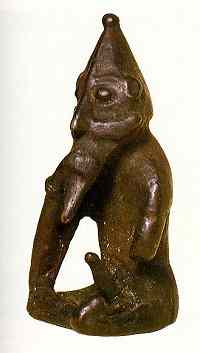
After a few offerings, I've decided to make representations of Them to sit on my nature altar next to Nerthus.   I made them out of salt-dough, which is almost like playdough to work with, and super cheap to make.  I shaped them based off of an image of Freyr from an archaeological dig in Sweden (though no visible penis - this is being displayed in my kitchen, after all!).  After drying them out in the oven, I painted them with greens and golds to imitate vegetation and wheat.  I painted Fréo an amber necklace, though I don't believe She was connected with an Anglo-Saxon version of Brísingamen - however, since we know so little of Her, there's no way to say Fréo didn't have an amber necklace of her own either.

I've been offering Ing and Fréo birdseed, which is what I keep to offer to Nerthus, but I may begin experimenting with other offerings related to the earth or plants.  I've been saving some rose petal powder to burn as incense that I'd like to see if Fréo enjoys.  If my readers have any offerings suggestions, please let me know in the comments!

Tuesday, January 14, 2014

Cheap Religion: Salt Dough Deities


If you are a parent or someone trying to be a more thrifty Pagan, and you haven't tried salt dough, something is wrong here and we have to fix it quick.  Here's a recipe for the simplest clay anyone's ever used - you probably won't even have to go to the store, because there's literally three ingredients and they're in almost everyone's kitchens.  Salt, flour, and water.. did I mention cheap?  You can make just about anything out of it, it's super cheap, dries pretty quickly, and if you give it a coat of paint or a sealant it'll last at least a few years.

I've been wanting to do a series for awhile about doing Paganism less expensively, because let's face it: Paganism, especially in the beginner 101 books so many start with, tends to be pretty commercialized.  You don't need much but a bible to start out as a Christian, but pick up a beginner Pagan book and there's all kinds of lists of things you might need - wands, different colored candles, divination tools, deity representations, and on and on.  A lot of that stuff is actually really helpful to your practice, especially a person like me who is both very tactile and visual.  But Pagan and New Age stores tend to be expensive, sometimes prohibitively so if you're a Pagan on a small budget, or a Pagan with children who aren't the best at looking but not touching.  Trust me, it is hellish trying to do a ritual with small children when you're terrified at every second that someone is going to break an expensive something.  This is also helpful for those Pagans who honor obscure enough deities that finding a decent representation is next to impossible.

Try not to leave your receipt on the counter when taking pics!
Salt dough deity representations are super easy to make, even if you're like me and terrible at sculpture.  Your first step is to pick a picture of the deity you're crafting a representation for - it can be something you draw, or a picture you like from the Internet (copyright law doesn't cover a few pictures printed at home that aren't for sale - though if the artist is selling their pictures, it's courteous to actually buy it).  For my representation of Ogma, I chose a carving on the US Library of Congress's doors, which you should totally check out because there's representations of writing or scholarly gods or people from many cultures and it looks awesome.  It's usually a good idea to print your picture the day you make the salt dough, giving both the dough and the picture a chance to dry so the ink doesn't run.

But if you do, just add a cute heart - no one will notice.
Then you gather up your supplies, and get to work!  First roll out the dough like you would at the beginning of a pizza or sugar cookie recipe - careful not to make the dough too thin (it will rip!) or too thick (it might never dry).  This takes a bit of experience, but if you have ever done pizza or cookie-cutter cookies before, you'll be able to feel the tension of the dough and the thickness it needs. Pick it up and lay it flat as you can on a flat plate.  Using a knife, cut out a rough square (it helps if the corners are rounded rather than sharp) and peel off the extra dough you won't be using.  Use the extra dough to fashion a "stand" of sorts to stick to the back of your square, making sure the two pieces are connected well and the bottom is flat.  The salt dough recipe I use then recommends microwaving it for about 3 minutes, and afterwards I usually let it dry overnight.  You may need more or less depending on the size and thickness of your square - the smaller one for Ogma took just 3 minutes, while the bigger one pictured on the plate took about 9 and then I let it sit for three days.  Be warned - you may get some air pockets that form bubbles, and the bigger the surface area of your project, the bigger they will get.  It's my theory that adding another flat object on top of the dough would help with that, but I don't have anything the right size that's also microwavable.

After everything is dry, you can use a paint brush and some Mod Podge or other glue/sealant combo to stick your picture to the flat surface of the salt dough. You can get creative and paint different colors around the picture to create a more colorful look, or just leave the color plain.  Again, print your picture the day you cut out the salt dough, because the colors may run when using the sealant otherwise.  I ran into this problem on my first attempt, and the results were more like modern art than the pretty pictures I had envisioned.

So there you have it!  It's probably not the best representation of Ogma that ever sat on an altar, but the fact that I made it for less than $1 makes me love it a lot more.  Even if you're a broke Pagan or worshiping Slavic deities for whom no statues have been made, you can have an altar that works for your spirituality.

Sunday, December 15, 2013

Frige and the 'Womanly Arts'

Growing up, my mother was a feminist.  Not a radical feminist, or a particularly far-out-there one; but I grew up being told not to get married or have children, that there were so many other things in the world I could do if I wanted to.  Well, it turned out that I did decide to go the traditional husband-and-babies route; and now being a stay at home mom, it can sometimes feel as if I've taken a step backwards.

Enter Frige.  An Anglo-Saxon Goddess, Her name is cognate with the Norse Frigg; wife of Odin and Queen of Asgard.  Through Norse sources, we know that She is the Goddess most often associated with women, children, and the home.  She is also the patron of what those of generations past would have called the 'womanly arts': spinning, sewing, knitting, cooking - the things a woman needed to know to maintain her home.  However, Frige is no 1950s housewife, and those who honor Her certainly aren't, either.  In the Lokasenna (you can find Benjamin Thorpe's translation free), Loki accuses Frigg of sleeping with Odin's brothers; the Goddess Freyja retorts by saying "Mad art thou, Loki! in recounting thy foul misdeeds. Frigg, I believe, knows all that happens, although she says it not".  This has led many to speculate that Frigg winds the threads of fate that the Norns spin into orlæg (ørlög in Old Norse).  By the way, later on in the poem the God Njörðr says: "It is no great wonder, if silk-clad dames get themselves husbands, lovers", seeming to say that women having multiple sexual partners was not a big deal.  In the Prose Edda book Skáldskaparmál, it is mentioned that Frigg has a "falcon form"; not quite as tame and feminine as one might expect from the Queen of the Æsir.

Now that I've gone off-topic talking about all the ways Frige is not like a housewife, it's time to circle back around and talk about the more traditionally feminine crafts She is associated with.  Because I don't have a spindle or access to raw wool, I've eschewed the traditional spinning and have instead learned to crochet as a devotional act.  It's very calming and meditative, as the same motions are repeated over and over, but requires constant attention; it's not the kind of thing you can do absentmindedly while watching a movie, you must be looking at your work.  It's the same with embroidery, which I learned long ago in Home Economics, but still enjoy doing on occasion.  These actions both quiet and focus my mind in a way that traditional meditation - which usually just puts me to sleep - is unable to do for me.  This kind of work does not have to be only a time-consuming chore put aside when faced with modern conveniences.  It doesn't have to be a symbol of subservience, as if being domestic and taking care of one's living space is somehow lesser.  The act of creation: of a meal, of a scarf, of a clean space; is very powerful, and lands squarely in Frige's domain.   I think this is part of the reason crafting is so popular today - many of the people I know either work office jobs or are working on their education; there's a lot of work that happens but doesn't produce any real, tangible result that can be held in your hand or used for a practical purpose.  But the creation of those tangible things can be so satisfying; the simplicity of taking a strand of yarn and working on it for a few hours until it becomes a cute little pouch is something I think a lot of people crave.

I know I titled this post about the 'womanly arts', and that's because they've historically been a woman's domain.  But I want to make it clear that men can absolutely benefit from learning these things as well!  I taught my brother how to sew one day when he lost a button, and now he fixes his own pants when they get holes in them; and finds a great deal of satisfaction in being able to do so.  On the one hand, simple things like sewing and cooking are great life skills; and your life will be easier for having them.  On the other, as I said earlier - these activities are also very psychologically fulfilling.  I plan to pass these skills down to all my children, daughters and son, and hopefully an appreciation for Frige as well.

Thursday, November 7, 2013

Crafting the Runes: Os


The mouth is the source of all language,
a pillar of wisdom and a comfort to wise men,
a blessing and a joy to every knight.


The Anglo-Saxon rune Os (according to a Wikipedia article which steadfastly refuses to cite its sources!) is one of three Anglo-Saxon runes that split from the Ansuz rune of the Elder Futhark.  Because of the development of vowels in England at the time, the 'a' rune was split into an 'o' sound, an 'æ' sound and an 'a' sound.  If I'm remembering my diction class correctly (which is debatable), the 'o' sounds like the o in 'moat', 'æ' sounds like 'cat' and, and 'a' sounds like the a in 'caller'.  Os is our 'o' rune.

There is also a bit of controversy over the translation of the name of this rune.  I discovered, by googling some of the information in the before-mentioned Wikipedia article with no sources, a lovely volume titled The Anglo-Saxon Minor Poems, Volume 6 by Elliot Van Kirk Dobbie.  One of the poems he analyzes is the Anglo-Saxon rune poem, and his commentary has a great deal of information on the runes, as well as what seems like a wealth of sources - which I am, unfortunately, unable to see with the brief Google Books preview; I'll be ordering it through inter-library loan and will hopefully be able to update with more direct sources soon.

 "The name os, given for this rune by Hickes, is perhaps the Anglo-Saxon word os, "(heathen) god"."  He goes on to say: "In the Iclandic rune poem the rune (in a somewhat different form) stands for óss (or áss), "god," but in the Norwegian rune poem it stands for óss, "river-mouth, estuary."  An alternative translation of the Anglo-Saxon rune name, by Kemble, Archaeologia XXVIII, 340, favored by Dickens and accepted by Keller, Anglia LX, 142, takes os as the Latin noun, "mouth."  This meaning fits better with the [stanza of the Anglo-Saxon rune poem], "source of every language," but no other foreign words are found in the poem as the names of runes."

Given this evidence, I think it is reasonable to discount the Latin translation 'mouth' as a Heathen interpretation of the runes.  I believe that Van Kirk Dobbie is quite correct in his supposition that the name for this rune translates to 'god', especially since the Icelandic rune poem, as noted in the quote, quite specifically mentions it (God // aged Gautr // and prince of Ásgarðr // and lord of Valhalla).  Given the connections we know Woden has to the runes, language, and poetry; I don't think it's outside the realm of possibility that the line "the source of all language" may be referring to Him.  Again considering the Icelandic rune poem, who would be the "lord of Valhalla" but Odin?

Now that we've analyzed the possible translations of Os, it's time to discuss the meaning of this rune and its possible implications in divination.  My take on this is obviously going to be informed by my association of the Anglo-Saxon rune poem's stanza with Woden, so bear with my potentially over-reaching conclusions!  I see this as Woden's rune, much like Tyr is associated with Tiw.  We don't know much about how the Anglo-Saxons viewed Woden, and how those views may have been similar or different to the view of the Norse; and this rune poem was written a few generations off from un-Christianized Heathens.  Nevertheless, I feel this rune's strongest associations are with Woden as a god of language and poetry; a poet's rune.  To me, it would represent creativity, and the struggle that must so often be engaged in to let the creation come to light.

Wednesday, October 23, 2013

Crafting the Runes: A Beginning

Since I began my work with an Anglo-Saxon hearth, I've been wanting to acquire a set of Anglo-Saxon runes to work with.  I've looked around (a bit half-heartedly, I must admit) and nothing struck my fancy.  Then about a week ago, I was getting ready to mow my lawn.  It's a multi-step process for me, the procrastinator that I am, and the first is to clear up all the tree branches lying in the grass that have been knocked loose by these crazy prairie winds.  This particular day, I found a nice branch, about three feet long, that was almost exactly the same thickness all along its length.  "How perfect that would be for making runes," I thought as I threw it on the stick pile.  I spent the next few days thinking about that branch - I couldn't get it out of my head.  It really was perfect for this project.  So I went outside and rescued it, and now am beginning my adventures in rune-crafting!

First, I performed a fairly simple ritual for Woden, asking Him to bless the branch I was going to work on.  Now, when I say "fairly simple", I mean very simple.  It was very impromptu as well, but I'll try to recreate it as a bit of a guide.

"Woden, you who drank the mead of poetry, and hung from the Tree for nine nights and nine days, and who drank from the Well of Mimir.  Mighty Woden who sees all Runecraft, bless this branch from which my runes are made.  I offer you this gift (libation of mead) so that I may see with wisdom, speak with wisdom, live with wisdom."

After the ritual, I sawed off some circles for the first Aett and sanded them down until they were smooth.  With all the bark gone, they are a bit smaller than I anticipated, but I think my already over-laden altar will be happier for it.  I plan to make one rune each day, spending the day meditating on its meaning, and hopefully doing a summarizing blog post at the end of each day.  (And hopefully also helping me out with the meditation requirement for the Dedicant's Path - I have a much easier time meditating when I have something to think about!)

The fantastic thing about the Anglo-Saxon runes is that there is a fully intact Rune poem that describes what the runes meant to the people of the land.  Being post-Christian, there's definitely some questionable stuff in there, but it's nothing that can't be figured out with some good old UPG!  I'll be quoting the relevant portion each day as I continue to study the runes.  Hopefully this will be a helpful resource for future students to come!

Friday, September 27, 2013

T is for Temple

Alright, so Stonehenge may not have been a temple (we don't really know), and it certainly wasn't a Druid temple, but it's still the most easily-recognized and impactful image of pre-Christian European worship.  Ritual for Celtic and Germanic Pagans seems to fit best under the stars, out in the open or within a sacred grove of trees.  This is something that I want very much for myself - a permanent area of outdoor worship, that I can use for its intended purpose and also isn't altogether obvious to visiting relatives or passers-by!

There is a large area in my backyard that was once a garden, but the previous owner let it go and it has collected a great deal of weeds and other detritus.  Last winter we put tarp over a lot of it, and this winter we'll be tarping over the rest to prevent weeds coming up in the spring.  And then, next spring, I plan to begin the "construction" of my own temple.  I put construction in quotes, as there will be a lot more growing and planting involved then actual building!

The area is square, but I will be bricking off a small circular area in the center to be the main ritual site.  Inside the circle will be a decorative pole (Sacred Tree in ADF), and at its foot will be a small birdbath (the Well for my ADF rituals), and a space for my larger cauldron that I also use as a small fire pit.  Outside this circle will be a small circular bricked path, which will branch out like the spokes of a wheel, and it will be between the spokes that my garden will be growing.  What I'm most excited about is imitating Stonehenge and other solar-aligned standing stones by building an astrological garden into the plans.  For this I'll use small bricks that will mark the shadow of the pole at sunrise, noon, and sunset on the solstices and equinoxes; which should add up to nine bricks; they'll be inscribed with runes or ogham and half-buried.  They'll be small and unobtrusive, but will represent a long-time project, and will connect my own little temple with the many that have come before.  It will be relatively small, and probably wouldn't support a group larger than my children and I, but I think on its completion, it will be worthy of the name temple.

Obviously, not everyone has the time or the resources to make their own outdoor temple, and I can't even begin to express how blessed I feel to be able to do this.  I hope my plans have been inspiring to some of you, and that you can find a way to make your own space into sacred space!

Sources: The 2012 Farmer's Almanac, on astrological gardens


Tuesday, August 28, 2012

ADF Prayer Beads

I found myself with a bit of time alone this afternoon, and felt in the mood to do something for the Gods.  I haven't been struck in that way for awhile (not to mention that I have precious little time to myself lately!), and so I came up empty when searching for a ritual I knew well and could perform easily.  Of course, my musings got away with me as they usually do, and I found myself thinking about making a set of prayer beads.  I'd seen some neat ones around, and I recently found a post by Ozark Pagan Mama describing how she made her beads compatible with ADF ritual.

And so I attempted to put my own spin on this recently-popular concept.  I put a 'visual-aid' sort of key at the bottom of this post in case anyone has trouble envisioning which prayers go where.I wanted my beads to be not only a prayer and devotion set, but also a helpful aid to remembering ADF's Core Order of Ritual.  Much of the ritual is borrowed and modified from one found in the Dedicant's Manual of ADF Druidry; some poetry comes from the Celtic Prayer Book.


Saturday, August 11, 2012

Altar Tools: Making the Bell Branch


 I love crafting!  Honestly, I'm not the most artistic person in the world, and I'll probably never make something as nice-looking as what you'd find in a store; but I find that I love the homemade touch and the connection with a tool that crafting it gives.  Celtic myth tells of a silver apple branch hung with bells that was the tool of a Druid.  This isn't necessarily historically accurate information, and as such it's not a commonly used tool in ADF Druidry, but its history and symbolism is so rich within revival Druidry (Yeats even wrote a poem about it) that I really wanted to have one myself.


This project was easy and straightforward, exactly the kind I like!  I used nine bells bought from the local metaphysical supplier, three colors of embroidery thread (I had it lying around) and a beautiful strong branch of unknown wood that I picked up in the park last year and has been drying in my garage ever since, just waiting for a project like this.

First, I had to prepare the branch.  As I said, it had been drying in my garage for nearly a year, and so it was relatively easy to strip it of its bark with my pocket knife.  After it was as clean as I wanted it to be, I took a piece of very high grit sandpaper and sanded it for a good half-hour.  With that kind of sanding, it was mostly a beautiful pale white color, and extremely silky - the kind of feel wood takes on after a nice polishing.


I then strung three bells on each of the three lengths of thread, tying them in place.  I placed a bunch of three near the top of the branch, and the other six I tried to space evenly along the rest.  I then wound the threads around the wand, tying it carefully at each end.  For extra insurance to make sure the strings didn't slip, I placed a dab of wood glue at each knot.


And that was it!  All together, including the carving and sanding of the branch, it took about two hours - hardly a major time investment!  The bells are beautiful; but unfortunately don't give much of a sound except where the three are bunched together at the top.  If I ever make another, I think I'll choose the more traditional kind of round jingle bells; they would probably give a better sound.  Still, I really love this branch, and I hope it will make a great and atmospheric addition to my future Druid rituals.


Saturday, March 24, 2012

Constructing an Altar

If anyone was wondering why my Pagan Blog Project post was so scatter-brained and late last night, its because I decided to start a little project at 8 o'clock last night!  My husband is out of town for the weekend, so after laying the little ones to sleep I had a big block of time all to myself; and I really wanted to use it to complete an altar project that I've had rolling around in my head for awhile now.  I was up until three, so bear with me if this post is a bit meandering as well!

My altar is on top of my dresser in my bedroom (though, by this point, most of the clothes have been moved to the closet to make room for supplies and tarot decks!).  It's a nice big dresser with lots of space, but lately I've been wanting to separate some space out - I want to have a separate moon altar, space to work magic, and another space for my ADF and Druid things.  I spent a few days coming up with the plans - building a little desk hutch that would have three distinct areas, while still leaving the space underneath open and usable.  I bought some lumber a few days ago, and have been waiting for the right time (and an empty garage) to put my plans into motion.

We don't own any power tools, so this was done with an old hand saw and some wood glue.  I also used my wood burner to put some designs on the top and the two pillars.  I glued everything together, and set it up to dry overnight.  Tons of books are piled on top to keep everything stuck together while it's drying!
And here's the final product!  Well, mostly final - I'd like to get some light stain and seal it once my husband is back with the car - but this is the general idea!  The space on the right is devoted to a Sun altar at the moment, but it will be moved for any magical altars I'd like to set up.  My favorite is the new ADF area; the seasonal Tree, Fire, and the Well tucked beneath them on the lower shelf.  Overall, things are much less cluttered, and I feel like my daily devotions are more focused since each area has its own purpose.

And now that I've shared mine, please share yours as well!  I love to see people's altars; they're such a wonderful window into the spiritual practices of others.  If you don't have one of your own due to a lack of furniture, let my project be an inspiration!  This is literally the very first thing I've ever built out of wood, if you don't count the scrap pieces my dad used to let me glue together as a kid - and it didn't turn out too bad.  Just remember: measure twice, cut once!