Showing posts with label prayers. Show all posts

Wednesday, April 29, 2015

Daily Devotional - Evening

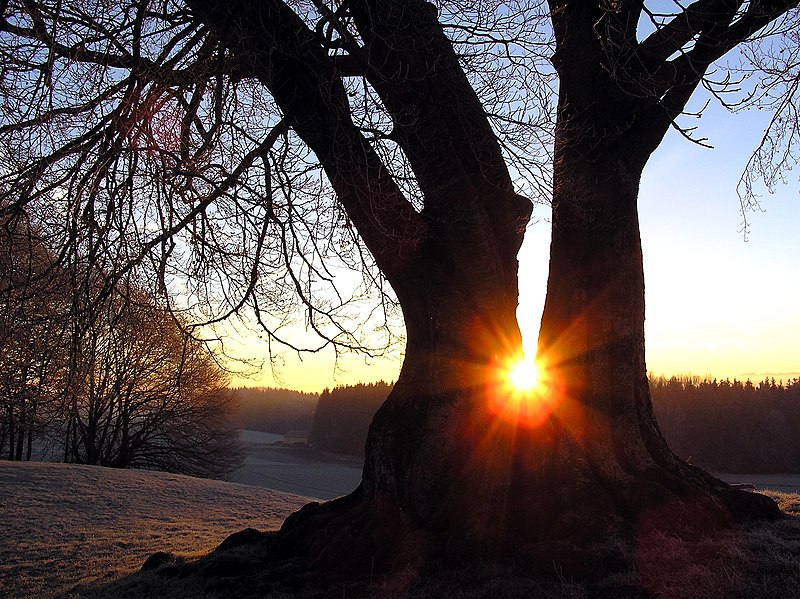
photo by Michael J Bennet
creative commons license
I've been feeling the need lately to round out my day with a night-time devotional to mirror my morning routine.  I chose to honor Earendel and Niht, the evening star and the personification of the night.

Hail Earendel, evening Star,
bearer of light before the Sun and Moon.
Bright above me every evening,
star in the darkness, jewel of the sunset.

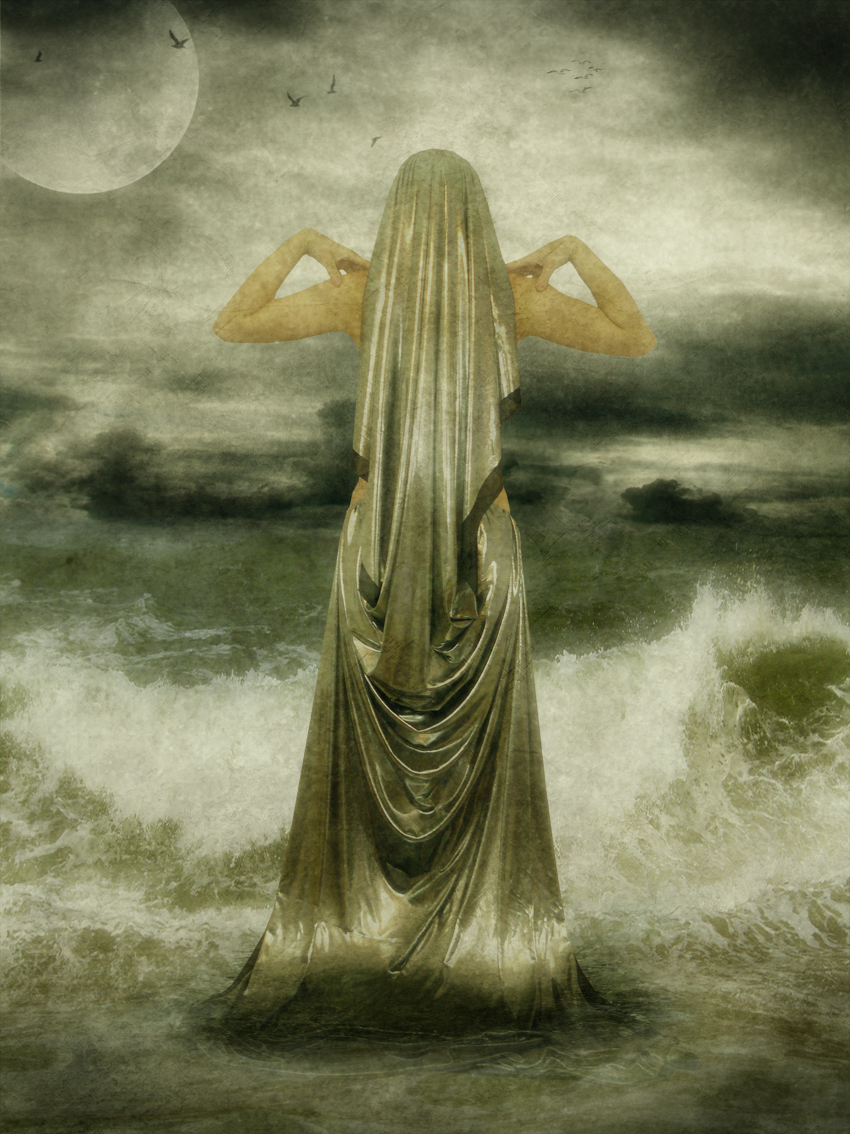
Hail to Niht, the darkness of night,
Mother of the good earth.
Joy of sleep and goddess of dreams,
black that blankets all.

I smoor the sacred fire
as the light of day wanes.
May it bring rest and sweet dreams
to me and mine.


Sunday, April 19, 2015

Nature Spirits, Nerthus, and Celebrating Earth Day

photo by David Luther Thomas
creative commons license
What does Earth Day mean to you as a Pagan?  For me, Earth Day (and its constant Nebraskan companion, Arbor Day) is a secular holiday that nonetheless holds a great deal of religious meaning.  I hate to say things like "the nature spirits are the most important part of my practice" because of course my ancestors and the deities are also incredibly important.  But the land wights are certainly more present in my day-to-day life.  Just looking out my windows, walking my daughter to school, or even driving down the street on my way to work, I encounter hundreds of them, and there's no ignoring it.  People who would never think to discuss their God(s) or ancestors will comment often on the weather, the flowers, etc.  We are always thinking about our fellow earth-dwellers, all the time.

This is a ritual I wrote to celebrate the Germanic Goddess of the Earth, Nerthus.  I have written about Her before, a relatively 'dark' mother Goddess who allegedly received human sacrifice after parading about the land bestowing Her bounty.  Of course I am Her devotee and fairly biased, but I believe that as the earth becomes more and more damaged by human actions, more people will begin to see the darker side of the land.  I find it powerful and motivating to stand in awe of Her, not motivated by love or trust; but sometimes by genuine fear.  In my mind, it is She who sustains all life, and if She so chose could end that sustenance at any time.  She is truly awe-worthy.  It is my hope that this Earth Day ritual captures some of that wonder.

There are a few rituals for Nerthus out there, most centering on the journey of Her wagon bringing peace and feasting to every village She visited.  Since this is an Earth Day ritual, however, I find it more appropriate to focus on the things I can do for Nerthus, rather than parading Her about and asking Her blessings on the people who hold partial responsibility for the damage done to the land.

Set up a small shrine out of doors; in your backyard, a local park, or wherever you can be relatively assured of solitude.  If absolutely necessary this can be done indoors as well, be sure to face a window or have some reminder of your local land available.

Needed items:
Representation of Nerthus - something as simple as a bowl of water to represent Her lake will work
Found objects from the land to decorate shrine - my permanent shrine has dried leaves and twigs from each tree in my yard, as well as feathers and other found things; this is a good place to start if you're not sure what to use
Offerings for Nerthus and land wights - I often use birdseed or dried corn, but anything that does not
actively harm the land would probably be acceptable

Plans for an Earth Day activity to help the Earth

Approach the shrine, calling out:
"I call to all the spirits of this land:
the dancing wights of stream and creek,
the swaying spirits of the trees,
the singing grasses played by the wind.
I call to the stones, solid and stoic,
to the dark and fertile earth beneath my feet,
to the flowers that fly open and fade away.
I call to the furred spirits, waiting for twilight,
the feathered wights that serenade the dawn,
the tiny crawling beings, spirits of scales and slick skin,
to all the spirits of this land.
Be welcome and pray welcome me.
Accept this offering!"
Scatter or place offerings for the wights before the shrine.

Bending or sitting as you are able, place your hands upon the earth.
"Hail Nerthus, veiled Goddess,
dark and silent in your sacred grove,
hiding your eyes from the hurt of the Earth.
Vibrant with life, shining with death,
keeper of the never-ending circles all things dwell within,
green that grows from dark decay.
I see the broken land, I work to right it;
join your power to mine, and bring life from this death,
lend your aid to me and mine as we heal the hurts."
Scatter or place offerings to Nerthus before the shrine.

This is a great time to actually do some kind of service to the Earth - perhaps going around picking up trash, planting a tree, or any other activity you may have planned for Earth Day.  If you are not able to do it right away, simply tell the spirits what you plan to do in service to the cause of helping the land.

"Hail to Nerthus, sweet mother of earth,
and all the wights that dwell here in this place.
I thank you for your gifts of sustenance, gifts of beauty.
Remember me as I will remember you.
Hail and farewell!"

The found objects should be left to continue to give beauty to this piece of land, unless you feel one is meant to come home with you.

Sunday, April 5, 2015

Prayer and Offering for Eostre

by Norbert Nagel, Creative Commons License
Hail Eostre, the rising dawn and the coming spring!
As Your golden rays gleam above the horizon,
the buds begin to bloom and open,
heralding the return of light and life!
Beautiful Goddess framed in flowers,
the beginnings of apples, peppers,
all fruit that flourishes on branch and vine,
bring brilliance and bounty to me and mine.

My favorite offering for Her this time of year is dyed eggshells.  First poke two holes at either end of an egg, and blow the contents out into a little dish to save for omelettes or whatever you like.  Then the eggshell can be dyed in natural dyes, and it will color both the inside and outside of the egg.  I have had a good time crushing several eggs together until they form a colorful sort of eggshell gravel, but they can certainly be offered whole as well depending on what you’d like!

Sunday, March 29, 2015

Prayers to the Gods

In times of difficulty, I often feel so drained or exhausted that even thinking about praying or giving an offering seems to much.  It feels there are no right words for the circumstances, no flowery phrases that can directly translate the pain and heartache that must be dealt with.  In these times, I find it best to use a simple prayer, a good prayer that affirms the order of the world and calls down blessings.  One such prayer can be found in the Sigrdrífumál, part of the Poetic Edda.  This version was translated by Bellows in 1936, and reads:

Hail Day!  Hail sons of Day!
And Night and Her daughter now!
Look on us here with loving eyes,
that waiting we victory win.

Hail to the Gods!  Ye Goddesses, hail,
and all the generous Earth!
Give to us wisdom and goodly speech,
and healing hands, life-long.

This is such a powerful prayer for me.  I have written my own version that I like to use when I can't find the words but feel the urge to pray, to affirm my place in the cosmos and ask for the good favor of the Gods and spirits.

Hail to the Day that rises,
hail Sunne who brings light and life!
Hail to the Night that brings joyful sleep,
hail Mani who keeps the time and tides!
Ever keeping Your circles,
look on us with loving eyes,
bring blessings like shining light.

Hail to the Gods and Goddesses,
to the lands and the living waters,
to the ancestors, ancient and wise,
to all the generous Earth!
Give to me wisdom and a happy heart,
a voice and hands that heal hurts,
for all the days of my life.

Wednesday, February 25, 2015

Konudagur - a Celebration of Spring

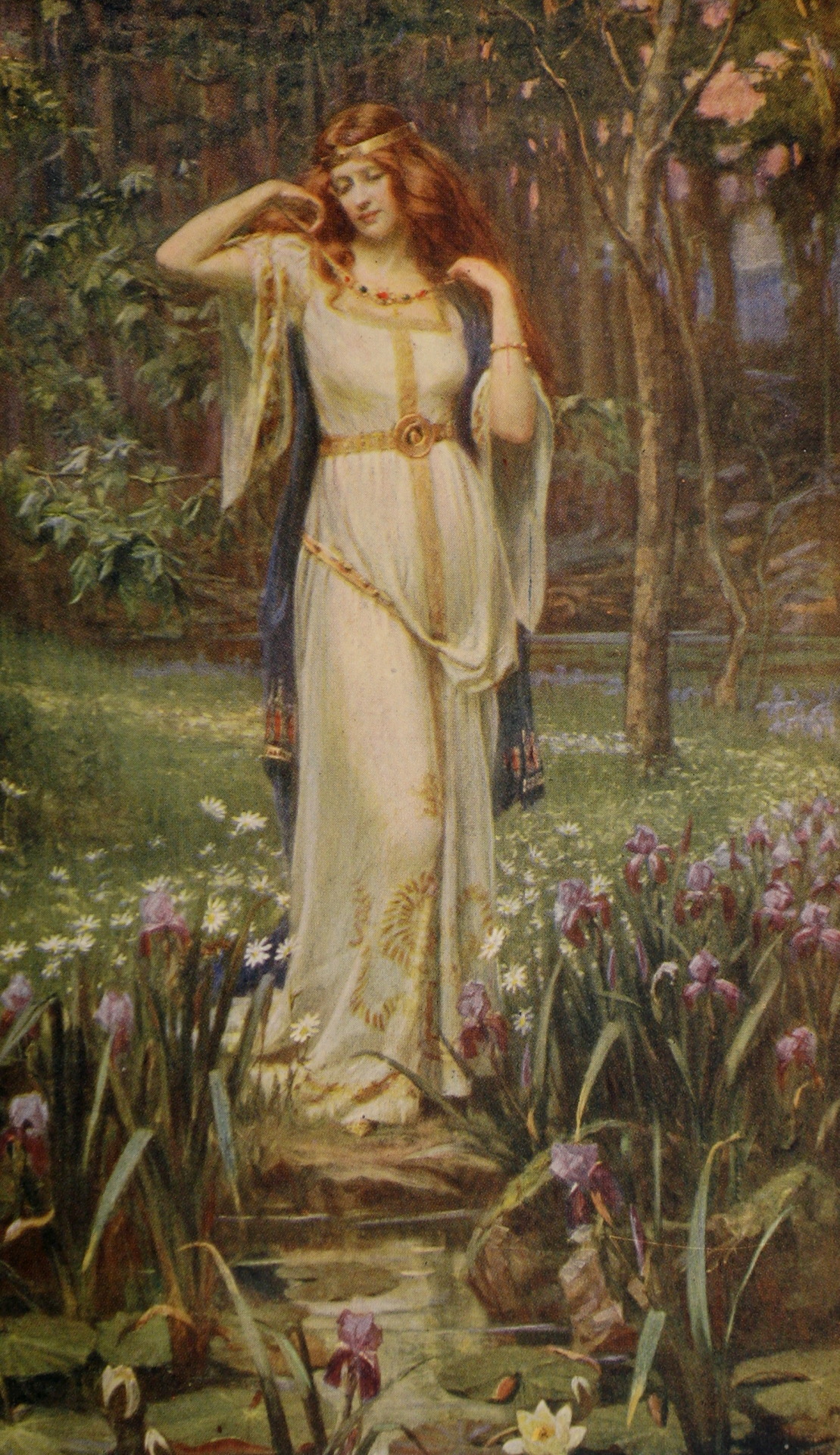
Spring Maiden
by Frank Dicksee
As explained by tumblr user Thorraborinn here, the first day of the Icelandic month of Góa is a day celebrating women and wives.  Góa is alternately either the daughter or the wife of the frost-king Thorri, who disappears at midwinter, and a blót is given to bring her back.  I have written a small ritual to honor this tradition of welcoming back the spring.

Bring a small meal and drink to the threshold of your home.  Call out and address Góa, saying:

Hail the daughter of the Frost King,
who hides in the winter
and returns in the spring-long day.
Your eyes are thawing pools,
your hair like shining sun,
your limbs long and empty branches
soon to sprout new leaves.
I come bearing gifts for the lady of spring,
food to nourish new growth,
to bring forth green sprouts,
to warm the thawing earth.

Open the door, go outside, and pour out the drink on the earth, saying:

Be welcome, dear Góa,
and go into the house;
don’t be outside in the wind
in the spring-long day.
(translation by Thorraborinn)

Come back inside, bringing the plate of food to the table, and set it out as you would for any other guest.  Dine with Her and leave the offerings outside afterwards, if possible.

Monday, January 26, 2015

Week 4: Álfablót Anytime

photo by Aymi and Laurel
creative commons license
One of my favorite things about Heathenry - and possibly what initially drew me to the path - is the emphasis on honoring ancestors and land wights as much, or more than, the deities.  Don't get me wrong, I like the Gods, but being able to go out and sit in the garden and connect with the land wight there is so much more concrete and immediate than reaching out for a deity that travels this world and the otherworlds.

Álfar is an old Scandinavian term that is a subject of some controversy in Heathen circles - whether it refers to the spirit of a male ancestor, a land spirit, or some mix of the two is under some discussion.  The old holiday  Álfablót was a time of sacrifice to these beings, held individually in the autumn at each farmstead.  Since there aren't actually any grave mounds on my property, I chose this time to do a special sacrifice to the land wights.  But one day a year is not nearly enough, in my opinion.  Honoring the land spirits had to become a major practice for me, simply because they are such an ever-present part of my life.

And so every Friday, I go out to the altar in my garden, bringing a bit of food or drink for the land wights.  It doesn't have to be an elaborate blót - in fact, it rarely is - all that's needed is to call the spirit's attention to the offering.  This consistency is important towards building a relationship with a land wight; it establishes a mutual hospitality where gifts are given on both sides - and a land wight's gifts are not to be underestimated.

Spirits of the earth and soil,
of things green and growing,
expanding and entwining,
rooted deep in the dark,
hear me now.
Spirits of the lithe and limber,
of wandering wings and fleet of foot,
sprinting and spry,
digging and devouring,
hear me now.

Hail to the land and the wights of the land.
A gift is given, and another is given in turn.
May we meet again on the dark earth.

Saturday, January 24, 2015

A Thorrablót Ritual for Thorri

Photograph by Ian Capper, shared via Creative Commons License
As Vanatru or Earth-centered Heathens, it's easy to love the Vanir.  They're flashy, they're green, they grant prosperity and fertility - usually thought of as warm and friendly in contrast to the more 'stern' of the Norse deities such as Odhinn and Tyr.

Where I live on the Midwest prairie, it's hard to forget about winter.  And yet I think many Pagans often forget about honoring this time of darkness and cold.  In my many gardening adventures, one important thing I've learned is that many of the plants that grow in my home state can't grow farther south, where the winters are short and warm if they exist at all.  They require this period of dormancy, of rest in the cold earth.  And yet, it's important that the land doesn't become too cold - below zero temperatures for weeks at a time can spell disaster for many plants typically grown in Nebraska.  As a person who honors this land and its weather, not recognizing and encouraging a natural, normal winter takes away from my practice and my relationship with the land.

And so we come to the old Icelandic holiday of Thorrablót.  Last year, I addressed some etymological questions about this day as Thor's, and came to the conclusion that as an Earth-centered Heathen, this day and season more appropriately belong to Thorri, a spirit of winter and cold.  Anglo-Saxon Heathens may choose to honor Jack Frost, who has similar folklore origins.  This year, I've taken the time to write a small ritual to propitiate this king of frost, that the spring may come in a timely fashion.

First, prepare a small feast or special meal that can be shared with the spirits; if you want to go all out, there are many traditional Icelandic dishes associated with the holiday.  Also have a special drink on hand - preferably mead, but any alcohol or 'fancy' drink will do.  In fact, if you prefer the non-alcoholic route, hot cocoa or mulled cider would be a particularly suitable offering!

via Creative Commons License
Once the meal is ready, make up a small plate and take it and the drink outside with you, into the cold.  If you have an outdoor altar, perform the ritual there - otherwise the threshold of the home or natural place that calls to you are good options.  Call out and address Thorri, saying:

"Hail King of the Frost, son of Snow-King,
You rule this icy winter.
The chilling winds that blow are Yours,
the gray clouds that hide the sun are Yours,
the frozen crystals that cover the ground are Yours.
I come bearing gifts for the Frost-King,
food for the spirits to warm Your heart,
to turn aside the winter winds,
to relent in the cold that covers all."

Set the plate of food on the altar or ground, and raise your glass.
"Hail Thorri, great King, who gives the world rest,
Ancestor of my heart, bringing sparkling frost,
I honor Your gifts and welcome their return
in their due course, in Your right season.
Hail to Thorri!"

Drink half the glass and pour the other half out.  You may eat your feast outdoors, or if weather or other circumstances prevent, inside looking out at the winter landscape.

Wednesday, October 8, 2014

Blōtmōnath, Winter Nights, Dísablót, Samhain - All the Holidays!

by Boschfoto on Wikicommons
Creative Commons License
Sometimes, being a Heathen with a leaning towards the historical can get a little confusing.  Depending on exactly what Germanic culture you're working within, this time of year is good to sacrifice cattle to the gods (Anglo-Saxon Blōtmōnath), offer to the Dísir (Scandinavian Dísablót), or possibly even to honor Odhinn as may have been done during the Icelandic Winter Nights.  For those who follow a more pan-Germanic approach, or draw inspiration from more than one tribe or geographical area, this is a lot to sift through.  For a great discussion of Winter Nights, head over to tumblr blog The Frozen Oak.

I personally tend towards the Anglo-Saxon direction, and so I save honoring the Dísir for Mōdraniht in December.  That leaves Blōtmōnath, the month of sacrifices when cattle would be dedicated to the gods.  According to Swain Wodening's reconstructed Anglo-Saxon calendar,  Blōtmōnath starts on November 3rd this year.  There's a lot of talk in Neo-Pagan circles about Samhain being the 'meat harvest' and I think this is one of the inspirations of that idea.  This time of year, our ancestors who had to carefully ration food to make it through the winter would figure up just how much feed they had, and how long that would last their current herd of cattle.  Usually, it wouldn't go quite far enough - and then the cattle would be ritually slaughtered, and the meat feasted upon and saved for the winter.

Now, modern-day Heathens, especially those living in suburban or urban areas, are not generally going to be able to ritually slaughter their own animals.  Instead, I choose to observe this time of year as one of awareness and remembrance for the gifts given to me: both by the animals who gave their lives that I could eat, and by the gods who create and sustain the lives of all things on this earth.  In keeping with that idea, not only do I like to have one large family feast featuring a roast or some other delicious meat dish, but I find it helpful to remember to address a prayer to the spirit of the animal, and the gods that went into its growth, each time I cook or eat something using meat.  This is one I wrote to use when honoring the cow from which our roast will come this year.

Nerthus, Sunna, Thor, and Frey:
For the black earth,
for the shining sun,
for the pouring rain,
for the sweet grass,
I thank you.

Strong cow who roamed the black earth,
lay in the shining sun,
drank the pouring rain,
grazed on the sweet grass,
for your gift of life,
I thank you.

Wednesday, October 1, 2014

A Charm to Halt the Rain

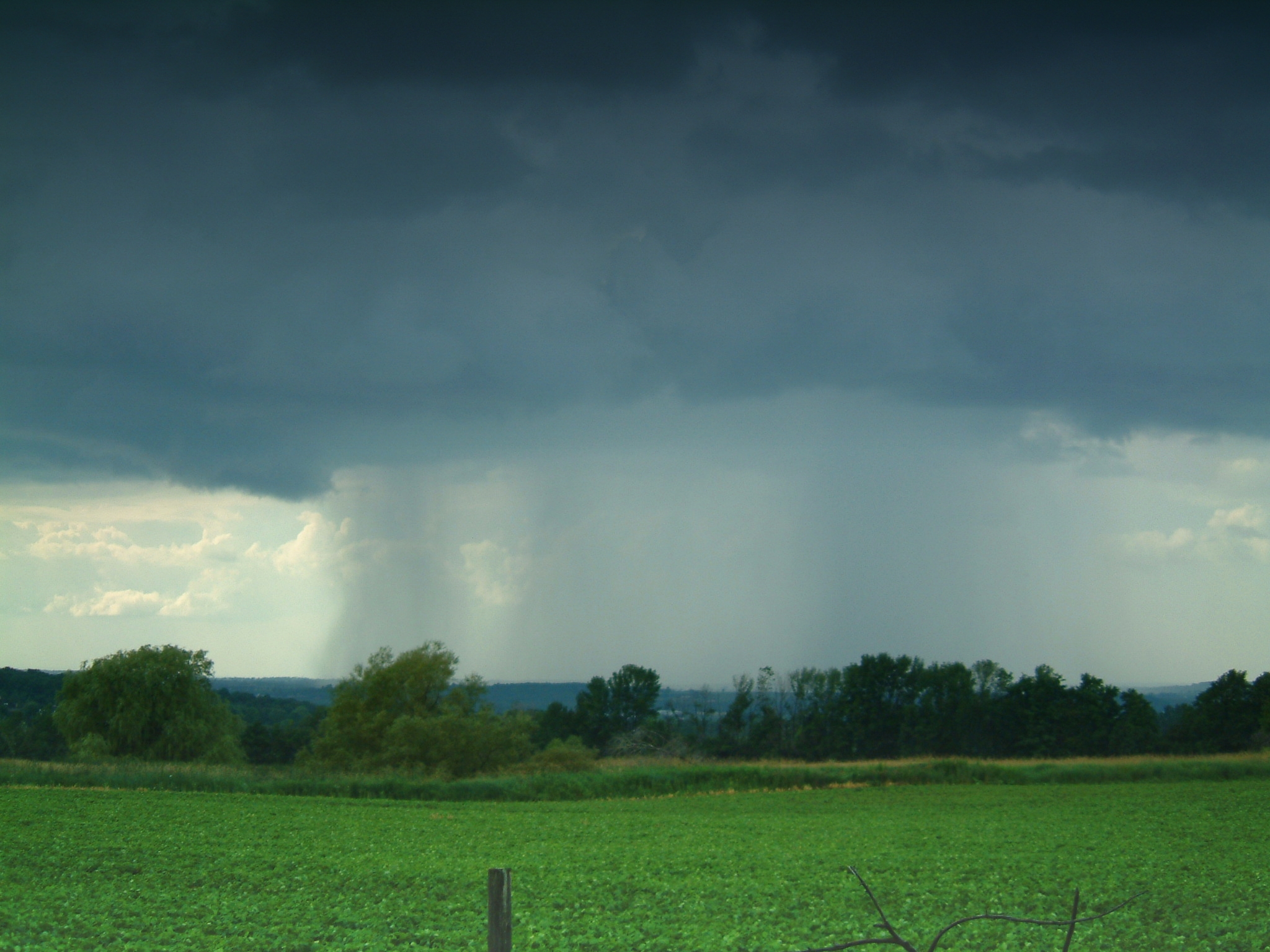
From Wikicommons
In my little corner of the midwest, any group that does magick or prays to natural gods has probably done a spell or ritual to bring the rain.  It gets dry and hot here, and our economy depends a lot on agriculture; so any prolonged drought has a ripple effect, first on the farmers, then on local businesses, and then on the employees of those businesses, and on and on.  Everyone is impacted.

So it's not very often that you'll find someone from my region talking about prayers to stop the rain.  But it does occasionally happen that we get just too much in too short a time, and it all runs off and creates dangerous conditions, carrying valuable topsoil with it.  This isn't exactly ideal either.

The past month, we've had far greater than our average amount of rain, which for a time was great, because we were rather behind.  It's getting to be too much, though.  We've already had more than two inches today as I write this, and it's supposed to be raining until early this morning.  So what can we do to gently ask the deities to halt the rain for a bit?  Why, write a charm, of course!

Hail Thunor the Thunderer!
You whose mighty storms cover the sky!
The rains have grown great,
laying our lands with water,
flooding our fields.
You who rule the wind and weather,
dry the rain, scatter the clouds,
return only when you are needed.

Hail Ingvi Frey, God of the World!
You who rule the rain and the shining of the sun!
The water is rising,
choking the green things,
stealing the soil.
You who bless the fields with growth,
dry the rain, scatter the clouds,
bring forth the shining sun!

Saturday, September 27, 2014

Winterfinding Ritual


As the daylight begins to wane, cooler nights settle over the land and cause all sorts of changes in the world around us. Many ancient Germanic peoples held sacrifices or festivals to honor this time of the year and to give thanks for a good harvest - and when building a relationship with the land, it is always good to say thanks.

Swain Wodening’s reconstruction of the Anglo-Saxon calendar, unfortunately no longer available online, sets today as the start of the month Winterfylleð. According to the Venerable Bede this translates to ‘winter full moon’. Called Haustblót in Icelandic (autumn sacrifice) or Álfablót (elves’ sacrifice) in Scandinavian sources, the end of autumn was a good time to offer to the land and the spirits. Whether you’d like to try it today, on the full moon, or at a seasonally appropriate time for your locale, this is a simple but powerful ritual to acknowledge the gifts of the harvest and the coming of winter.

Things to gather: representation of Frey, locally harvested produce that can be made into a meal or left fresh, mead or other celebratory drink


Carry the representation of Frey around the space set out for the ritual, whether that be your home, yard, or other area, saying “Frey, who blessed the fields and gives bounty to humankind, we thank you and offer you gifts now in return for your kindness.”

Set the image of Frey before you, and walk the edge of the space again, noticing the changes that are coming over the land. Use your own words that resonate with your local land, or say “Trees that have begun blazing with color, squirrels that are hastily gathering nuts, cold earth ready and waiting to rest: you herald the coming of winter. Landvaettir, wights, alfar that surround this place, I thank you for your bounty, and offer you gifts now to see you through the coming cold.”

Come back to the center or your altar, and lift the cup of drink in a toast. After each hail, pour out some drink, drink some yourself, and offer a portion of the produce.
“Hail my ancestors who prepared well for the dark of winter! Watch over me in these days of coming cold. Feast and drink with me, in thanks for your protection!”
“Hail the alfar and wights of the land, fertile soil and growing food! Feast and drink with me, in thanks for your harvest!”
“Hail Frey, Lord of Alfheim, who blessed the fields to grow! Feast and drink with me, in thanks for your bounty!”


If you have some things in particular to be thankful for this season, you should also toast the gods or wights responsible and share with them as well. When you are finished, pour out the rest of the drink and leave the produce to be composted or where it will be found by wild things.

Monday, September 15, 2014

My Oath Rite

Nerthus by ErebusOdora
It's getting to be that time.  I've been working on my Dedicant Path documentation for ADF on and off for more than two years, and I'm finally nearing the finish line (still have to do a write-up on my meditation practice, but that's going to take some compressing).  I've spoken with Amber, the Grove Organizer for Prairie Shadow Protogrove, and we've scheduled my Oath Rite to take place during our Samhain ritual.  So here I am, desperately trying to write an oath that is simple, addresses all the points I feel are necessary, has the right gravitas, and yet doesn't drag our ritual out to twice its usual running length!  After more than a few drafts, I feel ready to present it for critique - please let me know your thoughts!


I stand here tonight that I may make an oath before the Kindred, my friends, and my Goddess. This oath is the result of more than two years of study and dedicated practice in the tradition of Ár nDraíocht Féin, and the culmination of more than ten years following a Goddess of the dark, still earth.

Today I Oath to my Ancestors, to my lineage that stretches back to the once dark and wild forests, my Disir who guide me wisely, to my great-grandparents and my Grandpa Lee.  Ancestors, accept this offering, and hear my oath.
Today I Oath to the Landvaettir, to the house spirit who dwells in my home, the tree spirits around us, the spirit of the wide prairie and the brown river Goddess that spreads across it.  Landvaettir, accept this offering, and hear my oath.
Today I Oath to my Gods, to Nerthus my patron, the dark Goddess of the fertile earth and the wild places, to Her children Freya and Frey the divine twins, to Thor who brings the rain.  Gods, accept this offering, and hear my oath.

I swear to seek the knowledge of the past, and bring what I find of value in my Ancestor's practice into this time.
I swear to cherish the Earth and the spirits of the earth, and do what I can to reduce and heal the damage caused by my people.
I swear to honor the Gods and Goddesses, to maintain the relationship of hospitality between us, and to continue in my commitment to the service of Nerthus.


These things I swear before the burning Fire that sends up sparks to the sky, the dark Well that flows in the deeps, the sacred Tree that bridges the worlds. These things I swear before my Ancestors, the landvaettir and wights, and my Deities. These things I swear before all those gathered here, on these beads that have long taken my prayers for the Kindred. As I swear, so be it!

Wednesday, September 3, 2014

Thoughts and a Morning Devotional

Wind Turbines at Sunrise, Emilian Robert Vicol, Public Domain Photos, CC by SA, 2.0
Over the past few months, I've been drawn deeper and deeper into my work with what I'm calling Earth-centered Heathenry.  Nerthus, my patron deity, led me to this place - but it's gone beyond just the Vanir (which may be a term and classification invented much later than anyone thought; see Rudolph Simek's The Vanir: An Obituary).  To me, Earth-centered means to be focused primarily on the natural world, which includes not only the Earth itself, but also the sky, the seas, all of nature that surrounds us.  Yesterday, I felt strongly led to alter my morning devotional, currently a very ADF standard acknowledging of Gods, Ancestors, and Nature Spirits.  

The morning star has always been special to me, and Eostre and Sunne since I began honoring Anglo-Saxon deities; but suddenly I felt strongly led to acknowledge these deities of the morning.  Taking inspiration from Cynewulf's 9th century poem Crist II, which contains beautiful verses about the morning star, I wrote a new morning prayer.

Hail Earendel, brightest of stars,
Herald of the coming dawn,
bright above the morning, every season
a perfect illuminated jewel.

Hail Eostre, the shining dawn,
brilliant beginning of the day,
rays of light crowning the East,
a bright and glorious birth.

Hail Sunne, bright bride of the heavens,
All-shining bringer of life,
flaming chariot riding through the sky,
the fire that feeds the world.

I kindle the sacred Fire
with the joy of dawning day;
may it bring light and life and warmth
to me and mine.

Monday, March 24, 2014

Hreda and the Month of March

Public Domain
The Venerable Bede, an English monk and scholar writing in the 8th century, leaves us a very incomplete, but helpful picture of the Anglo-Saxon ritual year.  One such celebration is Solmonath (Solmōnaþ), roughly equivalent to the month of February, when cakes were offered to the Gods.  I find it reasonable to assume, based on the Æcerbot where cakes are offered to the earth in exchange for growth and fertility of the crops, that the deity honored in the rituals of Solmonath was the Anglo-Saxon idea of the earth mother Goddess.  Bede also mentions two deities of the Anglo-Saxons by name: Rheda (a Latinized form of the word Hrêða) and Eostre, from the month names Rhedmonath and Eosturmonath (Ēostermōnaþ).  Eostre is a fairly popular Pagan deity nowadays, and I've written about Her before; but I'd like to dedicate at least one post this month to Hreda (or Hretha) - the much less popular Goddess of March.

Bede tells us little besides that the month of March is named for Her.  Some modern Heathens identify Her with Hertha, a deity similar to Nerthus attested in northern Germany, but I feel that the linguistic links between them are tenuous.  Also, since I honor the Earthy Mother deity of the Anglo-Saxons during February, my personal UPG is that Hreda is a different sort of being - though not completely dissimilar, as we see with Eostre, who is still very much a deity of growth and spring.  Hreda's name can be linked to a few Anglo-Saxon words: primarily 'glory', 'victorious', and 'swift'.  Philip Shaw, in his book Pagan Goddesses in the Early Germanic World: Eostre, Hreda, and the Cult of the Matrons, argues that Hreda is the matron of a specific kin group.

Lately I've been thinking about the Christian idea of Lent, which often coincides with much of our modern March.  The word Lent comes from the Anglo-Saxon 'lencten', which means spring.  It's been speculated that Lent, a traditional period of fasting before the Christian Easter, was a natural result of the food shortage at the end of winter and beginning of spring - when supplies were running out, and milk from the ewes was often all people had to sustain them.  It seems possible that Hreda, a victorious and glorious deity, was associated with this lean time with the purpose of Her eventually triumphing over the difficulties and ushering in a more prosperous time of year.

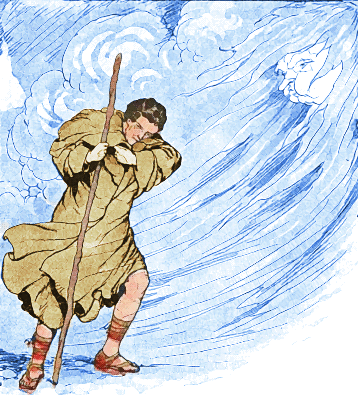
I was born in the month of March, and have always had a certain affinity with the strange weather that can happen in the midwestern US at this time of year.  The wind is said to roar like a lion, and temperatures can fluctuate wildly: from beautiful balmy days to heavy dumps of snow.  Hreda comes to me in the weather of my own country, different as it may be from Britain's; I see Her primarily as the late winter/early spring wind that can be so powerful here.  She too roars.  Eventually all that blustering wind blows in warmer weather, just as Hreda ushers in Eostre as the months continue to turn.

There is so little concrete information on this Goddess, I feel there are few wrong ways to honor Her.  However She chooses to manifest in a person's life, I do think it is important to continue to offer to this lesser-known Goddess, who was obviously important enough to the Anglo-Saxons that an entire month was named for Her.  This weekend is the full moon, when I choose to observe the mid-point of the Anglo-Saxon months and also their festivals; so this weekend I will be doing a ritual in honor of Hreda.  I've written a  prayer that incorporates mostly my UPG surrounding Her (how could it not, given the lack of information), feel free to use it or modify it to better reflect your own experience of the Goddess of March.

Hreda, Goddess of March,
roaring lion and swift wind.
Drive out the snow
and bring the shining sun,
the glorious warmth of spring.
That the plants may grow,
that animals may mate,
that life may wake from the land.

Francesco La Barbera
Creative Commons license

Friday, March 14, 2014

F is for Fréo

Freya and the Necklace
James Doyle Penrose (Public Domain)
Fréo of the cat-drawn chariot,
Fréo of the falcon cloak,
Fréo of the passions of all men:
with your vitality, with your passion, with your magic,
come and bless me and mine.
Fréo of the amber and gold,
Fréo of the soveriegn land,
Fréo of the boundless seidh:
with your vitality, with your passion, with your magic,
come and bless me and mine.
Fréo, strength of women,
Fréo, golden beauty,
Fréo, fierce in battle:
with your vitality, with your passion, with your magic,
come and bless me and mine.
- prayer to Fréo

Fréo is an Anglo-Saxon Goddess, experienced by many Anglo-Saxon Pagans, though not obviously attested - though one reason for this may be the similarity between Her name and Frige's, making it difficult to discern who place-names are referencing.  I experience the AS deities as separate, though similar to Their Germanic counterparts; Fréo is linguistically related to the Goddess Freya, of whom we have many reports.

She is a member of the tribe of the Vanir (the Wanes in Anglo-Saxon), a tribe of deities closely associated with nature and the earth.  Talking for a moment about Freya, there are many stories describing Her skill at magic (particularly seiðr), Her multiple sexual partners, Her warrior associations, and Her sovereignty.  Many see Her as originally being a sovereignty Goddess, granting Odin His power over the land through sexual relations - this is corroborated by the Sörla þáttr, in which not only is Freya described as a 'concubine' of Odin, but He becomes extremely jealous when He discovers She has given Her sexual favors to others.  Whatever Her function originally, it is clear in the many other stories of Her that She has become much more.  In Gylfaginning, it is said that "whenever She rides into battle She takes half of the slain," clearly marking Her as also a warrior Goddess.  She is also said to have taught seiðr magic to Odin - whether seiðr is Her own power or knowledge common among the Vanir, we do not know.  She is also portrayed as sorrowful; Her husband Óðr is frequently gone, and She is described as weeping tears of red gold for Him.  Her associations with fertility and the Earth are obvious.  It is speculated that many plants now named after Saint Mary in Northern Europe were originally named after Freya.

It is my impression that Fréo is a Goddess of the land, but not as much so as Her mother or Her brother, Ing Fréa.  She is associated with those parts of our lives that are still very much tied to our animal instincts: sexuality, hunger, etc.  And yet She also calls us to the mystery that lies behind these seemingly simple pleasures, the mystical experience of otherworldly trance and magic that stems from that which is green and growing.

Monday, March 3, 2014

Daily Devotionals

With three children and a crazy schedule, it's difficult for me to find the motivation to do daily devotionals.  But they're incredibly helpful when growing a spiritual practice - since I've been offering to different deities or spirits most days, I feel more connected with the earth and my spirituality than ever before.  But these are all simple prayers to just one deity or spirit, and I really feel the need to have a more consistent practice day-to-day.  So, I've taken the time to put together a daily prayer that hits all of the points I find important, and can be done in less than 10 minutes - that's less time than it takes to go through Ian Corrigan's guided Two Powers meditation!  Modified a bit, it can be a thanking prayer for night-time rituals, or even done twice daily, at morning and night.

I come here, on the earth and under the sky, to call the day to being.
I stand before my mothers and fathers,
before the spirits of land and place,
before the Gods and Goddesses,
to call the day to being.

Max, Hattie, George, Opal, 
Herman and Anna,
Lena, my namesake,
and all my beloved dead,
watch over me and mine on this day.

Nebraskier(1), prairie-grass,
oak, maple, garden-fruits,
rabbit, robin, house spirits,
and all the spirits of this land,
be friendly to me and mine on this day.

Nerthus and Manannán,
Brigid and Frige,
and all the honored Gods and Goddesses,
give freely of your blessings to me and mine on this day.

With reverence, I give these gifts
To my ancestors, the beloved dead,
to the spirits of this land and place,
to the Gods and Goddesses I honor,
as I call the day to being.

Let the day begin!

1) I use the name the Otoe Native American tribe gave to the local river as Her name.  I struggled with this for a long time - whether it would be more disrespectful to continue to call Her by the name European conquerors had given Her, or to use the name She had been called for years and years though I have no affiliation with the Otoe tribe.  I chose to use Her Otoe name, though I know it's not a choice everyone would make in this circumstance.

Friday, February 28, 2014

E is for Eostre the Goddess

Ostara by Johannes Gehrts
Eostre, the fiery dawn,
the waxing sun,
the warmth of spring:
Open the gates and bring to me
the growth of joy,
the light of life,
the glow of beauty.

Though it's a bit early in the year to be talking about Her (even earlier than most Pagans might think, but that's a topic for the next 'E' post) the letter is 'E' and it is coming up on spring - so Eostre it is!

Eostre is a rather elusive deity.  In the lore, She is attested to only by the Venerable Bede in De Temporum Ratione, where he talks about the Anglo-Saxon month of Ēostermōnaþ; claiming it is named for the Goddess Eostre who was honored that month.  Normally, if all the evidence we had for a deity was one post-conversion scholar, I would probably dismiss it.  But the curious thing about Eostre is, though Her existence is not attested to by other authors or place-names, She is rather easy to trace through the etomology of Her name.

According to Ceisiwr Serith, an expert on Proto-Indo-European religious reconstruction based on linguistics, there was probably a PIE Goddess whose name was similar to Xáusōs - in fact, She's one of the only PIE Goddesses we can pin down.  Her name, and probably Her functions, are the etomological source of many Indo-European Goddesses, such as Eos, Aurora, Saule, and our Goddess, Eostre.  This indicates that She is a Goddess related to the dawn - to the liminal time between light and dark - but it does not tell us anything specific about an association with the spring.  No other Indo-European dawn Goddesses that I could find have specific spring associations.  However, Bede tells us that the entire month (near our modern-day April) was named after Her.  Her association with the season was apparently so strong in Anglo-Saxon England that Her name supplanted the more traditional, and Christian, European name for Easter (variations of Paschal).

It is my opinion that the Anglo-Saxons who dedicated the month of Ēostermōnaþ to their dawn Goddess did so because of the symbolic connections between dawn and spring - dawn is the beginning of a new day, of light and warmth, just as spring is the beginning of a new year, of that same light and warmth.  I'll discuss this more next week as well; but until 1751, the new year of the British calendar began on March 25th, the traditional date of the vernal equinox - making an obvious 'beginning' connection.

In this way, I think of and honor Eostre in Her dual roles: that of Goddess of the Dawn, and also Goddess of Spring.  Her associations with eggs, flowers, and rabbits have been touted for years, but I feel it's also important to recognize Her fiery sun aspect, and also Her association with in-betweenness and liminality.  Straddling the gap between day and night, summer and winter, She is the Goddess who is ultimately responsible for the changing of unfortunate circumstances into blessings.

Monday, February 24, 2014

Book Review: The Clann Bhride Book of Hours

Logo for Clann Bhride
It's no big secret that my home-away-from-home on the internet is the eCauldron forums - there's always interesting discussion and good people to talk to.  I'm also a member of the Cauldron's Cill, a group of people devoted to flametending for the Goddess Brighid.  Some members there have been working on beginning a Brighid-specific religious group separate from the forums for awhile, and recently they launched - the group is called Clann Bhride.  It's not what I'm looking for in a religious group, but I very much respect the people behind it and their tremendous efforts; so when they released a book of prayers, rituals, and essays surrounding Brighid and Her lore, I immediately downloaded it.

The Clann Bhride Book of Hours, written by Aster Breo, Finn, Gilbride and Sage, is a fantastic resource (and free!) for anyone interested in the Goddess Brighid (and may be of interest to many others, for reasons I'll get to in a moment).   It's a fairly quick read, clocking in at around 140-some pages on my Kindle, but is absolutely packed with prayers, rituals, lore, and reflective essays.  It is a very practical guide to a spiritual practice devoted to Brigid.  The book begins with a dedication ritual, and then gives possible prayers that can be used throughout the day; and then goes on to describe occasional prayers and practices, such as flametending.  A new concept that I hadn't heard of before is called well tending - caring for or donating towards the care of a body of water.  Of all the possible practices laid out in the book, this was my absolute favorite, and I'm already thinking of how to incorporate it into my life.  Various festivals (generally Celtic) and their relation to Brigid are discussed, and some possible rituals and prayers for life events such as births, deaths, and rites of passage are given.  In the second part of the book, there are some wonderful essays discussing both practical practice and theology surrounding Brigid.  My personal favorite was "Brigid: Lady of Our Hearths, Lady of Our Hearts", in which the authors present a wonderful list of all the different deities, saints, and mortal women in the Celtic lore who bore a name or title etymologically related to Brigid; and the general idea of their stories and attributes.

The main issue I had with the book - and it can hardly be called an issue, as for some it will certainly be a positive point - is the tendency of the authors to universalize Brigid, associating Her with Goddesses such as Vesta and Minerva.  This is not necessarily a problem - and happily makes the book applicable to those who worship a hearth or fire related Goddess - but is far enough from my personal view of the divine that many of the prayers would need some modification to work in my personal practice.  She is also often associated with the creation of the cosmos, and also the moon and stars; which doesn't apply to my experience of Her.  I want to reiterate that these things are only a drawback for me personally - I imagine these aspects of the book will actually open it up to many others who aren't drawn to honor Brigid in a Celtic-specific or hard polytheist manner.

Overall, I think the Clann Bhride Book of Hours is an excellent resource, and I can't say enough good things about the people behind it.  Full of beautifully-written prayers, wonderful practice concepts, and brilliant essays; it's absolutely worth a download - especially at its current price of FREE.  There's also a paperback version available for a small fee to cover printing a shipping.  If you're even remotely interested, pick it up!  It's absolutely worth the time.

Monday, February 17, 2014

Charming of the Plow

This past Saturday, my children and I gathered in the garden to perform an old Anglo-Saxon ritual - the Æcerbot, first recorded in the 11th century.  As recorded, it is rather Pagan with a thin Christian veneer; but it has become a seasonal celebration for us because of a passing mention by the Venerable Bede in De Temporum Ratione in 725.  In the passage, he describes the month Solmōnaþ, roughly equivalent with our February and beginning and ending on the new moon.  He translates the name as "cake-month", because he says that the English would offer them to their Gods in that month.  Fast-forward to the Æcerbot a few centuries later, and we see that the ritual calls for digging a furrow in the garden to be planted, and offering cakes to Mother Earth.  And so, we celebrate this holiday - called the Charming of the Plow because it is a common Heathen name for holidays at this time of year, and because the original Æcerbot ritual does just that.  I like to position the holiday and corresponding ritual near the full moon of February; it seems like the best way to condense what may have been a month-long practice into one holiday.  Here is my re-Paganised (and slightly simplified for modern life) version of the ritual:


After sunset on the night of the full moon, go out and dig four small holes in the four corners of the garden, saving the soil.  Mix together oil, honey, and yeast.  If you have any perennial herbs or plants, use twigs from those to drip the mixture onto the soul three times; otherwise, use twigs gathered from nearby trees, saying this each of the three times:

"Grow mightily and fill this earth with fruits; Nerthus bless this soil with your great power."

After that, leave the soil out in a sacred place overnight - perhaps at the foot of a mighty tree or a nearby creek.

The next day, write or inscribe the rune Berkana onto each of the four twigs reserved for this purpose.  Place one into the bottom of each hole, putting the soil back into place, and saying "Grow" nine times over each hole.

In the center of the garden, stretch your arms to the sky and turn clockwise three times, keeping your face lifted to the sky.  Say:

"This soil is filled with plenty.  May its fruitfulness nourish the bodies of me and mine, and may my efforts give honor to the spirits of this place, the land wights, and the Earth, mother of all."

Take some seeds that you are planning to use in that land, and place them in a bowl on the soil before you.  Then say (feel free to substitute some of your own plants for those listed):


"Erce, Erce, Erce, earth's mother,
May Nerthus grant you
fields growing and flourishing,
propagating and strengthening,
tall shafts, bright crops,
and red tomato crops,
and soft sage crops,
and all earth's crops.
May Nerthus grant you
that your produce be guarded against any enemies,
and that it be kept safe from harm,
from poisons sown around the land.
Now I bid the Mother, who shaped this world,
that none shall overturn the words thus spoken."

Dig up a small portion of the land - or more, if you are planning to plant that day - and say:

"Whole may you be Earth, mother of men!
May you be ever-growing and ever-fruitful,
with food filled for the needs of me and mine."
Placing the cake in the soil, just as you would normally plant seeds, say:
"Field full of food for me and mine,
bright-blooming, you are blessed
in the holy name of the one who gives all fruitfulness,
the Earth on which we live;
Nerthus, the one who made the ground,
grant us the gift of growing,
that for us each fruit and leaf might come to use.

Then say three times: "Grow, in the name of Nerthus, be blessed."


Supplies:

Spade or shovel
bucket or container for soil
oil
honey
yeast
twigs from perennial herbs or trees on property
four twigs or small branches to use as rune staves
a few early seeds or bulbs for planting, or seeds for later planting if seasonally appropriate
cakes - these can be either like pancakes or cookies, but flavored with honey rather than sugar

Here's a possible recipe for the cakes, based on a recipe from New Varangian Guard, a re-enactment society in Australia:

Honey Shortbread
1 cup flour
1/4 cup corn starch
3/4 cup butter, softened
1/2 cup honey
Mix the ingredients and form a dough, spoon into a well-greased pan.
Bake at 325 for 30 minutes, let cool and cut into pieces.


Saturday, February 8, 2014

A Prayer for Manannán mac Lir

Photo by Robert Herring
Used under a Creative Commons License
As the winter drags on here on the cold and sunlight-starved prairie, I tend to lose a lot of my motivation and drive.  I'm naturally an introvert, so one of the first things to go is my desire to get out and engage in social things.  Some days I have a hard time bringing myself to open Facebook.  It's times like these that I find myself drawing inward, finding more time to sit and think rather than rushing to finish whatever task is next on my to-do list.  As I focus more on my personal spirituality, I am drawn more towards deities I honor that also have a strong sense of inner and spiritual work.

In contrast to the crochet I do for Frige, the house cleaning I try to maintain for Brigid, and the everyday writing I do for Ogma, in my UPG Manannán is a much less concrete deity.  I know for many He is like a favorite uncle, a God largely of laughter and good times - and He is that for me also, at times.  But much more often, He is the deity that calls to me when I am sinking in the dark depths of the proverbial ocean.  When I need to step back from the world for a bit, He is there to guide me to the deep sea - where no storms stir, where no light penetrates - only the solitude that is so refreshing to me.  In an effort to build a more consistent devotional practice, I've taken to writing prayers for each deity I honor; this I wrote for Manannán.  It is based on Ian Corrigan's call to Manannán in ADF's solitary Celtic ritual template, with the wavelets inspired by a baptism charm from the Carmina Gadelica.

Oh Manannán, powerful son of the sea,
holder of the magics of the crane bag:
a wavelet for sweet dreams,
a wavelet for laughter,
a wavelet for good song,
nine waves for Your graciousness.
Oh Lord of the Otherworld, bearer of the silvered apple branch,
I ask that you hear my call:
a wavelet for grief,
a wavelet for tears,
a wavelet for the dead,
nine waves for Your graciousness.
Mist-shrouded rider of the maned waves,
clothed in the sea-shifting cloak:
a wavelet for solitude,
a wavelet for wisdom,
a wavelet for oneness,
nine waves for Your graciousness.