Showing posts with label parenting. Show all posts

Friday, March 7, 2014

E is for Eostre, the Holiday


This is not a post about the NeoPagan holiday of Ostara, but rather about the word from which early Wiccans borrowed the name of their holiday.  Ostara is a reconstructed Old High German word, reconstructed based on the Anglo-Saxon word Eostre.  The origin of Eostre itself is somewhat questionable.   The venerable Bede, writing De temporum ratione in the 700s, gives Ēosturmōnaþ as a name for a month in the Anglo-Saxon calendar that corresponds roughly with April (for more about the Anglo-Saxon calendar, Wednesbury Shire's website has some fantastic info).  He also notes that the month is named after the Goddess Eostre, whom the Pagans would honor with feasts during this month.  She is not attested in any other works, but her name can be linguistically linked with several other Indo-European dawn goddesses.

As an Anglo-Saxon Heathen, I think that celebrating the month of Ēosturmōnaþ is vitally important to my religion - in his writing, Bede references very few beings worshiped by his ancestors, which leads me to believe that the customs he does mention were very important that that time.  I choose to celebrate this holiday as a one or two-day affair rather than the entire month, though I do give honor to Eostre through all of the spring (which is considerably longer than a month here in the midwest).  Given that the Anglo-Saxons had a lunar-based calendar, I have chosen to celebrate Eostre's holiday on the day following the Full Moon - which usually ends up falling quite close to Easter, given that Easter is calculated as the first Sunday after the Full Moon after the spring equinox.  This year I'll be celebrating on April 15th, almost a full week before Easter.

In De temporum ratione, Bede specifically references feasts being given in honor of Eostre.  The feasting at least is very much practiced in our culture today - every Easter, my family and many like mine get together and enjoy a ham or turkey.  In our culture, which is becoming more secular, good times and good food with family are the markers of many holidays (which works out great for a Heathen!).  According to the Wednesbury Shire, many of the English-speaking world's Easter customs, such as egg decorating and the celebration of hares, go back almost to Anglo-Saxon times.  Alaric Albertsson in his book Travels through Middle Earth talks about the effects of light on the egg production of hens: by Eostremonath, the hen's eggs would have been an abundant food source, making them both an important symbol of the season and an object worthy of reverence.

So much like my Christian childhood, my children and I will be decorating eggs, cutting out bunnies from paper, and cooking up a delicious feast this mid-April - only instead of hauling them off to church that Tuesday morning, I'll be taking my children outside to explore all the changes happening around us: what flowers are sprouting, which trees have nests in them, what birds have brought their song back to our prairie now that the winter is over.  We'll rise with the dawn to give honor and thanks to Eostre for the return of the light and the warmth.  And that night, we'll all sit down and enjoy a feast together, leaving Eostre Her due on the altar.  For us, this is how Eostre's holy day is celebrated.

Wednesday, February 12, 2014

TC Blog Project: Family


This time of year, we start to hear a lot of talk about love.  And love in February is almost never referenced as the love between friends, the love of family, or even *gasp* a love for things.  No, our entire culture frames Valentine's Day - a celebration of love - as celebrating only romantic love.  Those who don't have romantic partners are said to be "alone on Valentine's", whether they will actually be physically alone or not.

I'd rather talk today about one of my favorite aspects of Heathenry: familial love.  For a long time, I considered myself the 'odd duck out' in many Heathen circles, being generally the most leftist of the US-politics liberals.  It's taken awhile, but I've come to realize that perhaps I found Heathenry because some part of me understood that, deep down, I actually hold a few traditional values.  One of the most important of these values, to me, is the importance of family.

Growing up, my immediate family was sort of the odd one in the extended family.  We were poor in a family full of middle-class, my mother was too Evangelical and my father too atheist, us kids were socially-awkward brainiacs and always wanted to play with the wrong genders.  And yet, despite the unspoken uncomfortableness surrounding those topics, the entire family was always warm and welcoming.  We were weird, but it didn't ultimately matter, because we were family.  There weren't any family feuds or in-fighting; we all got together on Thanksgiving, Christmas, and Easter and made generally pleasant dinner conversation with each other.

Growing up, I didn't exactly appreciate how rare and precious a family like this is.  When I went to college, I basically cut all ties with everyone - I didn't speak to even my parents for about a year.  It wasn't until I found myself pregnant, faced with beginning my own family, that I began to appreciate just how amazing a good family can be.  The biggest recent influence on my concept of family has been my mother-in-law; she comes from a very traditional culture where it is a woman's duty to care for her house and her family.  She welcomed me with open arms, took me in as her daughter, claimed me as part of her family.  She cares for her elderly mother together with her three local sisters, all of whom work full-time, because it is her duty to love and honor her mother the way her mother loved and raised her.  I have watched her pour out her heart into the food she makes for our family dinner every Sunday; all of her love and good wishes and affection goes directly into the meal.  She holds the most love for family of anyone I've ever known - and though I aspire to be like her in caring for my own family, I must admit that I seldom hit the mark.

I'd like to be clear that by valuing family, I am not referencing only a traditional nuclear family.  That's how mine worked out, but it's certainly not the be-all, end-all.  I spent a large part of my life with my mother and step-father on one hand, and a single father on the other, and we were just as much family as anyone else.  Same goes for gay, poly, or whatever relationships - if you think of yourself as a family, you are.  This is a special kind of love, and no matter how some conservatives would like to play it, it is there for everyone to experience.

I try to give my children the good things I had growing up, while skipping over the worse ones.  We eat dinner together every night, no TV or other interruptions, and talk about our days.  I make it a point to talk to my kids in the car when we're driving somewhere.  I plan family celebrations - not just for my own holidays; I throw a darn good party for Eid twice a year too!  Just as my mother and grandmother did growing up, I tell stories of the ancestors I remember, and those that are still with us but who we don't have the opportunity to visit.  These are all religious acts for me.  The simple act of loving my family - and expressing that love by caring for them, cooking for them, making sure their lives are organized and also enriching - is a big part of my religious devotion.  In Heathenry, your family's honor is incredibly important - it is simultaneously your legacy and your gift to your ancestors.  Caring for my children, loving them, and teaching them the ways of my ancestors is an offering to those who have gone before.  It is also an offering to those I will leave behind.

Saturday, December 7, 2013

Resource for Children's Rituals

While stumbling about the internet today, I came across a wonderful resource for children's ritual that I had to stop by and share!

The website of Charter Oak Grove ADF has an entire section devoted to rituals for each of the High Days designed specifically for children.  While the rituals are written according to ADF's Core Order of Ritual, there's also a nice amount of resources for Pagan children of any path that honors Celtic deities.  Their book about the Kindreds (ancestors, nature spirits, and gods and goddesses) is available in print from Lulu.

I hope this is helpful to some parents and groups out there who might be having trouble coming up with ritual ideas for children!

Friday, November 29, 2013

X Marks the Spot: Why and How to do Rituals for Children

I'm currently putting the finishing touches on a ritual "just for kids".  I put that in quotes because, of course, adults are welcome to participate - but the ritual is written for children.  In Christianity, this is almost a given now; practically any church you walk into on a Sunday morning will have a dedicated children's church, usually taking place concurrent to the adult service.  There a Christian's children have a chance to play with one another, do arts or crafts, and to learn the moral and religious lessons their parents and the congregation have decided is important to them.  In the Pagan community (outside of large festivals) I've never encountered any children-specific programming that is also religious in nature.

I'm sure there are a number of reasons behind this, first and foremost that many Pagan parents are unwilling to teach their children about their religion - again, for a number of very valid reasons.  I'm not here to judge those parents or say they're doing it wrong.  But there are those of us who are teaching our children our religion, and the standard Pagan ritual is a particularly bad place for doing that.

Just imagine being five or six years old and attending a pretty normal Pagan circle.  Generally, they open with some kind of quiet or guided meditation, where noise and fidgeting are a pretty big distraction.  You as a child are not only asked to sit through this, but are frowned or glared at when doing your pretty natural kid stuff.  Then, again, you are obliged to wait in relative silence as the quarters are called and the God and Goddess are invited, calling out a late "blessed be!" when the adult next to you nudges you with an elbow - because listening to one person talk on and on, or waiting silently while that person walks slowly around the circle, has completely lost all of your interest.  No matter how engaging or interesting the mid-ritual activity, you've already zoned out completely.  Your interest might perk up again if juice and cookies are offered as cakes and ale, but that's usually followed by the reversal of the whole "be quiet, they're casting circle" routine.

Us Heathens have it a little easier (since objectively, blots are a bit more fun!) but I'm talking today about the generic Neo-Wiccan that so often accompanies the umbrella term Paganism.  And in this, I suggest we take a leaf out of Christianity's book.  I know, not many Pagans like to hear that; but the truth is that Christianity struggled with this same problem a few generations ago: Sunday school was a lot like regular school, and not a whole lot of kids were enjoying it or getting much out of it.  But youth pastors across the country came up with some great solutions to get kids more involved in their learning, and we can learn a lot from the one word that is emphasized over and over: Participation.

If we can write a ritual that actually gets kids interested and involved, that would go leaps and bounds towards helping children learn more about the faith of their parents (or at the very least, relieve the poor kids' suffering at the hands of boring adult ritual!).  To do this, I've broken down Participation into four easy-to-do parts that should make almost any ritual appealing to children.

          1) Language
I feel like this is one of the most important factors of all.  Use words that kids can understand.  Use words that kids can understand easily, so they can listen more attentively and actually internalize more of what is being said.  As adults, hearing a lot of technical jargon or subculture-specific vocabulary is often an instant turn-off of attention; for kids, flowery phrasing and Ye Olde English is much the same.  For participation, more 'repeat-after-me' is great, but only really works when those repeating can understand what exactly they're saying.  Also, make sure that the ritual really explains everything that's happening.  Before you call the quarters, just give a quick and simple sentence or two about the elements, and why we want to welcome them to the circle.  If the children have no idea why something is happening (or even what's happening at all!), attention dips quickly.

          2) Songs
This one goes hand in hand with language; basically, if you can sing it, you should be singing it.  Kids do best with simple melodies and repeated words, so it doesn't have to be anything complicated at all.  Get their hands clapping!  Let them dance!  One technique I'm using for the ritual I wrote is to have simple chants to welcome the elements, all with the same tune and simple repeated words, so kids can really lose themselves in the song and have a great time doing it.  If you're not great at writing your own stuff, there are songs and chants all over youtube that are simple enough for children to do, and an iPod with speakers (as long as you're singing too!) is a perfectly acceptable solution for the less musically-inclined.

          3) Kid-friendly Ritual Objects
We want our kids to be really participating in this ritual, so the last thing we need is a bunch of beautiful, breakable lying around to be tripped over, knocked over, or any variation thereof.  Having a well-defined center can be helpful for focus, so a small altar table is perfectly acceptable - just make sure the things on it are ready to be handled by children.  For my children, I bought some unfinished wooden boxes at the craft store and painted colors of the elements inside to serve as elemental representatives around the circle; but big rocks with bright paint in element colors works just as well.  For the altar table, cloth dolls for the God and Goddess would work great for very young children, older ones would probably be fine with the more inexpensive resin designs from Sacred Source or the like.  Plastic reusable (since we're green Pagans!) cups for cakes and ale, and make sure whatever you're using for 'ale' is set on the floor and has a lid.  Sticks make fine wands, athames really are not necessary, and a lot of dollar stores sell plastic wine glasses that would make great chalices.  Ideally, the children are actually interacting with these ritual objects, and we want them to be interacting with them freely and un-selfconciously.  If you're hovering over them, apprehensive about the condition of your things, the kids are going to feel that and close themselves off.

          4) Crafts
Like songs, kids almost universally love crafts.  It doesn't have to be big and complicated - in fact, it's probably better if it's not; this is a ritual where we want the children to feel like independent participators that don't need an adult to hold their hand through every step of the process.  Even coloring sheets and crayons would be great!  Something simple like "draw a picture of what you want to thank the Goddess for" can go a really long way.  Bonus points for opening up to children's natural creativity: hand out a coloring sheet and tell kids to use the colors that feel right to them in this moment, not necessarily the ones they would think of as being the 'right' colors.


The truth is that Pagan ritual is very uniquely suited to being kid-friendly; it only requires changing a few things, and a willingness to get down on the children's level.  Just like any ritual, sometimes things are going to go wrong, kids are going to get bored or not want to participate, and that's fine.  In fact, it's totally okay in a children's ritual, because the ritual itself should be written to accommodate these things.  The other children aren't going to get worked up if we have to pause to open a door for little Nadia, or if Travis trips over the representation of Earth and falls out of the circle; and I don't think the deities are, either.  Kids are kids, and recognizing and accommodating that, even in ritual, is in my opinion the best investment Paganism can make into its future as a religion.

Sunday, November 3, 2013

Family Samhain Adventure


I was reading an interesting post this week on the nature of Samhain, and its two-fold nature.  The night of Halloween, the author proposes, is about local community; with all the kids out trick-or-treating.  Samhain itself, the day of November 1st, is about the historical community - those who have passed on.  My family and I have celebrated in this way for the past three years or so, but I've never quite been able to articulate how trick-or-treating is related to my religious practices!

Walking around the neighborhood on the 31st, we get to see many neighbors that rarely get more than a passing 'hello' through the rest of the year.  There were several of my oldest daughter's classmates walking around this year, and many parents that I had talked to waiting to pick her up from school.  It really was a night where the local community came together to create fun for all of the children.

The next day, November 1st, we woke up early to gather offerings for our ancestors.  In past years, I've made bits of pie for my women ancestors (big pie makers!) and brought tobacco for the men; but this year my middle daughter insisted that we make and bring cookies!  With my recipe book (with the family recipe for the best chocolate chip cookies ever) still in a box somewhere, we instead made sugar cookies - a big Christmas tradition in my family.  Since the weather was so beautiful this year, we made it out to three different places and honored many of our ancestors: my grandfather-in-law, my great-grandparents and their siblings, and we even managed to find the graves of my great-great-great grandparents who came over from Germany with their young son in the 1800s.  At each of these places, we would sit for a while, offering the ancestors cookies and water (too many alcoholics in my family to bring anything harder), and talk about memories of them - and in the case of those more distant in time, things I had learned about them and how they are related to us.  I was so pleased this year when I began telling a story about my great-grandpa and my oldest remembered it exactly, and was able to finish the story for her younger siblings.  It really hit home at that moment that I am creating a tradition - that part of the job of first-generation Pagan parents is creating a tradition.  I can talk about tribal ways and the deep love and loyalty for family until I'm blue in the face; but my children are really learning it through the traditions and actions that I'm passing down to them.  Even if they grow up to find another religion - and, realistically, they probably won't be Heathens or Druids as adults - they will remember the stories.  They will remember where they came from, and how it is such a large part of who they are.  Even if they don't grow up to worship Thunor or Brigid, they may still come in the fall to put flowers on the graves of their ancestors, and tell their children the stories.

Tuesday, October 22, 2013

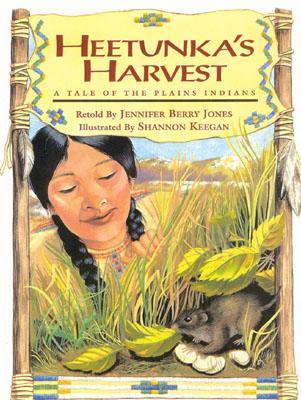
Children's Book Review: Heetunka's Harvest

Heetunka's Harvest: A Tale of the Plains Indians
Retold by Jennifer Berry Jones

I picked this book up from the library's pile of Fall-themed children's books because the mouse was cute.  I usually do a bit of a content preview because there's often either a bit of Jesus or unnecessary violence hiding in this midwestern library's children's section; but I didn't have the time, and so grabbed a couple of titles that looked promising.  Maybe I should do that more often!

This is a wonderful story for any Pagan children, regardless of their cultures or the deities their parents honor.  It is a story about sharing with and caring for nature and the nature spirits all around us; a story about our essential connection to them.

Heetunka is a plains mouse that gathers little white beans every winter.  In the story, a group of Souix Indians come to trade with her in the fall season, leaving corn or suet in place of the beans they take from her storehouse.  One woman, not considering the life of Heetunka, decides to be greedy and take all the beans without leaving anything in trade.  Because of her rash actions and haughty attitude, eventually she is punished by a prairie fire burning the tipi to the ground.

This story has a wonderful message about the interconnctedness of all life, and the importance of being good and kind even to those who seem like they can't do anything to harm us.  There is an end of fall/harvest theme that would work well around Mabon, Samhain or Winterfinding.  One word of warning: there is a brief speech by the woman's husband which came across rather rudely; but as a parent I'm very used to selectively editing stories as I read them.  If this is something you'd like to have an older child read, it may be good to discuss the actions of the husband as inappropriate also.  Otherwise, the book sparked a wonderful discussion between my five year old and I about the web of life, and how our actions affect many other beings that we share our world with.

Monday, September 23, 2013

S is for Small Pagans

Okay, so I cheated on the title, but I haven't made a PBP post yet this week, and this has been on my mind a lot lately.

There are almost as many opinions about parenting and Paganism in the Pagan community as their are Pagans!  Now that's a mouthful - but it's true.  With each person, comes a different religious background, a different upbringing, and a different attitude towards their childhood religious experiences.

I've met many Pagans who are refusing to raise their children in their own religion, many because of bad experiences having been raised in fundamentalist Christian households.  I can understand the worry that these people have.  Having been indoctrinated in a religion as a child, that's the last thing they want to do to their own children.  It's something that I fear for my kiddos - I don't want to dictate their beliefs, or tell them how to represent themselves to others.  They deserve the ability to decide for themselves.

However, I am of the opinion that a tabula rasa is not the best way to go about choosing a religion or spiritual path.  I believe it would be doing my children a great disservice to have them grow up and enter the public sphere without any knowledge of the many different beliefs the people around them hold.  We talk about Jesus occasionally, we celebrate Muslim holidays, and I generally try to give a small education on most of the major world religions.  But, it's a big step from education about a variety of religions to educating a child about your religion.

I feel it's important for children to not only be educated in religion, but to also experience religious community.  For a child growing up without that, it's awfully easy for one of the more evangelistic religions to jump in with the promise of unconditional love and community - not that I'd be unwilling to accept it if one of my children chose Christianity, but I want it to be an honest and informed choice, not something they turn to because they don't have a spiritual community.

Which brings me to my final point - for Pagans with kids who want their children raised in their religion, there are some hurdles in place.  Granted, I've never been to a big festival with a dedicated and organized kid area, but in my experiences with a few area groups, there's a distinct lack of kid stuff.  It's not that they aren't welcome - everyone is always very friendly and seems happy to see them at gatherings - but there's nothing for them.  Children are often welcomed at ritual, which is great, and I appreciate it; but it's not exactly easy for them.  It's like asking a kid to sit through a church service, which is tricky at the best of times.  Kids like to move, to talk, and they don't like standing around and listening to other people go on!  Other events have an area with kid activities, or let kids play while the ritual goes on; but then they're not having any sort of spiritual experience.

I think what a few larger Pagan groups really need is a time for children - small children who just can't be expected to sit through and understand adult ritual - to have their own spiritual space and experience.  I've been working on a ritual script that's just about ready to test out with my own kiddos; and after I've refined it a bit, I'd really like to invite some of the local Pagan children to come and enjoy it with us.  But having a group of small Pagans is contingent on having a group of Pagan parents who want their children educated in the basics of Pagan religion.

Reading back through this, my writing may be coming off as judge-y of other parents who choose not to raise their children in a Pagan religion.  To clarify, I think every parent has the right to raise their child exactly how they feel is best - I'm just lamenting a small gap in support for parents who do want to raise their children in their traditions.

Friday, August 9, 2013

P is for Parenting

Because as a Pagan parent, it's impossible for me to write up anything else for the letter P :p

I've been doing a lot more thinking about Pagan parenting lately as my oldest daughter prepares to go to kindergarten in less than a week.  Like most any parent, I worry about my kids, and my oldest is especially sensitive.  And we as a family are pretty strange in the middle of white bread, midwest America.  She has dark skin at a school with less than 10% minority population.  She doesn't eat pork in honor of my husband's Muslim roots.  She has different holidays, as we're celebrating Eid tomorrow and this last weekend attended a Lughnasadh circle.  She does have church and Sunday school, but it's at the local Unitarian church, and she doesn't know much about Jesus besides his name and a lunch-time prayer my mother taught her.  She's incredibly precocious and is already doing division and reading chapter books at home.  We don't have much money but are lucky enough to live for a cheap price in a nice neighborhood, which means she'll be going to school with a lot of kids with a lot of money.  She's about as different as you get around here!  And I fear, terribly, that it will leave her the odd girl out.

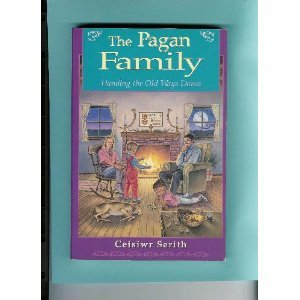
How does one reconcile their Pagan faith, and a desire to pass that down, with the stronger desire to raise a happy and well-adjusted child?  My strategy has been to teach her to be as strong and self-reliant and proud as she can be; to take great joy in her traditions and differences.  I've been reading The Pagan Family by Ceisiwr Serith recently, and it's convinced me that the two greatest weapons we have in the fight for our children's happiness are Family Traditions and Pagan Community.  Children need a sense of stability that is easily imparted by established religions with dogma and traditions and community laid out and easily accessible; but for Pagan parents it's much more difficult.  We have to make our own traditions, and stick to them.  We have to make our own community, and hold it together to the best of our abilities.

Family traditions are super fun, and great, but you have to commit to them.  You must perform them each year (or each month, or whatever set length of time) for them to truly become a tradition.  It is this stability that will help anchor a child when others bring up more mainstream traditions.  Sure, their friends go to church every Christmas Eve and then go home and read the nativity story before the family dinner the next day; but our daughter helps me light the candles the night of the winter solstice, then we turn off the lights and sip hot cocoa while watching the cold outside world and waiting for the new dawn.  Then the next morning we all go out to greet the sun and come back in to open presents and have a special solstice feast.  If my daughter has something similar to talk about when other kids are talking about Christmas, there's much less chance of her feeling left out or weird.

The other really essential thing is Pagan Community.  This is great if you have a local community, especially one with other kids, as I have been really blessed with the past year or so.  Teach your child a useful skill he or she can bring to gatherings.  My daughter practices drumming with me, and when we go to circles she brings her own drum and helps us raise energy.  She's learned some of the chants we use in circles and helps to sing along.  BUT this is something you can accomplish even if the "community" is only the two of you.  My husband is an atheist and isn't really comfortable taking part in rituals, so for a few years my daughter and I were all each other had spiritually - and it was okay.  The important thing is to talk about it, openly with your children, and not make Paganism seem like a touchy or strange subject.  Take them for nature walks, have them help with recycling, make them aware of the world and get them involved in your Paganism.  I think this is the best defense against proselytization and bullying for Pagan children.

After one year of preschool, my daughter is still proud and confident of her differences - but that was three days a week, two hours a day.  I'm not sure how things will pan out in a full-day kindergarten, where her dietary differences will be much more obvious, and we'll be pulling her out of school for a few holidays.  Like everything else in parenting, I try my best and wait and see how it turns out!

Saturday, February 2, 2013

C is for Christianity

Well, I wrote up a huge post yesterday; and then decided not to publish it.  It was full of my angsty journey from hostility to understanding of my Christian heritage, and honestly was probably way more words than anyone would want to read about my childhood!  So, a little late, I give you a new 'C for Christianity' post.

Many Pagans today were raised in Christian homes, and many of those in fairly fundamentalist ones.  I am one of those Pagans, and the journey of transition was a difficult one for me, as it is for many.  I know that at first, I took the stance of totally cutting everything about my birth religion out of my consciousness and my life - I refused to attend church with the family, refused to touch the books on religion they gave me, I even did up very elaborate goth makeup for my graduation to piss off the church elders!  But my attitude has slowly changed over the years, and I'd like to propose today that we don't have to do this.

I'm not advocating that we, as Pagans in a Christian family or society, bow to the wishes of those around us, confess our sins, and convert!  What we can do is carry forward some of the things we learned in our youth to inform the religious practices we have adopted as our own.  One of my favorite services was always Good Friday - it was very ceremonial with candles being lit and extinguished at specific times, dark and melancholy words and hymns; it always felt as if a cloud was passing over the earth and death was very near.  In my teenage wisdom I dismissed this as ridiculous; but now a bit older and a bit wiser, I can see that this was probably one of my first experiences in looking the otherworld in the eye, much as many Pagans do at Samhain.  After this realization, I began to tap into that very strong feeling and memory association from my youth and used that in my Samhain rituals - I used some of the same hymn tunes and put my own Pagan words to them, and I still follow the Tenebrae extinguishing of candles; but this is to honor the death of the light and life on the earth rather than Jesus.

I have been accused of being a catch-all, eclectic, take-what's-shiny Pagan, and I suppose that's a fairly accurate characterization.  But this is not just grabbing some random ritual from some random culture - it's borrowing from the religion of my birth, the religion of my society, and one with which I have very powerful sensation and memory associations.  I no longer believe in the literal existence of Jesus, but why should that stop me from borrowing a ritual that fits my purpose, has exactly the right tone, and that I am intimately familiar with after having been part of it for almost twenty years?

In that same vein, I feel that it is at our own peril that former-Christian Pagans eschew the general holidays and merriment of wider society.  I know one Wiccan woman who refuses to acknowledge the existence of Christmas to her children, insisting that they celebrate only Yule and that Santa Claus and Jesus are malicious stories intended to deceive their friends.  I can understand where she is coming from, but at the same time I don't think she realizes just how hard it is to be a child that doesn't celebrate Christmas, or Easter, or any of the other major Christian holidays - even the harmless, secular aspects.  My husband grew up Muslim, and he still carries animosity and anger about Christmas; not because he felt oppressed, but because he felt left out.  Is that what we want to do to our children?  Should we sacrifice their joy in the holiday season because we have issues about our Christian past?  In my house, we have chosen to celebrate Yule and Ostara in very ritualistic, religious ways - and at Christmas and Easter, we open presents from Santa and hunt eggs left by the Easter Bunny.  We don't generally talk about Jesus's birth or death, but that doesn't mean we have to ignore the holiday, especially in our increasingly secularized society.

I'd like to challenge all of the former-Christian Pagans reading this to take some time to think about your relationship with Christianity.  Do you view it with animosity?  Perhaps it is time to start changing that view.  I like to remember the Pagans of Europe, who when confronted with conversion to this new religion, went along with it - but still kept many of their old traditions and rituals as well.

Friday, January 25, 2013

B is for Books (for kids!)

Being the bibliophile that I am, it is no surprise that for me, B unquestionably stands for Books!  I'm currently sitting (metaphorically!) on a huge pile of esoteric literature while I work on another Tarot reproduction; but given the subject of this blog, I'd like to speak out and give some suggestions on Pagan books, fiction and non-fiction, that my children have enjoyed.

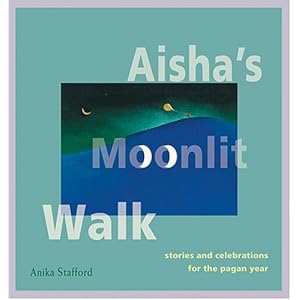
The first, and my eldest daughter's favorite, is Aisha's Moonlit Walk by Anika Stafford.  My daughter is just about to turn five, but we've been enjoying this book for a couple of years now.  It has a chapter for each holiday of the Wiccan Wheel of the Year, telling a story about Aisha and her family.  There are also lots of discussion questions that give lots of room to talk about your own family traditions and beliefs - so if you follow a season-inspired calendar of celebrations, even if they're not the typical Wheel of the Year, this book is really informative for kids.  For my daughter, it's helped to teach her that there are other kids out there like her.  We live in an isolated part of the Midwest, and the few groups that I do know of and attend occasionally don't have any other young members; and she is unfortunately already a bit hesitant to mention her holidays to friends or at school.  This book has really made her feel a lot less alone in her religion.

Some favorites for the 5 year old and the 2 year old are this series of books by Ellen Jackson: there is one for the Spring Equinox, Autumn Equinox, Winter Solstice and Summer Solstice.  Each book not only goes into the changing weather and plant and animal life of each season, but also talks about several ancient peoples and how they would have celebrated this time of year.  For me as a Druid, this series is perfect because it covers many of the basics of our modern practice (seasons and their change) as well as how the ancient druidic peoples might have celebrated.

One more recommendation for the Pagan pre-parent - Pagan Parenting: Spiritual, Magical, and Emotional Development of the Child by Kristin Madden.  I absolutely adore this book.  I didn't find it until I was pregnant with my third child, but it was such an uplifting and helpful read while I was struggling with some difficult emotions.  There are some great rituals, and very lovely meditations - some to prepare for childbirth, and many to connect with the unborn child which I found incredibly helpful.  I really feel this book is a must for anyone who is going to become a Pagan parent.


Monday, July 16, 2012

On Re-entering Formal Spirituality


It's a boy!  That's right - the reason I've been incommunicado for so long was the trials and travails of dealing with the last few months of pregnancy; unfortunately fraught with way too much worry and stress.  Gladly, my little boy ended up coming early but not-too-early, and now he's happily at home adjusting to the crazy life that is a five-person household.  While several posts may be forthcoming discussing the spirituality inherent in pregnancy, childbirth, and parenting; that's not what this post is for.  

I miss my spirituality!  Before my medical issues began, I was up (mostly) every morning doing my devotionals, spent the children's naptime working on meditation, and was generally quite in-tune with my Druid path.  With the coming of stress and concern, however, I quickly retreated back to my fairly vague Wiccish practices, seeking comfort in something familiar.  And while I believe the magick I worked in that time was a great help - it's not really fulfilling my heart or helping me to grow as a person.  And so, after many months, I'm attempting to ease myself back on to the Druid path I love so much.

Not to say that I haven't been busy with quite a bit of informal spirituality.  My garden, that I firmly resolved to complete this year, is nowhere near completion - but I am actually making progress, which is much better than previous years!  My container herbs are thriving, and there's fruit bushes on my porch waiting to be introduced to the huge garden in back, once the weeds are finally under control.  They've been mowed down and covered with a tarp - I'm hoping it will be enough to tame them!  I'm eager to get to planting.


All this time spent out of doors and with the spirits of the land around me has been incredibly eye-opening.  No, I haven't been working with my God/desses, but my connection to the nature spirits and to my ancestors has never been stronger!  While I honestly mourn the loss of so much plant life in my back yard (one reason I'd been procrastinating, I believe) the thought of being able to have plants that I've planted and cared for fill up that space is just amazing to me; not to mention that hopefully one day it will supply all our produce needs for the whole summer.  As for the ancestors, my closeness to them this summer is due to several factors.  I recently attended a family reunion that traced our common lineage back to an immigrant from Germany - not too long ago, he was my Great-Great-Grandfather.  Though much of my extended family has moved on, I and my family still live within a few miles of where he first settled so many years ago.  Though it is a very short span of time in the life of the nature spirits here, I feel it is very important - my family has been a stable presence here, and because of a love of nature that runs like brown hair in our genes, I believe that we have always been very close with these land spirits, and I am so glad to continue honoring that tradition.

I am very glad of my recent growth; but with all that said, I am eager to get back to my formal practice.  While I do feel very connected, I don't feel as if I'm being challenged as a person - perhaps that is the job of the God/desses I've been ignoring these past few months.  The first step is restarting daily devotions - not as easy with three children, especially since the little one still has me getting up every two hours - but I feel it's very important to my growth, and I'm going to try my hardest to make time for it.

Friday, March 9, 2012

Eostara vs Easter

As a Pagan parent, I've got my work cut out for me.  My husband is also a member of a minority religion (though very different from my own faith); so in my house, we end up celebrating a lot of holidays that aren't recognized by the world around us.  To make matters worse, both my in-laws and my own parents are very dedicated to their own religions; finding out I was a Pagan and raising my children in Pagan traditions would be a big problem on both sides - so the Wheel of the Year is celebrated with just our little family.  It takes a lot of creativity to come up with new celebrations in a tradition that has a lot less children than your typical Christian church, but I thought I was doing fine - until last Winter Solstice.

I was getting ready for our Solstice feast, cooking up a yummy beef stew while my eldest colored the winter-themed crafts we'd cut together earlier at the kitchen table.  "When is Christmas coming?" she asked.  "Oh, that will be in a few more days, honey," I replied, "but remember, today is the Winter Solstice, and we're going to each open one present tonight!".  She sighed deeply and looked at me with her big brown eyes.  "Mommy, the Winter Solstice is boring!"

Ouch.  But the worst part is: she's right.  At least from a child's perspective, how can one day of freezing nature walks and crafts possibly compare to two overnights at Grandma's, complete with Santa, a huge tree bursting with presents, and several family parties?  Unfortunately, Easter has the same issue.  We visit my mom's family, my dad's family, and attend church in the morning; Easter Day is filled with phone calls from far-away family members with holiday wishes.  There are multiple egg hunts with tons of adults cheering on the kids.  What can I possibly do to make the Spring Equinox equally as exciting?

I've come up with a few ideas I'll share in a bit, but I think for me, it was important to accept that the Wheel of the Year may never be as fun or exciting as the big mainstream holidays.  Like it or not, my children are being raised in a culture and family that's predominantly Christian, and their holidays are going to receive the most prominence and familial support - that's just the way it is.  Fortunately, our culture is also fairly secular; a lot of these holidays are celebrated in popular culture without much religious meaning.  This gives us a great opportunity, as Pagan parents, to introduce our children to the spiritual aspects of holidays.  In some ways, I'd argue that our job is a little easier than some Christian parents - it can be very difficult to take a secular holiday and give it spiritual meaning; but not quite as difficult to introduce a spiritual holiday that has no secular celebrations (think Halloween!).


This is the road I've decided to take.  My children may not be as excited about the Pagan holidays as Easter or Christmas - but at least they're celebrating them.  We emphasize the Summer Solstice as our big holiday, with a few presents and usually a camping trip and cookout; but for the others, we take a trip to the local metaphysical store and pick out one small and inexpensive seasonally-appropriate item to add to the family altar together.  For now, this has just been my eldest daughter and I; and it makes for a great bonding time to talk about the Earth, its changes, and how we fit within that cycle.  As my other children get older, I might take them separately, or find other ways of spending individual holiday time with them.  We'll color eggs and set them on the altar as well.  As always, nature walks and working in our garden will be a must; what better way to introduce children to the Earth's cycles than to let them observe first-hand?  This Sunday will also be my eldest's first public ritual - our local Wiccan group is holding an Eostara-themed Full Moon ritual open to the public and their children.  I'm hoping that alleviating some of the loneliness of the holiday - and showing her that other people celebrate the Earth as well - will help it seem more dynamic.

Our plans certainly aren't finalized, and I'd love to hear ideas from other Pagans (parents or not!).  What do you do or plan on doing with your children to make the Spring Equinox more special for them?