Showing posts with label altar. Show all posts

Thursday, December 18, 2014

A Yule Toast to the Gods of Peace and Good Seasons

photo courtesy of wikicommons

The Saga of Hákon the Good was written sometime in the 1260's, describing the reign of King Hákon I, who took the throne in 1217 and died in 1263.  There is a lot of interesting Heathen details scattered throughout this work, which talks about the time of transition from Pagan beliefs into Christianity for Norway.  But one of the gems is the description of a Yule ritual, at which a feast is eaten and offered to the Gods, and many toasts are drunk to the deities.  The ritual I have written here is an attempt to give form to the rather dry writing of the Saga, but certainly shouldn't be mistaken for a historically accurate representation!

Gather your holy liquid - either mead or water depending on how sticky you want things to get!  Say a prayer over the liquid, such as:


"This water is consecrated to the Gods, the wights, and my ancestors who watch over my steps.  May it please the spirits and make holy all it touches."

In the Saga, the liquid is sprinkled over the altars, the gathered people, and both the inside and outside of the temple.  For my celebration, I sprinkle my indoor altar, the thresholds of my home, and around the trees and garden - do whatever feels right for your home or gathering.  Repeat while sprinkling:
"Hail to the Gods and Goddesses.  Hail to the wights of the land.  Hail to my ancestors of blood and spirit.  Make this place sacred by your hand."

 Once you are finished, come to your table or hearth and set the remainder of the liquid aside.  Sit down to feast and offer it to the spirits, saying:
"This feast is consecrated to the Gods, the wights, and my ancestors who watch over my steps.  Thank you for your bounty."


Pour out a glass of whatever you are drinking - I always find that mead is beloved of many of the northern Gods and spirits, but fresh water is also appreciated by deities of the earth.  Lift it in a toast, saying:
"Hail Odhinn, the one-eyed wanderer, giver of Runic knowledge: for success and victory in the year to come, I ask You!" Drink the toast.

Pour another and say:
"Hail Njord, God of the waters, giver of bounty: for prosperity and a good season in the year to come, I ask You!"  Drink the toast.

Pour another and say:
"Hail Frey, married to the land, bringing peace in Your wagon: for joy and bounty in the year to come, I ask you!"  Drink the toast.


Pour another and say:
"Hail the Hidden folk, landvaettir and wights who dwell in this place: for friendship and peace in the year to come, I ask you!"  Drink the toast.

Pour another and say:
"Hail my Ancestors and departed friends, who are remembered on this night: stay with me in the year to come, I ask you!"  Drink the toast.

Outside or on your altar, leave a plate of food and pour out the consecrated liquid for the deities and spirits.  Say a quick ending prayer, such as:
"Gods and Goddesses, wights of the land, beloved dead who watch my steps, thank you for all you have done for me this past year.  Pour out your blessings in the new year as I pour out offerings to you.  Hail!"

Saturday, March 1, 2014

Fréo and Ing Fréa - More Fun with Salt Dough

For the past month or so, I've felt a pull towards the Wanic deities.  Well, that's not exactly right - I've been honoring Nerthus since before I knew Her name.  But recently, I feel as if I'm being asked to explore Her children as well.  Nerthus was the earth-mother Goddess of the Saxons before their migration to England, and it is assumed She was still very important to them, especially considering the Æcerbot's reference to the earth as a mother deity all the way in the 11th century.  Ing Fréa, whose name can be linguistically traced to Freyr and is thought to have many of the same qualities, was one of the three most important Gods in Anglo-Saxon times (the other two being Woden and Thunor).  Fréo, however, seems to have managed a complete vanishing act - though according to Alaric Albertsson in Travels Through Middle Earth, it's very possible that Her place-names are now impossible to distinguish from Frige's.

My interest catalyzed this past weekend when the local Heathen group offered a class exclusively focused on Freyja.  It was so interesting to discuss Her roles and stories.  As a hard polytheist, I do consider Her and Her Anglo-Saxon counterpart Fréo to be different deities; but in my opinion they are like close cousins.  Learning about Freyja has increased my desire to try to connect with both Fréo and Her brother, Ing.


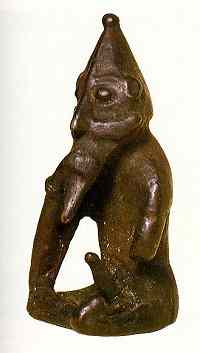
After a few offerings, I've decided to make representations of Them to sit on my nature altar next to Nerthus.   I made them out of salt-dough, which is almost like playdough to work with, and super cheap to make.  I shaped them based off of an image of Freyr from an archaeological dig in Sweden (though no visible penis - this is being displayed in my kitchen, after all!).  After drying them out in the oven, I painted them with greens and golds to imitate vegetation and wheat.  I painted Fréo an amber necklace, though I don't believe She was connected with an Anglo-Saxon version of Brísingamen - however, since we know so little of Her, there's no way to say Fréo didn't have an amber necklace of her own either.

I've been offering Ing and Fréo birdseed, which is what I keep to offer to Nerthus, but I may begin experimenting with other offerings related to the earth or plants.  I've been saving some rose petal powder to burn as incense that I'd like to see if Fréo enjoys.  If my readers have any offerings suggestions, please let me know in the comments!

Tuesday, January 14, 2014

Cheap Religion: Salt Dough Deities


If you are a parent or someone trying to be a more thrifty Pagan, and you haven't tried salt dough, something is wrong here and we have to fix it quick.  Here's a recipe for the simplest clay anyone's ever used - you probably won't even have to go to the store, because there's literally three ingredients and they're in almost everyone's kitchens.  Salt, flour, and water.. did I mention cheap?  You can make just about anything out of it, it's super cheap, dries pretty quickly, and if you give it a coat of paint or a sealant it'll last at least a few years.

I've been wanting to do a series for awhile about doing Paganism less expensively, because let's face it: Paganism, especially in the beginner 101 books so many start with, tends to be pretty commercialized.  You don't need much but a bible to start out as a Christian, but pick up a beginner Pagan book and there's all kinds of lists of things you might need - wands, different colored candles, divination tools, deity representations, and on and on.  A lot of that stuff is actually really helpful to your practice, especially a person like me who is both very tactile and visual.  But Pagan and New Age stores tend to be expensive, sometimes prohibitively so if you're a Pagan on a small budget, or a Pagan with children who aren't the best at looking but not touching.  Trust me, it is hellish trying to do a ritual with small children when you're terrified at every second that someone is going to break an expensive something.  This is also helpful for those Pagans who honor obscure enough deities that finding a decent representation is next to impossible.

Try not to leave your receipt on the counter when taking pics!
Salt dough deity representations are super easy to make, even if you're like me and terrible at sculpture.  Your first step is to pick a picture of the deity you're crafting a representation for - it can be something you draw, or a picture you like from the Internet (copyright law doesn't cover a few pictures printed at home that aren't for sale - though if the artist is selling their pictures, it's courteous to actually buy it).  For my representation of Ogma, I chose a carving on the US Library of Congress's doors, which you should totally check out because there's representations of writing or scholarly gods or people from many cultures and it looks awesome.  It's usually a good idea to print your picture the day you make the salt dough, giving both the dough and the picture a chance to dry so the ink doesn't run.

But if you do, just add a cute heart - no one will notice.
Then you gather up your supplies, and get to work!  First roll out the dough like you would at the beginning of a pizza or sugar cookie recipe - careful not to make the dough too thin (it will rip!) or too thick (it might never dry).  This takes a bit of experience, but if you have ever done pizza or cookie-cutter cookies before, you'll be able to feel the tension of the dough and the thickness it needs. Pick it up and lay it flat as you can on a flat plate.  Using a knife, cut out a rough square (it helps if the corners are rounded rather than sharp) and peel off the extra dough you won't be using.  Use the extra dough to fashion a "stand" of sorts to stick to the back of your square, making sure the two pieces are connected well and the bottom is flat.  The salt dough recipe I use then recommends microwaving it for about 3 minutes, and afterwards I usually let it dry overnight.  You may need more or less depending on the size and thickness of your square - the smaller one for Ogma took just 3 minutes, while the bigger one pictured on the plate took about 9 and then I let it sit for three days.  Be warned - you may get some air pockets that form bubbles, and the bigger the surface area of your project, the bigger they will get.  It's my theory that adding another flat object on top of the dough would help with that, but I don't have anything the right size that's also microwavable.

After everything is dry, you can use a paint brush and some Mod Podge or other glue/sealant combo to stick your picture to the flat surface of the salt dough. You can get creative and paint different colors around the picture to create a more colorful look, or just leave the color plain.  Again, print your picture the day you cut out the salt dough, because the colors may run when using the sealant otherwise.  I ran into this problem on my first attempt, and the results were more like modern art than the pretty pictures I had envisioned.

So there you have it!  It's probably not the best representation of Ogma that ever sat on an altar, but the fact that I made it for less than $1 makes me love it a lot more.  Even if you're a broke Pagan or worshiping Slavic deities for whom no statues have been made, you can have an altar that works for your spirituality.

Friday, January 10, 2014

A is for Altars


As a busy person, altars are very important to me.  In fact, I think my altars are actually the lynchpin that holds my spiritual life together.  I love my grovemates and fellow members of ADF, and I love ritual with them, but that's only once every six weeks or so.  I love the members of my coven, and I love ritual with them; but again, it's only a few times a month.

When first discovering Paganism and moving on from Christianity and that idea of religion, I had trouble understanding why most beginners books only had ritual or prayers for the High Days or the Full Moons.  Having been raised to practice religion every day - bible reading in the morning, prayer at meals and at night - I couldn't understand how this more present, accessible Divine was only acknowledged about twenty-one times a year.  It's something I continued to struggle with for many years, often letting my practice lapse to just those twenty-one days and ignoring my spiritual side for the other three hundred and fourty-four.  It obviously wasn't working for me.  Then I discovered ADF, Druidry, and Heathenry.  Though ADF is as formal as you make it, one big advantage for me is the option to make it very formal.  I don't usually go through a full Core Order of Ritual for my daily devotions, the template was incredibly helpful to me in forming a daily practice.  The other crucial piece of the puzzle?  My altar.

It's there every day.  It's a physical reminder of my spirituality, of the hospitality due to the Gods and spirits that I have invited to be part of my life.  With the representations of these beings sitting in my room or my kitchen, they truly feel like guests in my home and life.  Even in the busy rush-rush life of being a mom to three, I can make time to stop and say a prayer of thanks to Nerthus while preparing dinner, because Her altar is right there in my kitchen and I'm reminded of Her every time I go to open the fridge.

Here is the portion of my Dedicant Path work where I wrote about my home shrine(s), including some pictures.  It is quite long, as we are asked to describe the purpose of every item.

On one counter in my kitchen, I keep a shrine to the spirits and Goddesses of the home.  On the far left is a cute small-scale home in a box, which I use as a place to give offerings to my house spirits.  The next statue is a representation of Brigid, and is where I will leave a candle for my flamekeeping shifts or give offerings to Her.  The next statue represents Frige, and is where I will place offerings or say prayers for Her.  To the far right is a representation of a chalice made by my middle daughter at Sunday school, representing our family's dedication to the ideals of Unitarian Universalism.  I thought it appropriate to place it here, because UUism is our "family" religion that all who live in our home can agree with.

On the other side of the kitchen, next to the fruit bowl which is full of oranges and bananas this time of year, is a shrine to a few Earth and land Goddesses.  On the left is a representation of Nerthus, the Earth Mother of ancient Germanic tribes.  She is also strongly associated with water, and so I chose a statue that emphasized that aspect of Her.  In the middle is a figurine that's easily recognized as the Venus of Willendorf, which I use as a representation of the Goddess of the Platte River watershed.  Behind Her is a bottle of sacred water made from water from the Ogallala aquifer, a creek near my house that drains into the Platte River, and the river Herself.  To the right is a representation of the Goddess Yavanna, who many would argue is a "character" in JRR Tolkien's mythology; but who I experience as a distinct divine Goddess.  All of these representations are primarily used as placed to make prayers and offerings to the respective spirits.

My main altar is constructed in three tiers to represent the Three Realms.  On the bottom tier is my Well, a simple black bowl; and also a shrine to my Ancestors, seen on the right.  It features a box handed down by my great grandfather, a handkerchief made by my great grandmother, a skull made of quartz, and a statue of a woman to represent my Idesa (female ancestors in Anglo-Saxon culture).  The bottom tier is also a bit of a catch-all because of its size, and has (from left to right): a chalice to hold the Waters of Life when doing Core Order of Ritual, three candles for the Three Kindreds in Himalayan salt candle holders, a statue of the Goddess Varda (also featured in Tolkien's mythological cycle), two pitchers containing oil and water respectively for offerings, an incense burner for offerings, and a blue ceramic candle holder filled with sand which holds spent matches.  In the center is the Well, as described, and a small plate which holds items of spiritual significance to me: a vial of cinnamon oil gifted by a friend, my homemade set of prayer beads, and a candle inscribed with the symbol of Sunna from a recent Solstice ritual.  The left of the bottom tier features Ancestor representations already discussed, and also a brass incense burner for making offerings.

The second tier features my representation of the Tree, seen there in the center, and also several representations of local Nature spirits.  Here are leaves and a bit of twig from each tree in my yard, a stone I dug from the garden, and feathers my children have found.  There are also some stones of various types gifted to me by friends.  The carving behind the Tree is a seashell, a tree, and a feather; representing the realms of land, sea, and sky so prominent in Celtic cosmology.  On the left side I have grouped representations of the Anglo-Saxon deities I honor most; Woden, Eostre, and Thunor.  In front of Thunor is a sachet I made of several protecting herbs and a quartz crystal that I asked to be blessed by Him, and my hammer necklace.  On the right side are my Celtic deity representations:  a glass horse representing the Goddess Macha, a carving from the doors of the Library of Congress depicting Ogma, and a representation of the sea god, Manannan mac Lir.  In front of Manannan is a necklace I wear dedicated to Him.
On the top tier I keep my Fire, a grouping of three candles usually colored appropriate to the seasons.  I also have a plaque with the words "Fire and Well and Sacred Tree, Flame and Flow and Grow in me".  The cloths used are also colored seasonally; since it is nearing Imbolc at the time I'm writing this, I have used snowflakes and the color white to represent the winter that will begin to fade soon.  I also have a few crystals hanging from pegs, which are there because I am very pleased by things that shine and sparkle.  I feel they help bring the aesthetic of my altar together. 


In the future, I'd like to finish the carvings and staining that I had originally planned when I began constructing my three-tiered altar; including carving representations of each of the Three Kindred.  I'd also like to acquire a better representation for Macha, perhaps a horse made of stone that fits in better with the size and aesthetic of the other figures.  Since I have been connecting more with the Cailleach, a Celtic winter Goddess, I'd also like to find or make a representation for Her.  I would also like to hang a shelf in my kitchen next to the door that leads outside to house the representations of my Earth Goddesses, so they aren't relegated to a rather crowded corner of my kitchen counter.

Saturday, August 17, 2013

Q is for Quartz (and Thor)

Q is for Quartz - and since discussing it and all of its properties is a bit much to bite off, I'd like to talk about its relation to Thunder and the Germanic deities associated with it.

Recently I was reading Alaric Albertsson's Travels Through Middle Earth, which details a possible Anglo-Saxon Pagan path.  He mentions that quartz crystals,  in the England of the Anglo-Saxons, were called Thunderstones and were considered sacred to the god Thunor (who is roughly equivalent to the Norse god Thor), because they were placed in the ground by Him when lightning struck.

I've been honoring Thunor for a while, trying to build a friendlier relationship with Him and a few other Anglo-Saxon deities.  He was very much a deity of the people, honored by many commoners and farmers, and has a reputation for being approachable.  This has been my experience as well.  But it was difficult for me to connect His status as a thunder god with one of His other roles, that of protection.  Reading about His connection with quartz crystals really solidified it for me.  I've carried a small quartz marble in my pocket for a few years now, because of its ability to absorb negativity and output a positive energy; this is almost the definition of 'protection' for me.  Taking away the bad, bringing in some good - that is the role of a protector.  Since I had never found a good image of Thunor (or Thor) that I really liked, I now use a quartz sphere to represent Him on my altar, and both He and I appreciate the connection.

I'll be writing my review of the book I mentioned, Travels Through Middle Earth, soon; but for now I'd like to mention that it's a great read for anyone interested in a Germanic path.  It's pretty 101, so easy to understand, but there's little tidbits like this one about quartz hidden within it that make it a valuable read for just about anyone!

Saturday, September 1, 2012

Preparing for Mabon

The nights are becoming a bit longer, the days a bit shorter.  Here on the prairie, we've been watching the canadian geese and many other birds pass us by on their way south.  My extremely late-planted garden is finally yielding a harvest, and even some of the trees are yellowing a bit.  There's no denying it: Fall is upon us.

Maybe it's because fall is not my favorite season - I have trouble seeing the good in cold weather, and no matter how hot it's been I miss summer already!  Maybe it's because this is my first year really gardening and providing part of my own subsistence.  Whatever it is, I have a really hard time distinguishing between the holidays of Lughnasadh and Mabon.  Sure, Lughnasadh is the bread feast while Mabon is more about fruits and veggies, but to me it's never been enough of a difference to really set the two holidays apart.  So this Mabon will be my attempt to really appreciate the holiday in a way that is separate and distinct from the first of the Harvest holidays.


First of all, and most importantly, this year my feast will have fruits and veggies from my own garden.  There's nothing better than homegrown tomatoes, and I plan to make good use of them.  Homemade veggie pizza is on the menu, and hopefully my bell peppers will start fruiting in time to be included!  All this feasting is very similar to Lughnasadh, and honestly if I'd have gotten my plants in the ground earlier, they'd probably be ready for a first harvest closer to the first of August than September.


I recently was reminded of the liminal between-ness of the equinoxes, and I'm hoping to really recognize that this year.  Samhain is traditionally the feast of the ancestors, spoken of as the festival where the veil between our world and theirs is the thinnest; but perhaps Mabon can be thought of as sort of the twilight before Samhain's full darkness.  The light thins and comes through only in slanting rays, as all the colors mix together and the world goes in to a soft-focus of sorts.  Whereas Samhain is for the ancestors, and Lughnasadh seems uniquely fitted to celebrating the nature spirits, perhaps Mabon is the perfect holiday for really getting in touch with the gods and goddesses.  In my tradition, before the sun or moon were placed in the sky light came from another source, one that never really rose or set but instead faded in and out between silver and gold.  The world was bathed in the same half-light that I imagine Mabon represents.  So for me, I want to establish this holiday as reminiscent of that same time, when the gods and goddesses walked under the trees and helped to shape the world.


Wednesday, August 15, 2012

Dedicating to the Earth Mother

My local shop recently had a big sale, and I just had to pick up this lovely statue that I feel represents the Earth Mother of my pantheon so incredibly.  It's there in the top left, a resin and bronze mix that was relatively inexpensive but looks so amazing.

And so today was the dedication - I offered Her nine incense sticks scented with cedarwood (as the trees are her most beloved creation), and a small and simple chant asking Her favor.  In my pantheon, the Earth Mother is a bit of a distant figure; she cares most for the plants, which are unable to run or fight to defend themselves.  As a gardener and a life-long lover of trees, I feel Her interests are very close to mine, and am happy to be able to honor Her in this way.


In other news, my altar was recently featured on the website ShrineBeautiful.com, along with a little summary of my current practice.  There's all sorts of altars currently displayed, and the website is still accepting submissions if you're interested in showing off your own!  Either way, you should certainly visit - it's a wonderful website that displays the diversity of the Pagan community in a fantastic way.

Saturday, August 11, 2012

Altar Tools: Making the Bell Branch


 I love crafting!  Honestly, I'm not the most artistic person in the world, and I'll probably never make something as nice-looking as what you'd find in a store; but I find that I love the homemade touch and the connection with a tool that crafting it gives.  Celtic myth tells of a silver apple branch hung with bells that was the tool of a Druid.  This isn't necessarily historically accurate information, and as such it's not a commonly used tool in ADF Druidry, but its history and symbolism is so rich within revival Druidry (Yeats even wrote a poem about it) that I really wanted to have one myself.


This project was easy and straightforward, exactly the kind I like!  I used nine bells bought from the local metaphysical supplier, three colors of embroidery thread (I had it lying around) and a beautiful strong branch of unknown wood that I picked up in the park last year and has been drying in my garage ever since, just waiting for a project like this.

First, I had to prepare the branch.  As I said, it had been drying in my garage for nearly a year, and so it was relatively easy to strip it of its bark with my pocket knife.  After it was as clean as I wanted it to be, I took a piece of very high grit sandpaper and sanded it for a good half-hour.  With that kind of sanding, it was mostly a beautiful pale white color, and extremely silky - the kind of feel wood takes on after a nice polishing.


I then strung three bells on each of the three lengths of thread, tying them in place.  I placed a bunch of three near the top of the branch, and the other six I tried to space evenly along the rest.  I then wound the threads around the wand, tying it carefully at each end.  For extra insurance to make sure the strings didn't slip, I placed a dab of wood glue at each knot.


And that was it!  All together, including the carving and sanding of the branch, it took about two hours - hardly a major time investment!  The bells are beautiful; but unfortunately don't give much of a sound except where the three are bunched together at the top.  If I ever make another, I think I'll choose the more traditional kind of round jingle bells; they would probably give a better sound.  Still, I really love this branch, and I hope it will make a great and atmospheric addition to my future Druid rituals.


Saturday, March 24, 2012

Constructing an Altar

If anyone was wondering why my Pagan Blog Project post was so scatter-brained and late last night, its because I decided to start a little project at 8 o'clock last night!  My husband is out of town for the weekend, so after laying the little ones to sleep I had a big block of time all to myself; and I really wanted to use it to complete an altar project that I've had rolling around in my head for awhile now.  I was up until three, so bear with me if this post is a bit meandering as well!

My altar is on top of my dresser in my bedroom (though, by this point, most of the clothes have been moved to the closet to make room for supplies and tarot decks!).  It's a nice big dresser with lots of space, but lately I've been wanting to separate some space out - I want to have a separate moon altar, space to work magic, and another space for my ADF and Druid things.  I spent a few days coming up with the plans - building a little desk hutch that would have three distinct areas, while still leaving the space underneath open and usable.  I bought some lumber a few days ago, and have been waiting for the right time (and an empty garage) to put my plans into motion.

We don't own any power tools, so this was done with an old hand saw and some wood glue.  I also used my wood burner to put some designs on the top and the two pillars.  I glued everything together, and set it up to dry overnight.  Tons of books are piled on top to keep everything stuck together while it's drying!
And here's the final product!  Well, mostly final - I'd like to get some light stain and seal it once my husband is back with the car - but this is the general idea!  The space on the right is devoted to a Sun altar at the moment, but it will be moved for any magical altars I'd like to set up.  My favorite is the new ADF area; the seasonal Tree, Fire, and the Well tucked beneath them on the lower shelf.  Overall, things are much less cluttered, and I feel like my daily devotions are more focused since each area has its own purpose.

And now that I've shared mine, please share yours as well!  I love to see people's altars; they're such a wonderful window into the spiritual practices of others.  If you don't have one of your own due to a lack of furniture, let my project be an inspiration!  This is literally the very first thing I've ever built out of wood, if you don't count the scrap pieces my dad used to let me glue together as a kid - and it didn't turn out too bad.  Just remember: measure twice, cut once!