Showing posts with label Spring Equinox. Show all posts

Sunday, April 5, 2015

Prayer and Offering for Eostre

by Norbert Nagel, Creative Commons License
Hail Eostre, the rising dawn and the coming spring!
As Your golden rays gleam above the horizon,
the buds begin to bloom and open,
heralding the return of light and life!
Beautiful Goddess framed in flowers,
the beginnings of apples, peppers,
all fruit that flourishes on branch and vine,
bring brilliance and bounty to me and mine.

My favorite offering for Her this time of year is dyed eggshells.  First poke two holes at either end of an egg, and blow the contents out into a little dish to save for omelettes or whatever you like.  Then the eggshell can be dyed in natural dyes, and it will color both the inside and outside of the egg.  I have had a good time crushing several eggs together until they form a colorful sort of eggshell gravel, but they can certainly be offered whole as well depending on what you’d like!

Monday, March 23, 2015

Another Post About Eostre

Okay, they've been everywhere this past week - posts about Ostara the holiday, about Eostre, debating Her claim to historical fame, Her attributes, Her associations.  She has been paired with foxes, described as young and perhaps childish.  So as we head into the Anglo-Saxon month of Eosturmonath (rougly equivalent with our modern April), I'd like to write about some of my own impressions of Her.

For me, She is not just a Goddess of the spring.  It is one of Her domains, yes, and a very important one.  But primarily for me, She is the Goddess of the dawn.  The linguistics of Her name supports this - Eostre is etymologically linked to *austrōn, a Proto-Germanic reconstruction meaning 'dawn'.  Through this, She is linked to a fair number of Indo-European dawn deities, including the Vedic Ushas, the Roman Aurora, and Greek Eos.

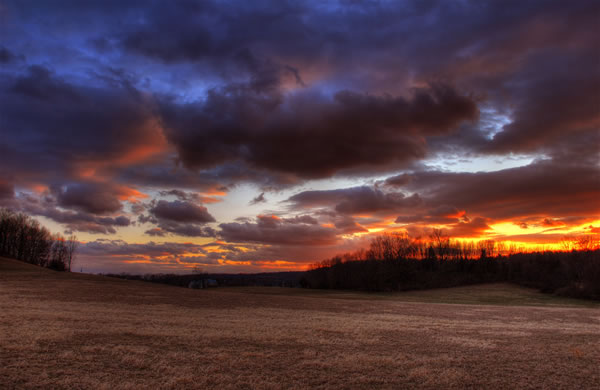
This time of year, I am still rising just a bit before dawn.  As I wake to dark windows and a silent home, I remember a bit of a poem by Rumi that I loved as a teen: "The breeze at dawn has secrets to tell you.  Don't go back to sleep!".  I come before my east-facing patio door, a large window that looks out over my backyard, and say my prayers to the deities of the sun and the morning that I honor: to the morning star, to the sun, to the opener of the gates of dawn. 

It is Eostre who holds that honor for me, afire in a blaze of golden and red and pink glory.  She throws open the gates, Her face shining with the holy light of the sun as Sunne passes by.  Her arms are raised, drinking in the glory, Her gown whipping against Her with the wind raised by the force of the sun.  She looks to the heavens above the earth in acknowledgement, but also with a sense of triumph: the stars will be put out, and She will be responsible for bringing real light to the world.  She is fire and glory and too bright to comprehend, a deity who will not tone down Her shining, holy light for my sake.  This is my Eostre, how She appears to me each morning as I implore Her to please open the gates.

Sunday, March 15, 2015

When UPG Trumps the Lore: Hreda

Via Creative Commons
This is the month when many Anglo-Saxon Heathens (and many Pagans in general) focus on Eostre, and so I thought I'd be a bit stubborn and write about a deity associated with March by the Venerable Bede.  I've written about Her before, covering most of the lore and speculation that's available to us at this time, and I've lamented its utter incompleteness.  How is it that Eostre, with basically the same amount of information relating to Her, became such a central figure in the Pagan springtime festivities while it's difficult to find even Heathens who know who Hreda is?

My personal opinion is that Eostre's associations just are easier to understand for us in English-speaking, Christian-heritage countries.  Everyone in this culture knows Easter and all that it entails, and since the Goddess Herself lent Her name to the festival - the connections are readily made.  Hreda has no such similar festival, no cultural markers that I'm aware of to lend Her importance in our modern age.  But that doesn't mean She's not there, waiting.

My devotional relationship with Hreda has been something of an experiment for me.  I'm usually pretty hidebound when it comes to matters of lore; I'll build a practice up around it using some UPG, but in matters of disagreement?  The lore wins hands down.  It's one method I use as a check and balance.  But for Hreda, we have less information than even Nerthus; only a possible etymology, and even those are conflicting.  Is it 'swift', 'glory', or 'victorious' - each of these have such different implications as to the kind of deity She could be.  And maybe the etymology matters not at all, and it's just a name unrelated to Her function or areas of interest.  We just don't know.

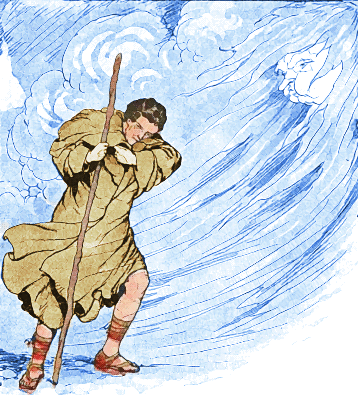
And so I reached out to Her.  This has been going on for a few years now; Her presence is certainly strongest for me in March, so that's when I get my best ideas of Her.  Each year, consistently, I find Her in the wind that drives out the winter.  All of a sudden, around this time of year, the winds start shifting.  Instead of howling out of the north biting cold, they begin to blow up from the south.  They are no more gentle - in fact, often the winds are strongest this time of year.  But the southern winds don't carry snow and ice; they tend to drive away the clouds so that ever-earlier rising sun can shine down on the land.  To me, these winds are a manifestation of Hreda.  She is swift.  She is victorious (eventually!).  She drives away the clouds to reveal the glory of the light. 

Every time I think of Her, I am reminded of a particular statue that I loved in my art history class, The Winged Victory of Samothrace.  I am not a Hellenist and don't know the story behind the statue, but when I think of Hreda it is forcibly brought to my mind.  The way She stands, leaning into the wind, the raggedness of Her clothes and feathered wings - She fights a long battle, but She is not cowed.  She is Victory.

Just to be clear - there is absolutely no indication in the lore that Hreda is this kind of deity.  I don't know much about British weather, but I think this time of year is usually much more mild than it is on the plains of the Midwest, so it doesn't even hold up historically.  I don't care.  I have been reaching out, making offerings, honoring Hreda for three years now; and this is how She comes to me.  I won't argue with anyone over their personal interpretation of Her.  At this point, I'm not really up for arguing with anyone over my interpretation of Her.  She is who She is to me, and I could not be more grateful for the gifts She brings and Her influence in my life.

Monday, March 31, 2014

High Holy Day Essay: Spring Equinox

For the spring equinox, Prairie Shadow held a Greek ritual honoring and welcoming Persephone back to the world. It was held in my living room, since unfortunately the weather was rather dismal; not very spring-like. Since it was indoors in a relatively small house, we did not process; but each person entered the ritual space after rinsing and drying their hands as an act of purification. We offered to Demeter as Earth Mother and welcomed Hermes as our Gatekeeper for the rite, and gave gifts of flowers to Persephone. I unfortunately do not recall the omen that was given for this rite, but I do remember that our sacrifices were accepted. After the main offering and the receiving of the blessings, we thanked the Kindred and closed the Gates.

 This ritual was also somewhat nerve-wracking for me. Because Amber was very sick that day, I had to lead the ritual myself; and unfortunately I don't have a connection to any Greek deities. There were many members of the Red Grail there (another group I had joined) and they were thankfully happy to help out; reading parts and helping build energy despite my stresses. In the end, it went rather well.

Monday, March 24, 2014

Hreda and the Month of March

Public Domain
The Venerable Bede, an English monk and scholar writing in the 8th century, leaves us a very incomplete, but helpful picture of the Anglo-Saxon ritual year.  One such celebration is Solmonath (Solmōnaþ), roughly equivalent to the month of February, when cakes were offered to the Gods.  I find it reasonable to assume, based on the Æcerbot where cakes are offered to the earth in exchange for growth and fertility of the crops, that the deity honored in the rituals of Solmonath was the Anglo-Saxon idea of the earth mother Goddess.  Bede also mentions two deities of the Anglo-Saxons by name: Rheda (a Latinized form of the word Hrêða) and Eostre, from the month names Rhedmonath and Eosturmonath (Ēostermōnaþ).  Eostre is a fairly popular Pagan deity nowadays, and I've written about Her before; but I'd like to dedicate at least one post this month to Hreda (or Hretha) - the much less popular Goddess of March.

Bede tells us little besides that the month of March is named for Her.  Some modern Heathens identify Her with Hertha, a deity similar to Nerthus attested in northern Germany, but I feel that the linguistic links between them are tenuous.  Also, since I honor the Earthy Mother deity of the Anglo-Saxons during February, my personal UPG is that Hreda is a different sort of being - though not completely dissimilar, as we see with Eostre, who is still very much a deity of growth and spring.  Hreda's name can be linked to a few Anglo-Saxon words: primarily 'glory', 'victorious', and 'swift'.  Philip Shaw, in his book Pagan Goddesses in the Early Germanic World: Eostre, Hreda, and the Cult of the Matrons, argues that Hreda is the matron of a specific kin group.

Lately I've been thinking about the Christian idea of Lent, which often coincides with much of our modern March.  The word Lent comes from the Anglo-Saxon 'lencten', which means spring.  It's been speculated that Lent, a traditional period of fasting before the Christian Easter, was a natural result of the food shortage at the end of winter and beginning of spring - when supplies were running out, and milk from the ewes was often all people had to sustain them.  It seems possible that Hreda, a victorious and glorious deity, was associated with this lean time with the purpose of Her eventually triumphing over the difficulties and ushering in a more prosperous time of year.

I was born in the month of March, and have always had a certain affinity with the strange weather that can happen in the midwestern US at this time of year.  The wind is said to roar like a lion, and temperatures can fluctuate wildly: from beautiful balmy days to heavy dumps of snow.  Hreda comes to me in the weather of my own country, different as it may be from Britain's; I see Her primarily as the late winter/early spring wind that can be so powerful here.  She too roars.  Eventually all that blustering wind blows in warmer weather, just as Hreda ushers in Eostre as the months continue to turn.

There is so little concrete information on this Goddess, I feel there are few wrong ways to honor Her.  However She chooses to manifest in a person's life, I do think it is important to continue to offer to this lesser-known Goddess, who was obviously important enough to the Anglo-Saxons that an entire month was named for Her.  This weekend is the full moon, when I choose to observe the mid-point of the Anglo-Saxon months and also their festivals; so this weekend I will be doing a ritual in honor of Hreda.  I've written a  prayer that incorporates mostly my UPG surrounding Her (how could it not, given the lack of information), feel free to use it or modify it to better reflect your own experience of the Goddess of March.

Hreda, Goddess of March,
roaring lion and swift wind.
Drive out the snow
and bring the shining sun,
the glorious warmth of spring.
That the plants may grow,
that animals may mate,
that life may wake from the land.

Francesco La Barbera
Creative Commons license

Saturday, December 7, 2013

Resource for Children's Rituals

While stumbling about the internet today, I came across a wonderful resource for children's ritual that I had to stop by and share!

The website of Charter Oak Grove ADF has an entire section devoted to rituals for each of the High Days designed specifically for children.  While the rituals are written according to ADF's Core Order of Ritual, there's also a nice amount of resources for Pagan children of any path that honors Celtic deities.  Their book about the Kindreds (ancestors, nature spirits, and gods and goddesses) is available in print from Lulu.

I hope this is helpful to some parents and groups out there who might be having trouble coming up with ritual ideas for children!

Friday, March 16, 2012

Fasting for Pagans

The season of Lent is in full swing now; the biggest period of fasting in the Christian calendar. I was raised in a Christian household, and I still remember Lent quite fondly - fish frys on Fridays, giving up chocolate or TV or some other luxury - and waiting, waiting, waiting for Easter Sunday, when all the self-restraint was lifted and I could eat as much of my giant chocolate bunny as I could handle. As I got older, I began to appreciate the spiritual benefits conferred by fasting; spending the time one normally would enjoying food or some other activity in prayer or meditation is incredibly powerful. I have always longed for a Pagan equivalent of sorts, but the closest I ever get is an all-night fasting vigil on the Winter Solstice.

So imagine my surprise to learn, when reading an article titled Rethinking Imbolc by Mary Jones, that Lent has its origins in the natural rhythms of the land as much as in Christian tradition. In early spring, the period between Imbolc and Eostara, the plants of Europe were just beginning to sprout and flower. Lambs and other domestic animals were not yet old enough for eating, and milk only added so much to stores of food strained from the long winter. In essence, early spring fasting was often a fast of necessity; later taken in and given religious meaning by the Catholic church.

This is an ancestral practice that we as Pagans can choose to honor as well. Though in our modern lives, we can just pop over to the supermarket for any fresh fruits, veggies, or meat that we'd like, it does us good to remember the cycles of the Earth that our ancestors were compelled to follow. Eating only seasonal, local produce becomes very difficult at this time of year, and it is in this way that I have chosen to honor my ancestors this year.

I have been unable to fast much for the past four years due to pregnancies and nursing, and it's something that I miss very much. Some day, when I am able to be a bit more lax about my nutritional requirements, I would like to undertake a bread and water fast during this Imbolc-Equinox period. For me, fasting is an incredibly powerful tool - meditation becomes easier, divination is clearer and more powerful, and rituals are full of a spiritual energy that can only be found when the body is not devoting its energy to the intake and digestion of food. Obviously it's not for everyone; but if you are a Pagan and have never given it a try, I heartily recommend it! Start small - ingest only water for twelve hours, or give up something special to you for a week and dedicate that sacrifice to the Gods/Goddesses or to your own spiritual growth. You might be surprised at the results you see.

Jones, Mary (2012). Rethinking Imbolc. Retrieved from http://www.adf.org/articles/gods-and-spirits/celtic/rethinking-imbolc.pdf

Friday, March 9, 2012

Eostara vs Easter

As a Pagan parent, I've got my work cut out for me.  My husband is also a member of a minority religion (though very different from my own faith); so in my house, we end up celebrating a lot of holidays that aren't recognized by the world around us.  To make matters worse, both my in-laws and my own parents are very dedicated to their own religions; finding out I was a Pagan and raising my children in Pagan traditions would be a big problem on both sides - so the Wheel of the Year is celebrated with just our little family.  It takes a lot of creativity to come up with new celebrations in a tradition that has a lot less children than your typical Christian church, but I thought I was doing fine - until last Winter Solstice.

I was getting ready for our Solstice feast, cooking up a yummy beef stew while my eldest colored the winter-themed crafts we'd cut together earlier at the kitchen table.  "When is Christmas coming?" she asked.  "Oh, that will be in a few more days, honey," I replied, "but remember, today is the Winter Solstice, and we're going to each open one present tonight!".  She sighed deeply and looked at me with her big brown eyes.  "Mommy, the Winter Solstice is boring!"

Ouch.  But the worst part is: she's right.  At least from a child's perspective, how can one day of freezing nature walks and crafts possibly compare to two overnights at Grandma's, complete with Santa, a huge tree bursting with presents, and several family parties?  Unfortunately, Easter has the same issue.  We visit my mom's family, my dad's family, and attend church in the morning; Easter Day is filled with phone calls from far-away family members with holiday wishes.  There are multiple egg hunts with tons of adults cheering on the kids.  What can I possibly do to make the Spring Equinox equally as exciting?

I've come up with a few ideas I'll share in a bit, but I think for me, it was important to accept that the Wheel of the Year may never be as fun or exciting as the big mainstream holidays.  Like it or not, my children are being raised in a culture and family that's predominantly Christian, and their holidays are going to receive the most prominence and familial support - that's just the way it is.  Fortunately, our culture is also fairly secular; a lot of these holidays are celebrated in popular culture without much religious meaning.  This gives us a great opportunity, as Pagan parents, to introduce our children to the spiritual aspects of holidays.  In some ways, I'd argue that our job is a little easier than some Christian parents - it can be very difficult to take a secular holiday and give it spiritual meaning; but not quite as difficult to introduce a spiritual holiday that has no secular celebrations (think Halloween!).


This is the road I've decided to take.  My children may not be as excited about the Pagan holidays as Easter or Christmas - but at least they're celebrating them.  We emphasize the Summer Solstice as our big holiday, with a few presents and usually a camping trip and cookout; but for the others, we take a trip to the local metaphysical store and pick out one small and inexpensive seasonally-appropriate item to add to the family altar together.  For now, this has just been my eldest daughter and I; and it makes for a great bonding time to talk about the Earth, its changes, and how we fit within that cycle.  As my other children get older, I might take them separately, or find other ways of spending individual holiday time with them.  We'll color eggs and set them on the altar as well.  As always, nature walks and working in our garden will be a must; what better way to introduce children to the Earth's cycles than to let them observe first-hand?  This Sunday will also be my eldest's first public ritual - our local Wiccan group is holding an Eostara-themed Full Moon ritual open to the public and their children.  I'm hoping that alleviating some of the loneliness of the holiday - and showing her that other people celebrate the Earth as well - will help it seem more dynamic.

Our plans certainly aren't finalized, and I'd love to hear ideas from other Pagans (parents or not!).  What do you do or plan on doing with your children to make the Spring Equinox more special for them?