Monday, June 30, 2014

High Holy Day Essay: Summer Solstice

For Midsummer, I wrote a ritual for Prairie Shadow Protogrove in a Germanic hearth culture to mirror the honoring of Sunna that we had done at Yule. Once again, Nerthus was our Earth Mother and Heimdall our Gatekeeper, and we invited the Kindred through the Gates of the Fire, Well, and Tree. A friend who's been attending our rituals brought home-made mead which we used for the Waters of Life, and we offered bright-orange tiger lilies from my garden to Sunna. The Kindred accepted our sacrifices, and sent us blessings of growth and physical well-being as determined through tarot card divination.

 Midsummer is always one of my favorite Pagan holidays, because I love the summer and the sun and Her light and warmth. Being able to do a ritual with a good number of Pagans whom by then I mostly knew well was absolutely wonderful; being less nervous performing ritual, I was able to get into it and feel the presence of each of the Kindred as we welcomed Them. I felt Sunna's pleasure at the fiery color of the lillies, and was so blessed by Her light (and also thankful for the shade of our Tree)!  

Sunday, May 11, 2014

High Holy Day Essay: Beltane

At Beltane, I attended a ritual held by the Order of the Red Grail. The ritual itself was very traditionally Wiccan, casting a circle, calling the four Elements and the God and Goddess, and was led by two High Priestesses. In preparation for the ritual, each member of the group had researched a deity associated with love or relationships and acted as that deity in the ritual; each giving speeches trying to prove that they were the 'best' god or goddess of love. I represented Aengus of the Irish pantheon, and had a fantastic time.

 After the ritual, the High Priestess crowned the May Queen (which I was rewarded for my stirring portrayal of Aengus!) and I led the group in a traditional Maypole dance – the pole was beautifully decorated with ribbon by the time we were finished. When the dancing was finished, we had a potluck and enjoyed the beautiful weather and each other's company. It was a very enjoyable ritual for me, though I think the most powerful part of the day was the dance – I always build a lot of energy and get great joy from simple easy exercise, especially when there are so many people to enjoy it with.

Monday, March 31, 2014

High Holy Day Essay: Spring Equinox

For the spring equinox, Prairie Shadow held a Greek ritual honoring and welcoming Persephone back to the world. It was held in my living room, since unfortunately the weather was rather dismal; not very spring-like. Since it was indoors in a relatively small house, we did not process; but each person entered the ritual space after rinsing and drying their hands as an act of purification. We offered to Demeter as Earth Mother and welcomed Hermes as our Gatekeeper for the rite, and gave gifts of flowers to Persephone. I unfortunately do not recall the omen that was given for this rite, but I do remember that our sacrifices were accepted. After the main offering and the receiving of the blessings, we thanked the Kindred and closed the Gates.

 This ritual was also somewhat nerve-wracking for me. Because Amber was very sick that day, I had to lead the ritual myself; and unfortunately I don't have a connection to any Greek deities. There were many members of the Red Grail there (another group I had joined) and they were thankfully happy to help out; reading parts and helping build energy despite my stresses. In the end, it went rather well.

Friday, March 28, 2014

G is for Garden


Thank goodness for being able to schedule posts, because I've been pretty absent over the past couple of weeks.  Between illness in the family and the loss of someone I'd grown up with but hadn't seen for quite awhile, I haven't really been up to writing.  But here I am, getting some words out into web.

This week I'd like to write about gardens, and how gardening is my most satisfying expression of my Paganism.  My patron Goddess is Nerthus, whom Tacitus in his Germania called the Earth Mother of Suebi tribes.  Though She is a complicated deity, and has many influences and interests outside of green and growing things, it is the primary way I encounter and honor Her.  Not only is She very present in the act of gardening; but in replacing generic green grass with plants that give food and support to both humans and animals, I feel the affirmation and appreciation of the local land wights as well.  After caring for my garden for a few years, I have become very close to the spirit of the soil there.

The first step to a good garden is clearing and preparing the earth.  It is in this step that I feel closest to the primal Earth.  Coming to gardening without knowing anything about it, I assumed the soil before planting would be pretty boring, requiring only a few holes and seeds to bring it to life.  But the truth is that the soil is already alive!  Each spade turned over reveals beetles and earthworms, centipedes and pill bugs, living off of and giving life to the decayed matter that makes up a large part of a garden's earth.  Working compost into the soil gives even more life, adding fuel to the biological processes that are already taking place, providing nutrients to feed an already thriving, but tiny, ecosystem.  The soil itself has a life to it - the feel, the texture, the smell, is different in every location.  Here in Nebraska, my soil is rather dense and clay-like, difficult to break apart and plant in; after a lot of shoveling and a bit of compost, it becomes more like the black, rich dirt we instinctively know is right for planting.

The next step is putting in the seeds, and watching over them while they sprout and begin to grow.  This is perhaps one of the most exciting times in the garden - growth is fast, new leaves are added every day, and the hard work of the gardener is quickly on display.  It's also one of the most magical.  It seems almost impossible that such large plants, such vibrant life, could come from such tiny seeds.  As each plant grows, its own unique personality and uses can be seen.  Some are showy and bright, spreading wide and tall, with beautiful flowers.  Some are more inclined to grow close to the ground, with just small green leaves to show their presence.  Some guzzle down the water from the rains, and some seem to prefer a drier summer.  Getting to know the plants, their ways of growth and their preferred conditions, has been my biggest and most rewarding challenge as a gardener.


Here in Nebraska, for many fruit-bearing plants, after the planting and initial growth comes a long summer full of watering, weeding, and various garden-care tasks that can seem to stretch on forever with little result.  Growth has slowed and become less apparent (though those plants are certainly still growing!) and pests move in that can be difficult to drive off.  Flowers come and go, and it's not until August or even September that tomatoes, peppers, and others are big and ripe enough to be harvested.  I always tell my children this is the season of patience - if we continue to put in the work and care for what we've planted, we will reap the rewards in the fall; but if we forget or put it off as sometimes happens, the little lives we are responsible for can suffer greatly.  During this time, I see the plants almost like another part of the family.  I am responsible for their care, for their well-being.

And then in the fall, we are richly rewarded with a lovely harvest.  There's nothing like biting into a tomato gifted from a plant that has received offerings of water and care through many months, warmed by the sun and fed by the cool earth.  After those glorious few weeks, the frost sets in, and it's time to pull up the annuals and trim the perennials, and place them on the compost pile to give life to next year's garden.  This process, repeated year after year, has attuned me not only to the local seasonal cycle but to the tiny ecosystem that fills the world of my backyard.  This intimate knowledge, this camaraderie built with giving and receiving over the years, feels more Pagan to me than anything else I do in my practice.

Wednesday, March 26, 2014

Crafting the Runes: Tiw

Modified from original sketch by John Bauer
Public Domain


Tiw is a guiding star; 
well does it keep faith with princes;
it is ever on its course over the mists of night
and never fails.


Tiw in the Anglo-Saxon rune poem seems to obviously be describing the North Star.  Like the deity for which the rune is named, thought to preside over matters of justice, the North Star is a fair and impartial guide when finding one's bearings in the night.  Interestingly, neither of the other extant rune poems make a reference to the star, instead dwelling exclusively on the deity.  The Norwegian rune poem states that "Tyr is a one-handed God; often has the smith to blow".  The Icelandic rune poem says this: "Týr, God with one hand, and leavings of the wolf, and prince of temples".  The first lines link Týr with perhaps His most famous story, where He places His hand in the mouth of the giant wolf Fenris to trick him into being bound, and loses His hand for the deception - a story that strongly links Him with a sense of justice and fair-play.  The other ideas mentioned, smiths and "prince of temples" are more obscure, I wasn't able to puzzle out what they may be referring to.

This rune is one of only two in the Anglo-Saxon futhorc that are specifically named after a deity (the other being Ing).  The rune, and its meaning, are strongly linked to Tiw's nature as a deity of justice; it "never fails".  This rune can mean that something is certain to pass, or it can also represent the need to look at one's situation objectively, almost as a judge deciding a case.  Used in magic, the rune can call the aid of Tiw specifically, or merely the idea of fairness or keeping faith.  Like Sigel and Sunne, this rune can be used as a fine representation of Tiw on an altar or shrine.

Monday, March 24, 2014

Hreda and the Month of March

Public Domain
The Venerable Bede, an English monk and scholar writing in the 8th century, leaves us a very incomplete, but helpful picture of the Anglo-Saxon ritual year.  One such celebration is Solmonath (Solmōnaþ), roughly equivalent to the month of February, when cakes were offered to the Gods.  I find it reasonable to assume, based on the Æcerbot where cakes are offered to the earth in exchange for growth and fertility of the crops, that the deity honored in the rituals of Solmonath was the Anglo-Saxon idea of the earth mother Goddess.  Bede also mentions two deities of the Anglo-Saxons by name: Rheda (a Latinized form of the word Hrêða) and Eostre, from the month names Rhedmonath and Eosturmonath (Ēostermōnaþ).  Eostre is a fairly popular Pagan deity nowadays, and I've written about Her before; but I'd like to dedicate at least one post this month to Hreda (or Hretha) - the much less popular Goddess of March.

Bede tells us little besides that the month of March is named for Her.  Some modern Heathens identify Her with Hertha, a deity similar to Nerthus attested in northern Germany, but I feel that the linguistic links between them are tenuous.  Also, since I honor the Earthy Mother deity of the Anglo-Saxons during February, my personal UPG is that Hreda is a different sort of being - though not completely dissimilar, as we see with Eostre, who is still very much a deity of growth and spring.  Hreda's name can be linked to a few Anglo-Saxon words: primarily 'glory', 'victorious', and 'swift'.  Philip Shaw, in his book Pagan Goddesses in the Early Germanic World: Eostre, Hreda, and the Cult of the Matrons, argues that Hreda is the matron of a specific kin group.

Lately I've been thinking about the Christian idea of Lent, which often coincides with much of our modern March.  The word Lent comes from the Anglo-Saxon 'lencten', which means spring.  It's been speculated that Lent, a traditional period of fasting before the Christian Easter, was a natural result of the food shortage at the end of winter and beginning of spring - when supplies were running out, and milk from the ewes was often all people had to sustain them.  It seems possible that Hreda, a victorious and glorious deity, was associated with this lean time with the purpose of Her eventually triumphing over the difficulties and ushering in a more prosperous time of year.

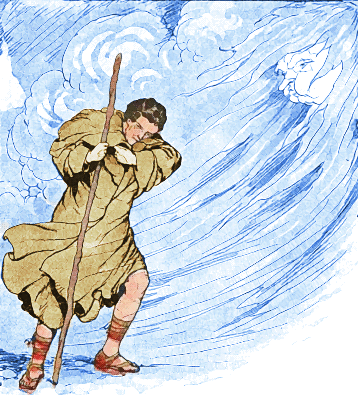
I was born in the month of March, and have always had a certain affinity with the strange weather that can happen in the midwestern US at this time of year.  The wind is said to roar like a lion, and temperatures can fluctuate wildly: from beautiful balmy days to heavy dumps of snow.  Hreda comes to me in the weather of my own country, different as it may be from Britain's; I see Her primarily as the late winter/early spring wind that can be so powerful here.  She too roars.  Eventually all that blustering wind blows in warmer weather, just as Hreda ushers in Eostre as the months continue to turn.

There is so little concrete information on this Goddess, I feel there are few wrong ways to honor Her.  However She chooses to manifest in a person's life, I do think it is important to continue to offer to this lesser-known Goddess, who was obviously important enough to the Anglo-Saxons that an entire month was named for Her.  This weekend is the full moon, when I choose to observe the mid-point of the Anglo-Saxon months and also their festivals; so this weekend I will be doing a ritual in honor of Hreda.  I've written a  prayer that incorporates mostly my UPG surrounding Her (how could it not, given the lack of information), feel free to use it or modify it to better reflect your own experience of the Goddess of March.

Hreda, Goddess of March,
roaring lion and swift wind.
Drive out the snow
and bring the shining sun,
the glorious warmth of spring.
That the plants may grow,
that animals may mate,
that life may wake from the land.

Francesco La Barbera
Creative Commons license

Wednesday, March 19, 2014

Crafting the Runes: Sigel

From the Runic Tarot
by Caroline Smith and John Astrop


The sun is ever a joy in the hopes of seafarers
when they journey away over the fishes' bath,
until the courser of the deep bears them to land.


Sigel, the sun, "is ever a joy".  The Anglo-Saxon rune poem above talks specifically about the sun being helpful to seafarers, but we know that the sun was very important in many aspects of life for the various Germanic tribes.  The Icelandic rune poem calls the sun "shield of the clouds, and shining ray, and destroyer of ice," and the Norwegian rune poem states that "sun is the light of the world".  In addition, we know from Caesar's Commentaries, authored by Julius Caesar in the first century BC, that the Germanic tribes "rank in the number of the gods those alone whom they behold, and by whose instrumentality they are obviously benefited, namely, the sun, fire, and the moon".  So not only is the sun praised as a great benefit to humankind, but it was also beheld as a deity - which could refer to an early iteration of the Germanic Goddess Sunna (Sunne for the Anglo-Saxons).

In divination, I would see this rune as very positive, bringing with it warmth and light; and perhaps specifically good guidance or advice, as referenced in the AS poem.  In magic it could be used to promote positive outcomes, or the light that is necessary for growth.  Naturally, I also think of it as a rune representing Sunne, and is a fitting representation of Her on an altar or shrine.